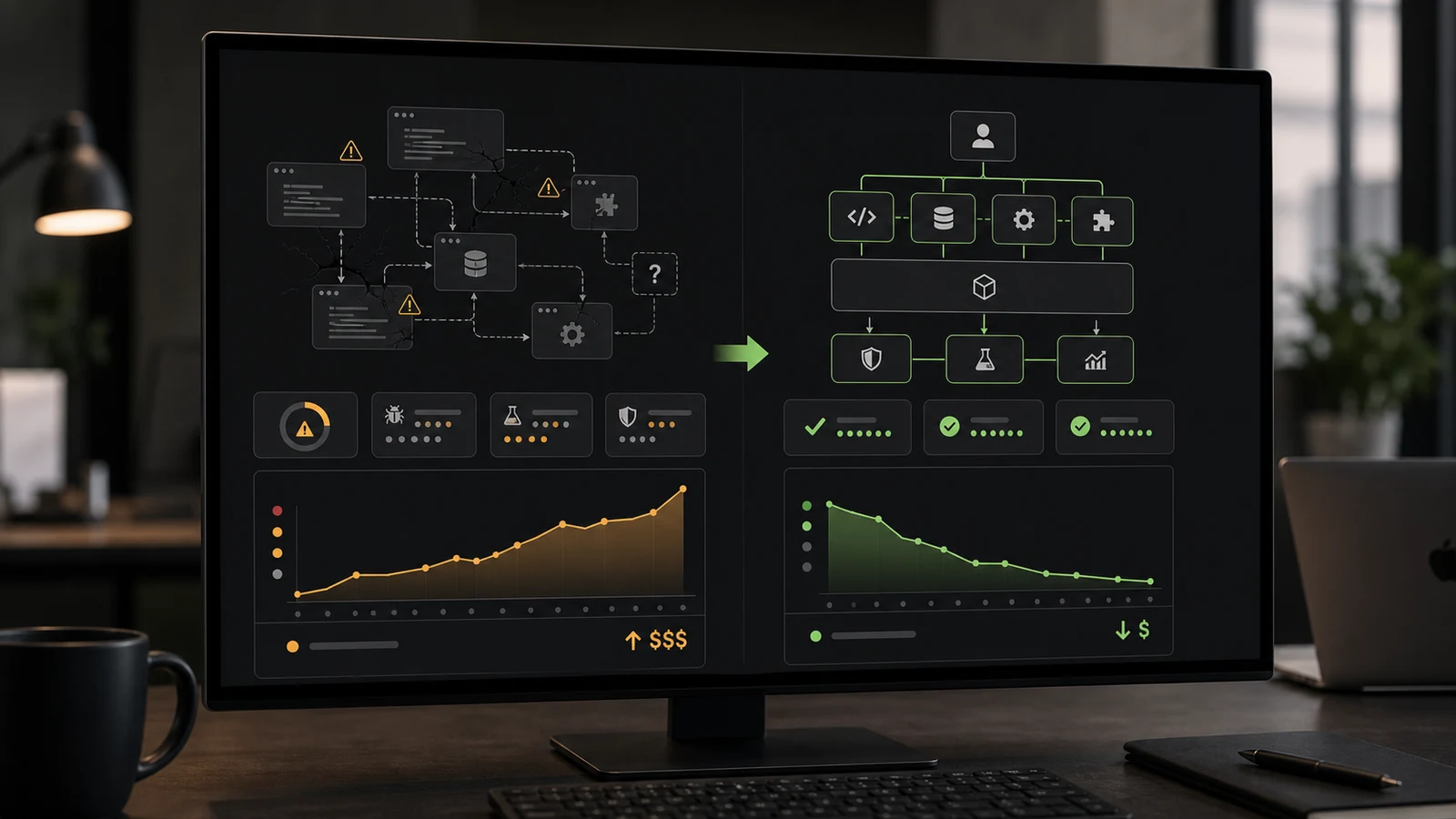

Cheap software is attractive at first: a low fixed price, a quick start and something visible to show. When budgets are tight or a market needs to be tested quickly, that can be a rational decision. Not every project needs a large platform architecture, a dedicated design system or an extensive test strategy from day one.
The problem starts when a low-cost solution is not treated as a prototype, but gradually becomes a core system. At that point, companies often pay back the saved cost later through slow delivery, unstable releases, security risks, weak usability, expensive migrations and dependency on individual vendors or platforms.
This article explains why cheap software can become expensive over time, when a lean start still makes sense and what companies should consider when investing in professional software development, backend development and web development.
Cheap versus cost-effective
Cost-effective means the scope is intentionally limited, quality matches the risk and the most important decisions are documented. Cheap often means the price is low because important work has been skipped.
That is hard to see at the beginning. A login screen, dashboard or order form can look good in a demo even if the underlying data model, APIs or components are fragile. The commercial question is therefore not only: "What does the build cost?" It is also: "What will it cost to run, extend and secure this software for the next three to five years?"
Technical debt: the compound interest of software development
Technical debt appears when teams trade maintainability for speed, consciously or unconsciously. One workaround is rarely a disaster. Many workarounds without boundaries become a brake on growth.
Common signs include:
- new features take longer over time
- small changes cause unexpected bugs
- developers need too much time to understand dependencies
- data structures no longer match the business model
- central logic is duplicated across the codebase
- nobody is sure which parts are still used
Technical debt is not always wrong. In a prototype, deliberate shortcuts can be sensible. It becomes dangerous when the debt is never made visible, prioritized or reduced.
Missing tests make every change more expensive
Tests take time at the beginning. Without tests, every later change becomes riskier. Teams have to manually check whether login, payments, emails, roles, imports, calculations or integrations still work.
For simple marketing websites, a few targeted checks may be enough. For core workflows such as booking, billing, customer management or internal operations, automated tests are commercially useful because they catch issues earlier and make releases more predictable.
Without a test base, companies create hidden cost:
- longer QA phases
- more production defects
- cautious, slower releases
- more coordination overhead
- fear of refactoring
That does not only make software more expensive. It also makes the business slower.
Vendor lock-in and platform dependency
Low-cost offers often rely on website builders, no-code platforms, proprietary plugins or heavily customized off-the-shelf systems. This can work very well for a start. The trade-off is often dependency.
Vendor lock-in becomes expensive when:
- data is hard to export
- business logic exists only inside one platform
- custom changes are not properly versioned
- licensing cost grows sharply with usage or team size
- integrations require expensive add-ons
- a vendor changes pricing, features or terms
Lock-in is not always a reason to reject a solution. Sometimes a platform is the pragmatic choice. What matters is evaluating the dependency consciously and designing critical data, interfaces and processes so a future migration remains possible.
Poor architecture limits growth
Architecture determines how well software can absorb new requirements. In cheap projects, architecture is often treated as a luxury. In growing systems, it is a major cost driver.
Weak architecture often shows up as:
- unclear separation between frontend, backend and database
- missing roles and permissions
- unplanned edge cases inside core processes
- slow database queries as usage grows
- inconsistent API structures
- no clear monitoring or error-handling strategy
Good architecture does not have to be over-engineered. For many companies, a simple, well-modularized approach is enough. The important point is that the software should not fight its own structure as soon as the first larger extension arrives.
Weak UX creates operational cost
Poor user experience is not only a design issue. It costs money because people take longer, make mistakes or need support.
In internal software, weak UX leads to:
- more training effort
- frequent support questions
- workarounds in spreadsheets or email
- incorrect data entry
- lower adoption in the team
In customer portals, shops and web apps, UX directly affects conversion, trust and retention. A cheap interface can become expensive when it slows down processes or causes users to abandon them.
Security is often paid for too late
Security is a common blind spot in low-cost projects. Not necessarily because teams build insecure software on purpose, but because there is little time for threat modelling, permission design, secure defaults, dependency updates and logging.
Typical risks include:
- weak authentication
- overly broad admin permissions
- missing input validation
- exposed APIs
- outdated dependencies
- unclear backup and recovery processes
- missing logs for security-relevant events
The more sensitive the data and workflows are, the less security should be treated as a later add-on. Retrofitting security is almost always more expensive than building solid foundations early.
Maintenance, handover and documentation
Many software projects are not maintained by the same team that built them. That is when the quality of the handover becomes visible.
A useful handover is more than a list of credentials. It needs:
- local development instructions
- an explanation of the architecture and key decisions
- deployment process
- environment variables and external services
- database and backup concept
- known limitations and technical debt
- contacts and responsibilities
Without this documentation, the next team pays twice: first through investigation, then through cautious repair.
Hidden operational costs
The quote is rarely the full cost. Software creates ongoing cost even when no new feature is being built.
Common operational costs include:
- hosting, databases, storage and bandwidth
- monitoring, logging and error analysis
- updates for frameworks, dependencies and operating systems
- privacy, consent, analytics and legal requirements
- backups and restore tests
- support and bug fixing
- performance optimization as usage grows
- migrations when services or APIs are discontinued
When these costs are not planned, they arrive as surprises. Professional proposals should therefore explain not only the build, but also realistic operation and future development.
When cheap software is still reasonable
Not every low-cost solution is a mistake. For prototypes, click dummies, internal one-off tools, landing pages or market tests, a small and fast approach can be exactly right.
Cheap software can make sense when:
- the risk is intentionally low
- no critical data is processed
- the expected lifetime is limited
- success criteria are clear
- a later rebuild is acceptable
- the team understands which shortcuts were taken
The mistake is not starting lean. The mistake is turning a disposable prototype into a permanent business system without a technical reassessment.
What companies should ask before deciding
Companies should compare more than prices. They should ask questions about long-term viability:
- Who maintains the software after launch?
- Are critical workflows covered by tests?
- How are security updates applied?
- Who owns the code, data and infrastructure?
- How easy is it to switch vendors?
- Is the architecture documented?
- What operating costs should be expected?
- What happens if the original project team changes?
These questions do not eliminate cost. But they prevent cost from staying invisible.
Conclusion
Cheap software becomes expensive when it optimizes only for launch and ignores operation. The biggest cost drivers are rarely visible in the first screenshot. They sit in testing, architecture, security, maintenance, documentation, handover and operational stability.
For prototypes, a low-cost start can be the right choice. For core systems, software should be planned as a long-term investment. If you want to assess which approach fits your project, you can reach us through the contact page.