Skip to content

Insights

Notes from the workbench

Field notes from the team — what we learned shipping product, design, and engineering work for our partners.

Business

Updated Jun 30, 2026

Build, buy, or agency? The Mittelstand software decision

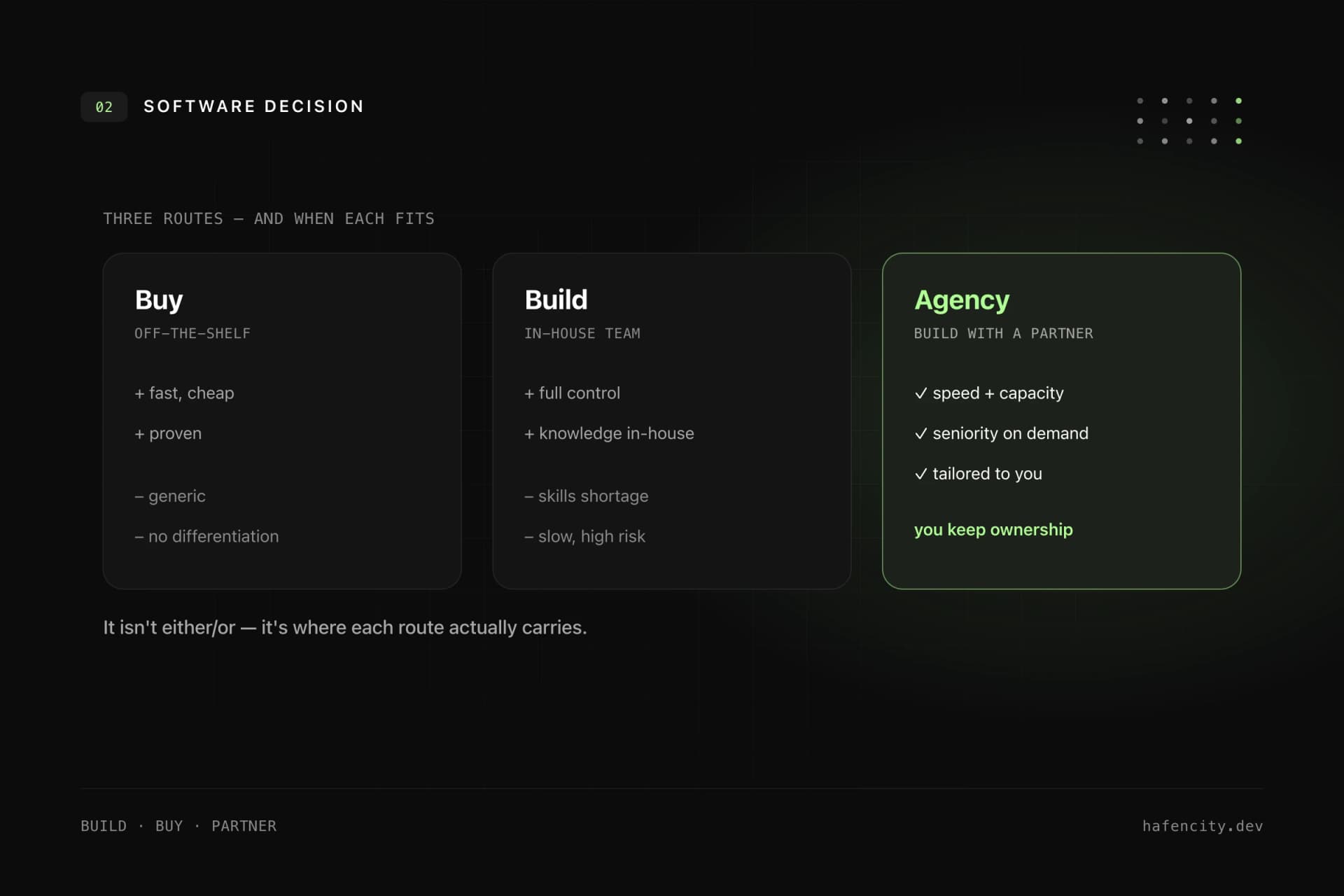
Buy standard software, build it in-house, or build it with an agency? In the Mittelstand the decision is rarely binary. We show, with current data, when each path works — and why the partner route delivers speed and capacity without giving up ownership of your software.

AI

Updated Jun 30, 2026

The EU AI Act for SMEs: using AI creates duties too

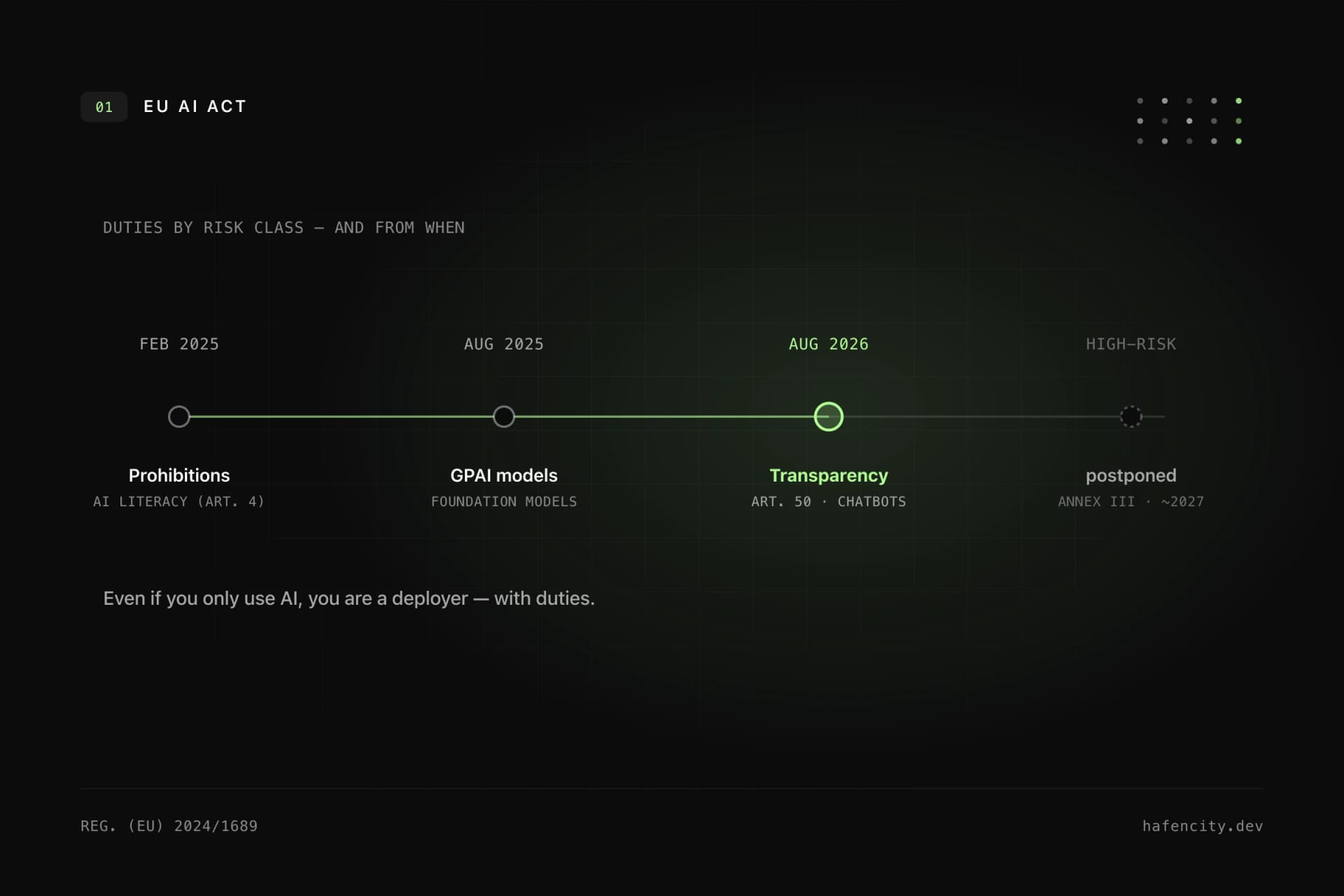
Many managing directors assume the EU AI Act only applies to companies that build AI. It does not: anyone who deploys AI – in recruiting, a service chatbot, scoring – is a deployer with duties. We explain who is affected, which obligations apply when, and how compliance-by-design turns a burden into a non-event.
AI

Updated Jun 30, 2026

AI in the German Mittelstand 2026: numbers, sectors, opportunities

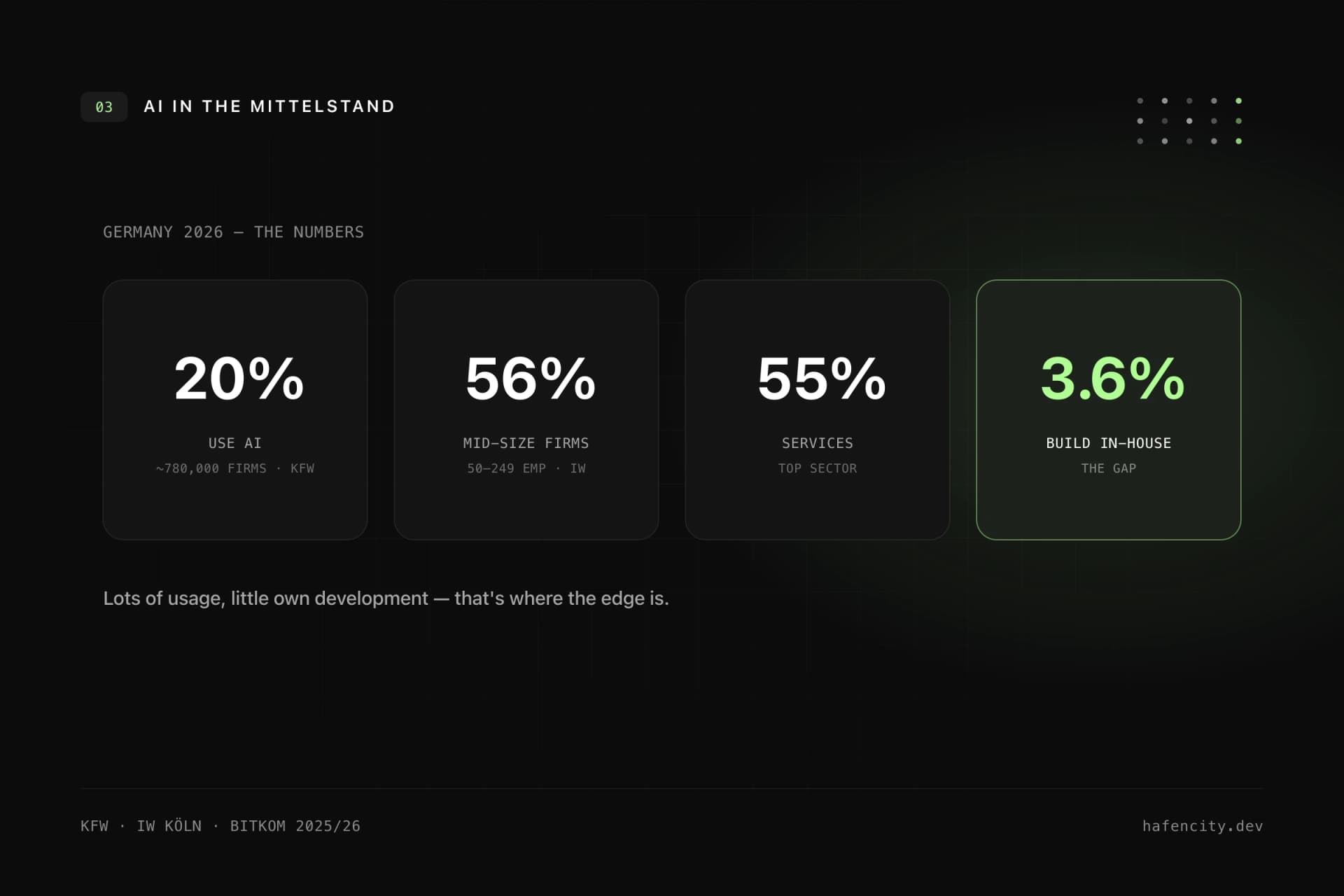
AI adoption in the German Mittelstand is accelerating, but unevenly. We frame the reliable 2026 numbers: who uses AI, which sectors lead, what companies actually do with it, and where the realistic opportunities are for a managing director.

Digitalisierung

Updated Jun 30, 2026

Software and AI Despite the Skills Shortage: Build Without a Team

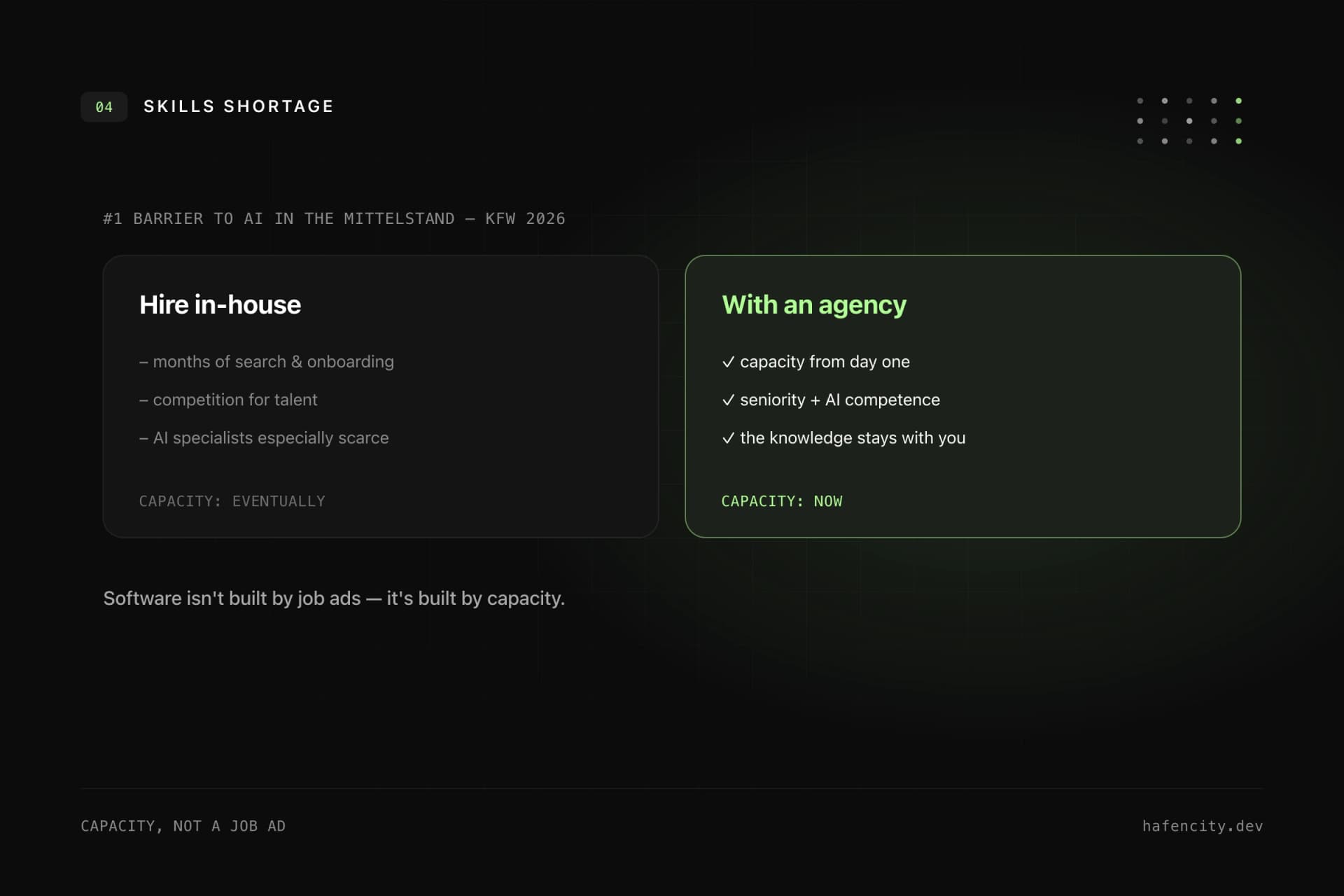
The biggest barrier to digitalisation and AI in the German Mittelstand is not the missing idea but the missing capacity: you cannot find the developers and AI specialists you need fast enough. We show how to ship software anyway — senior capacity on demand, without building a team you cannot staff, and without lock-in.

KI

Updated Jun 29, 2026

Will AI replace your software agency? Why the opposite is true

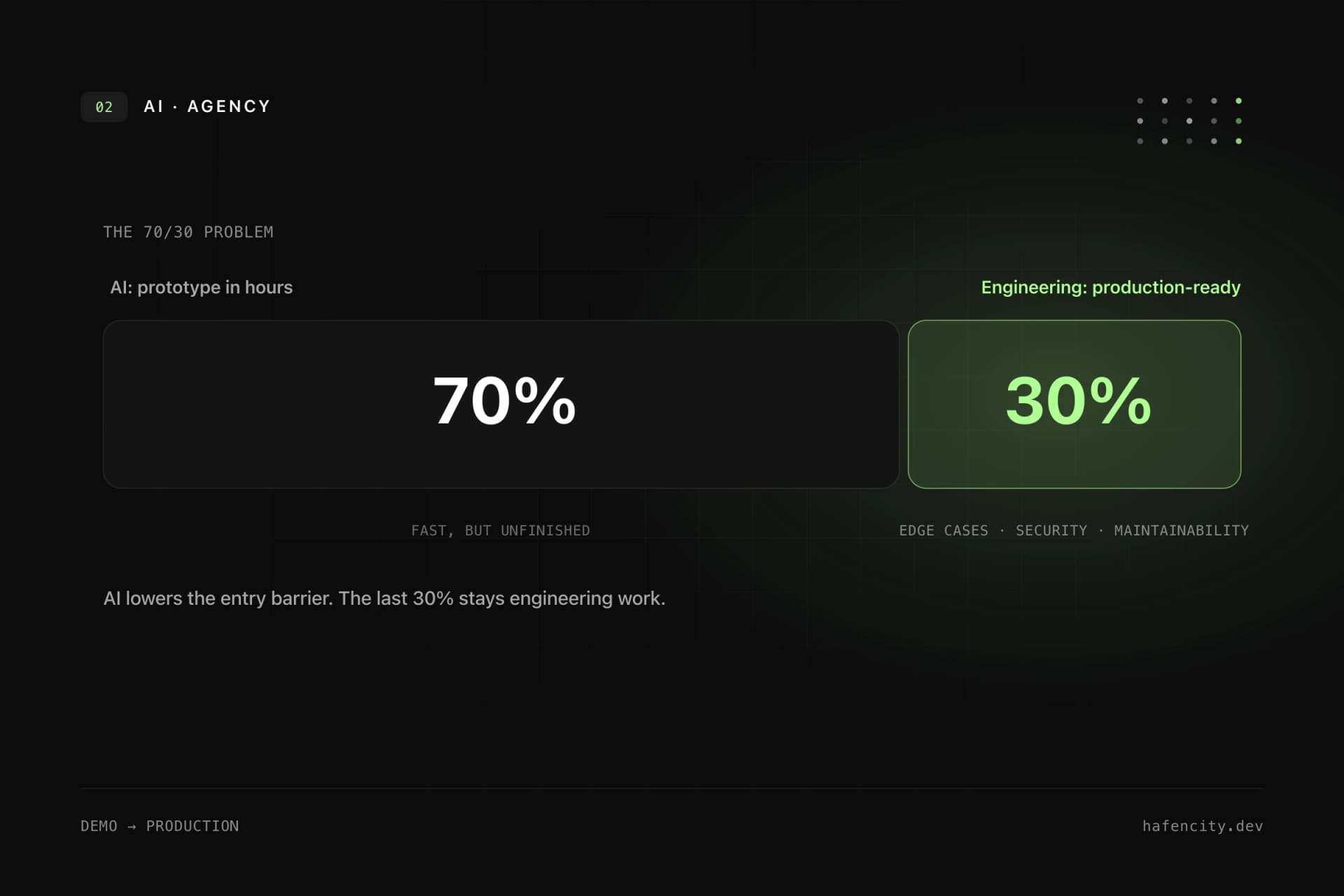
Since vibe coding, almost anyone can build a working demo in an afternoon. So the honest question is: why still hire an agency? The answer: AI lowers the floor — and raises the bar for production at the same time. An AI-native agency closes that gap faster than ever.

KI

Updated Jun 29, 2026

AI in software development: why an agency ships faster and better with it

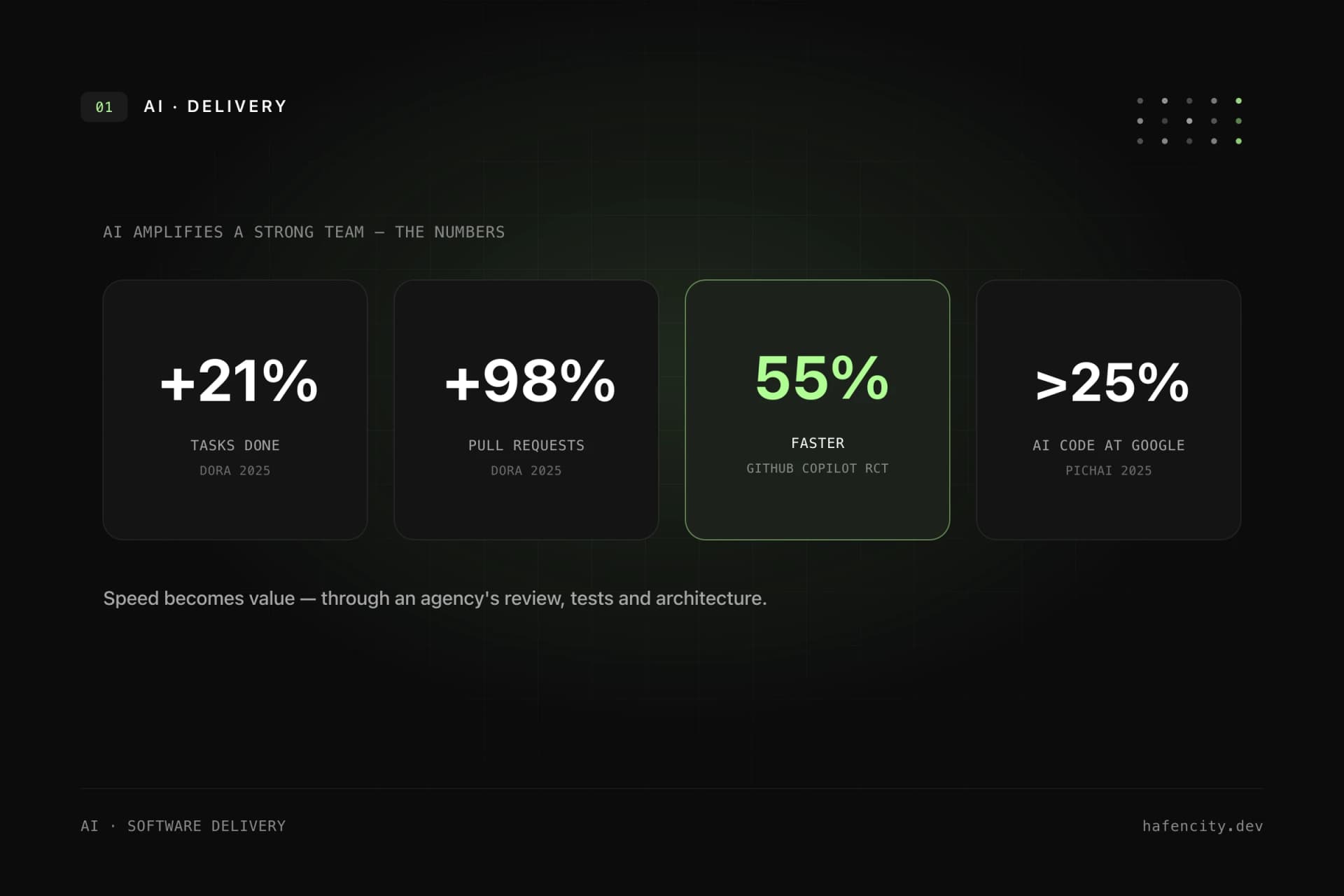
AI makes software development measurably faster – but only discipline turns speed into better outcomes. With current numbers from DORA, the GitHub Copilot trial and Google/Microsoft, we show where AI genuinely helps, where it misleads (METR), and why an AI-native agency converts that speed into value.
KI

Updated Jun 29, 2026

The risks of AI code generation — and how an agency keeps them in check

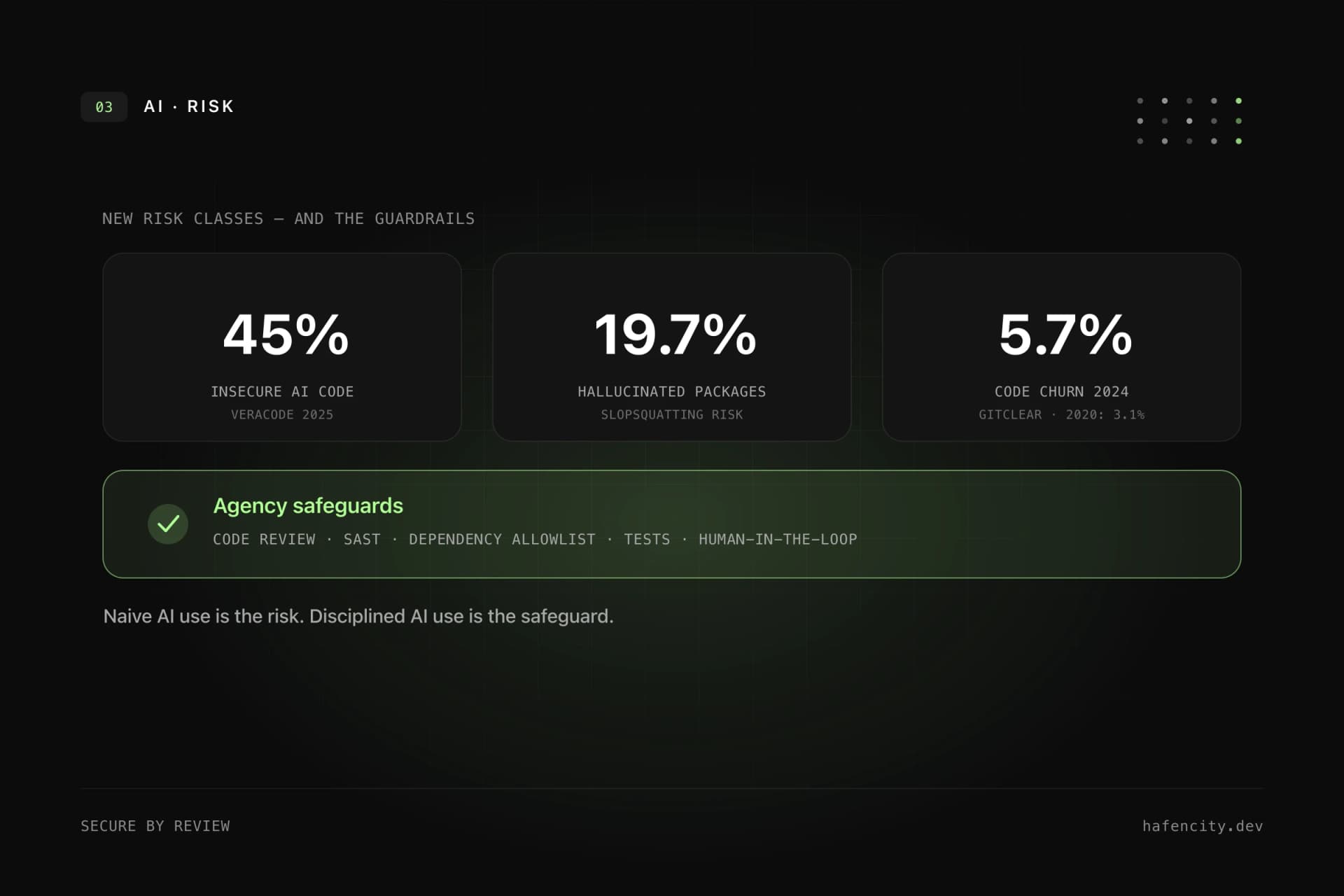
AI generates code in seconds — but 45% of samples contain security flaws, nearly 20% reference invented packages, and code churn is rising. The danger isn't AI, it's naive AI use. We lay out the new risk classes with numbers — and the discipline an agency uses to turn AI into a safe accelerator.

Software

Updated Jun 29, 2026

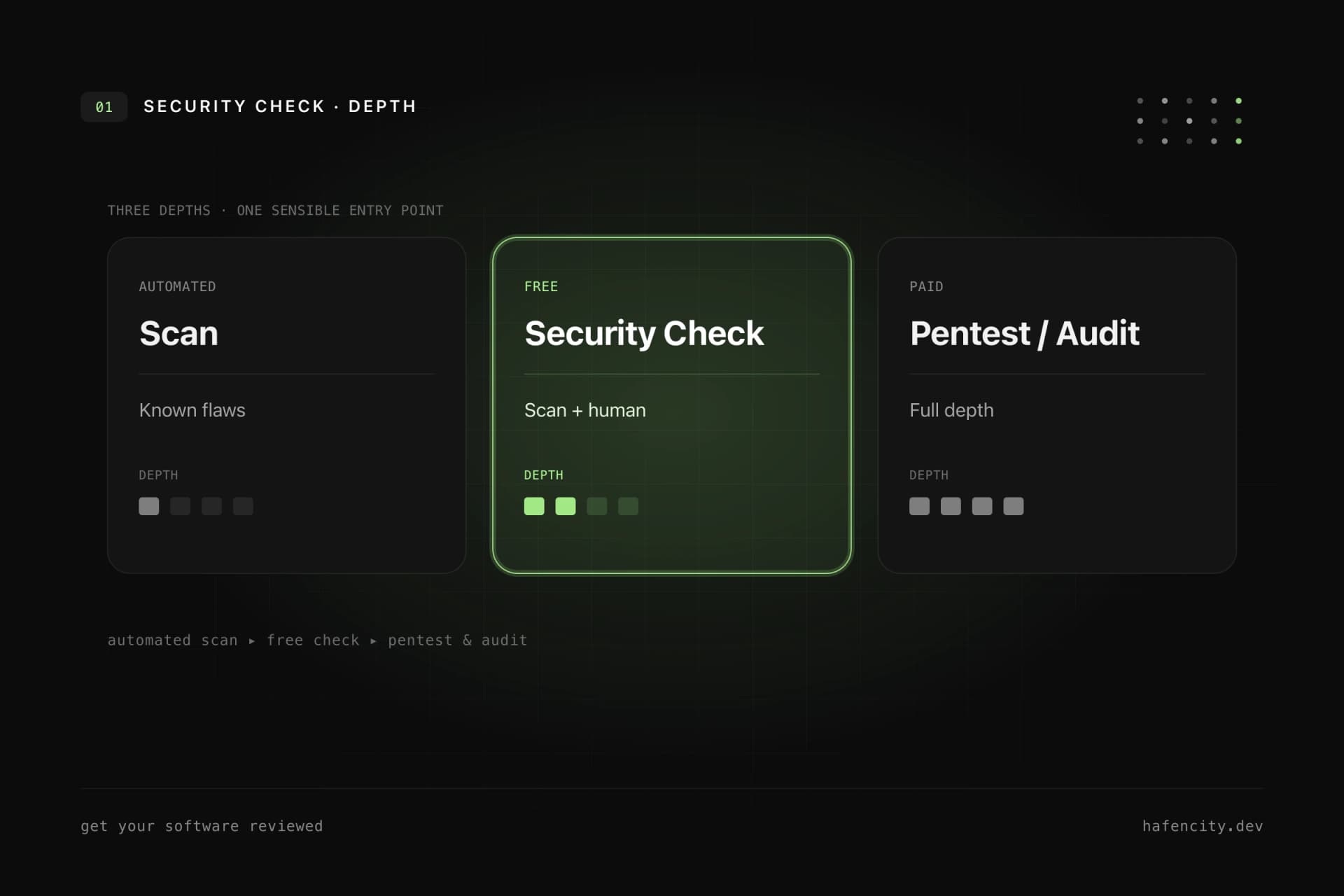
Software Audit 2026: Code Quality, Security, Cost and Roadmap

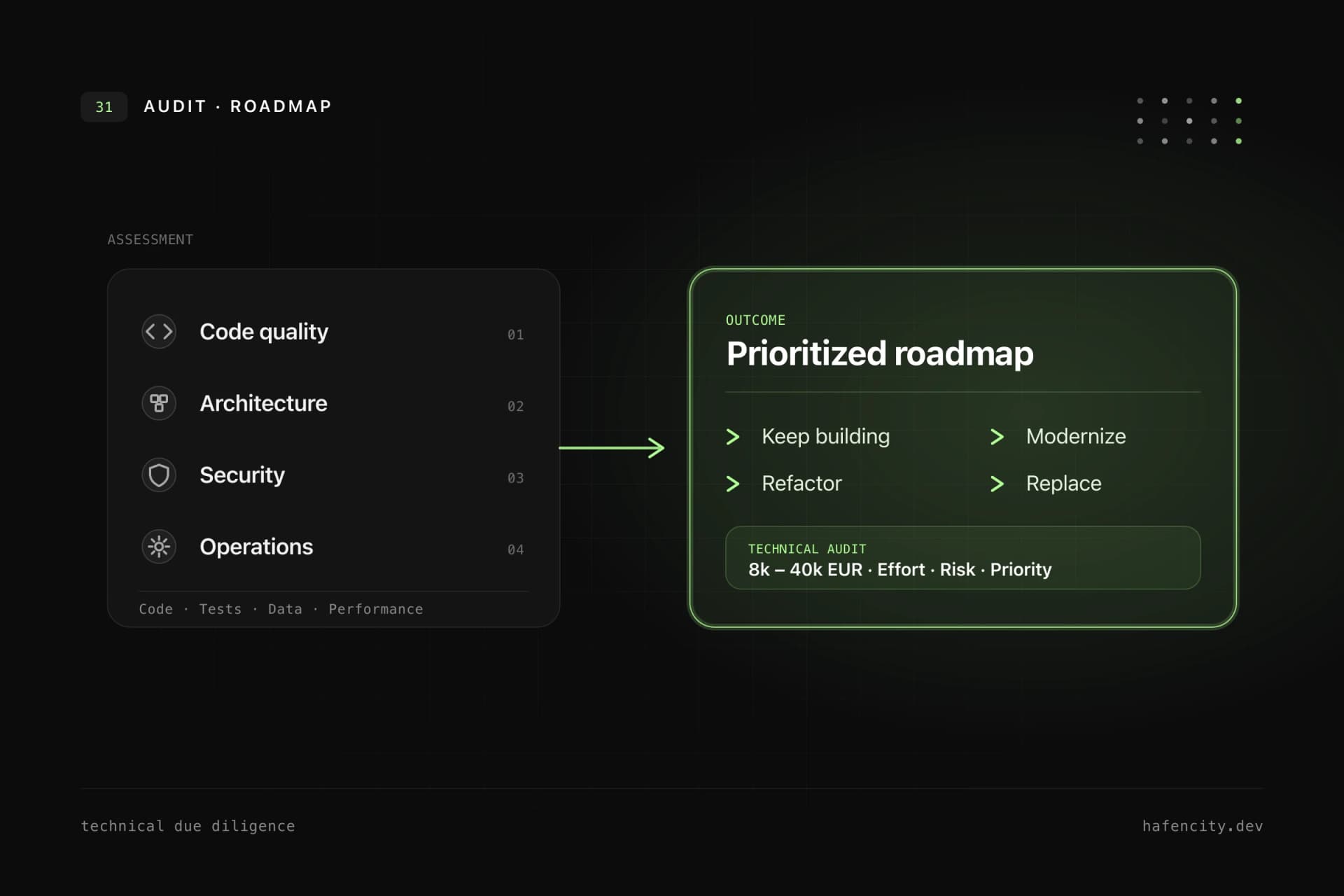
How companies have existing software assessed technically: code review, architecture, security, supply chain, operations and maintainability – with honest cost ranges for the DACH market and a prioritized roadmap instead of a list of complaints.

Software

Updated Jun 29, 2026

Software Maintenance 2026: Cost, Operations and Roadmap

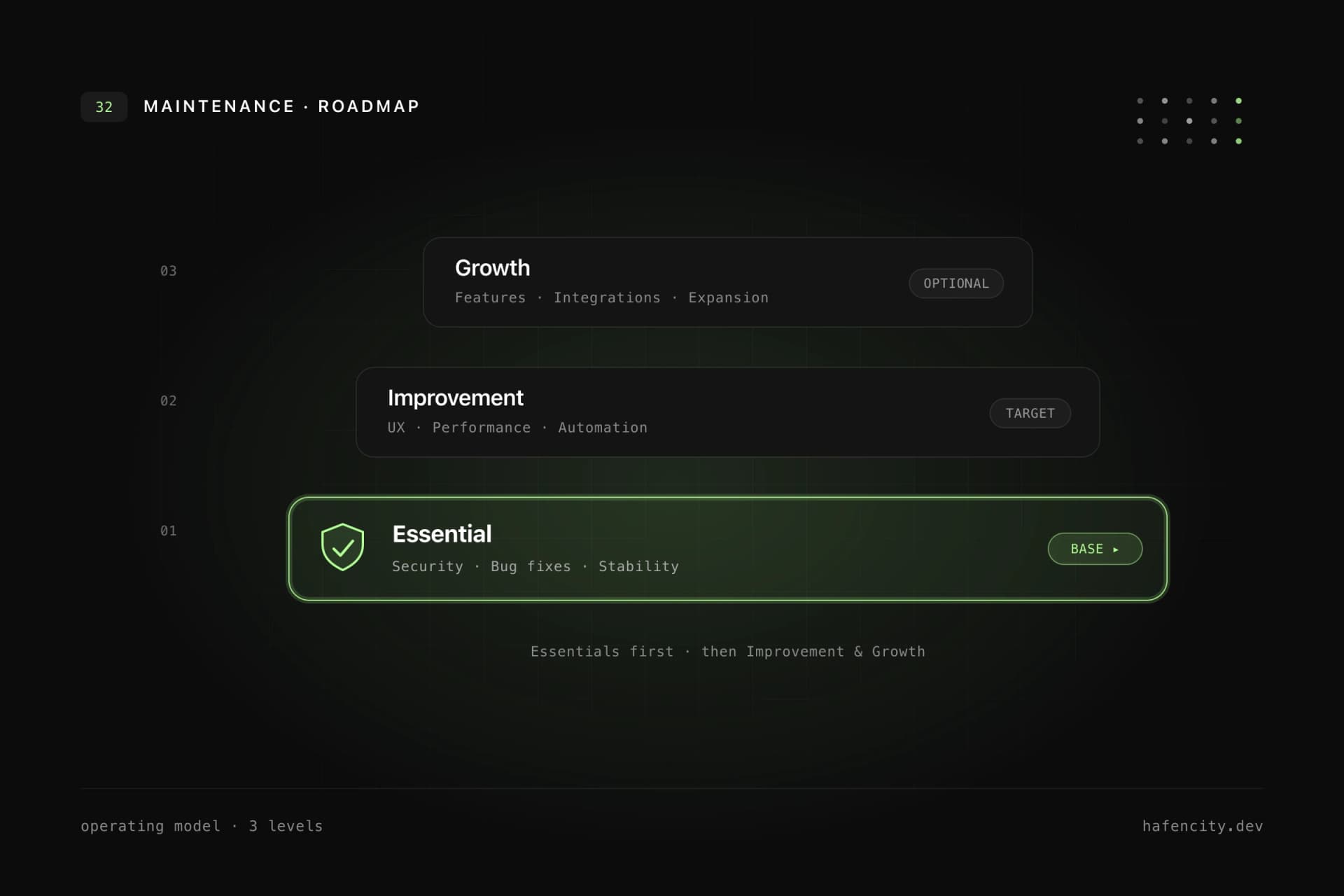
Launch is not the finish line — it is the start of the most expensive phase: over a product's life, maintenance is 50–80% of total cost. We use current data to show what maintenance and continuous development cost in 2026, what belongs in scope, and how to plan operations, SLAs and a roadmap cleanly.

Backend

Updated Jun 29, 2026

Custom API Development 2026: REST, GraphQL, Cost & Integration

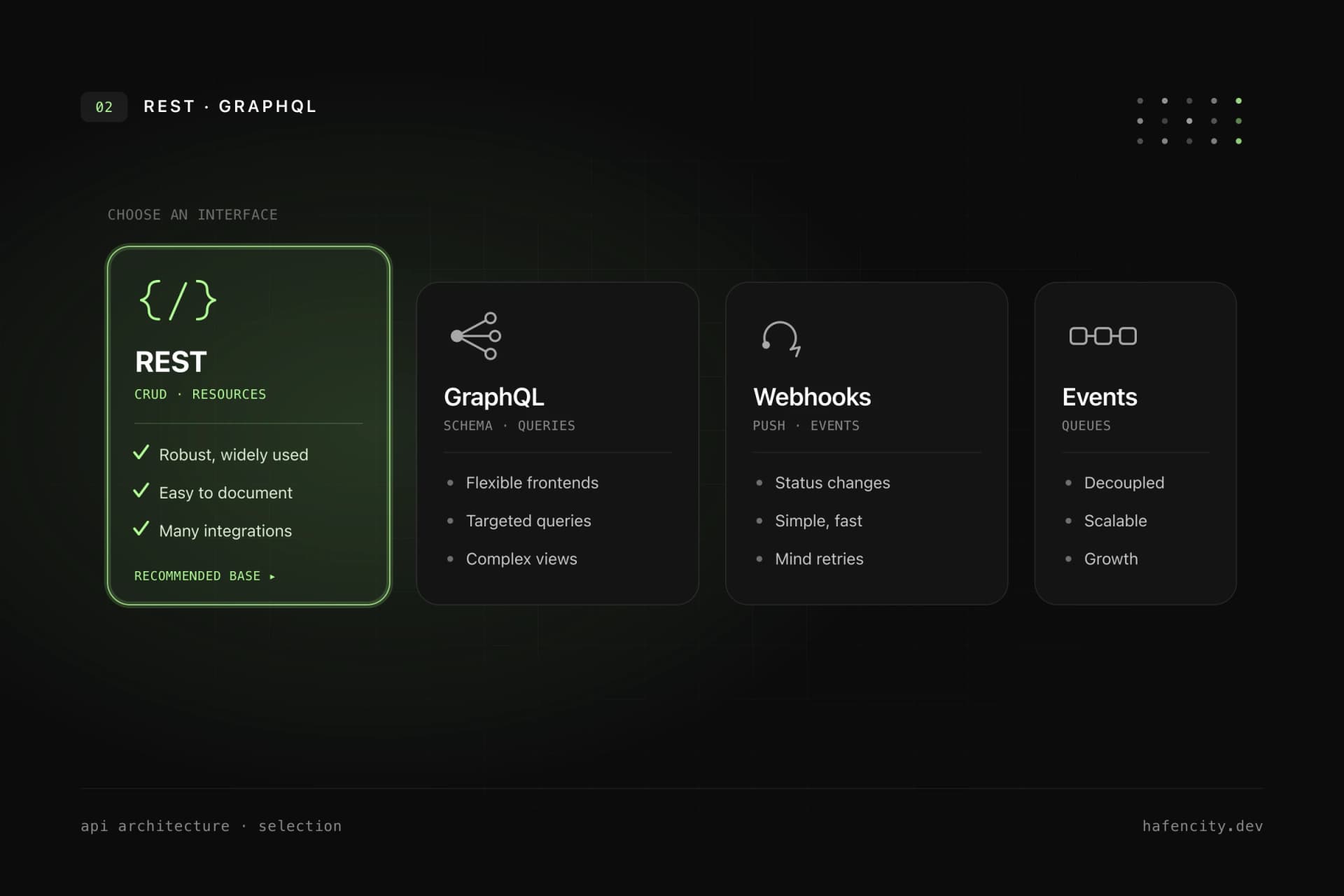
An API is not a technical by-product. It is a contract between systems – and in 2026 increasingly the interface to AI agents. We show when REST, GraphQL, webhooks or events fit, what development costs, and how interfaces stay secure and maintainable.

Engineering

Updated Jun 29, 2026

Legacy Software Modernization 2026: Cost, Risk, Migration

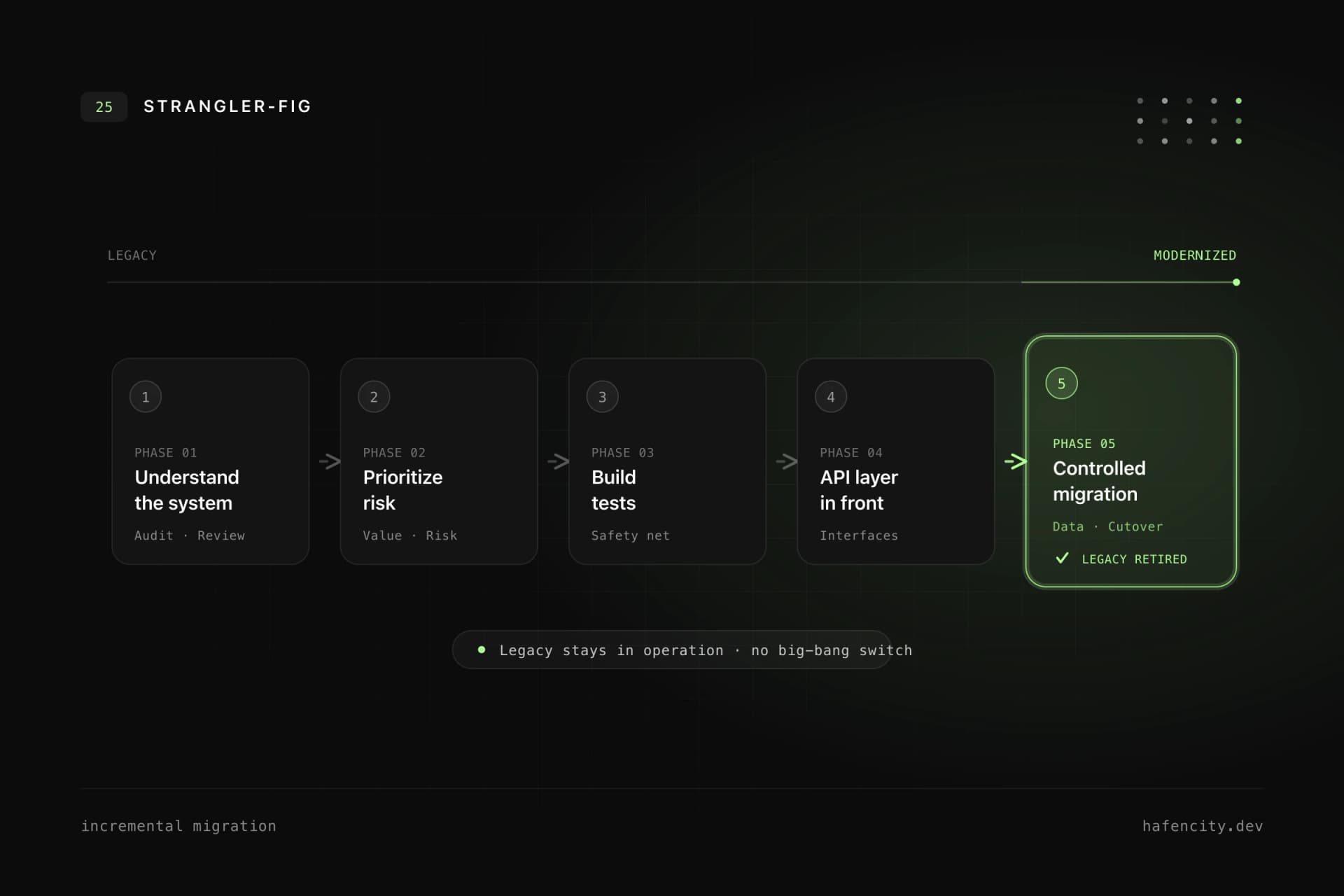
Outdated software rarely becomes a risk overnight – but technical debt ties up 20–40% of an IT estate's value, according to McKinsey. We show when modernization becomes urgent, which strategy lowers risk and what a migration realistically costs in the DACH market.

Product

Updated Jun 29, 2026

Custom MVP Development 2026: Cost, Timeline and Roadmap

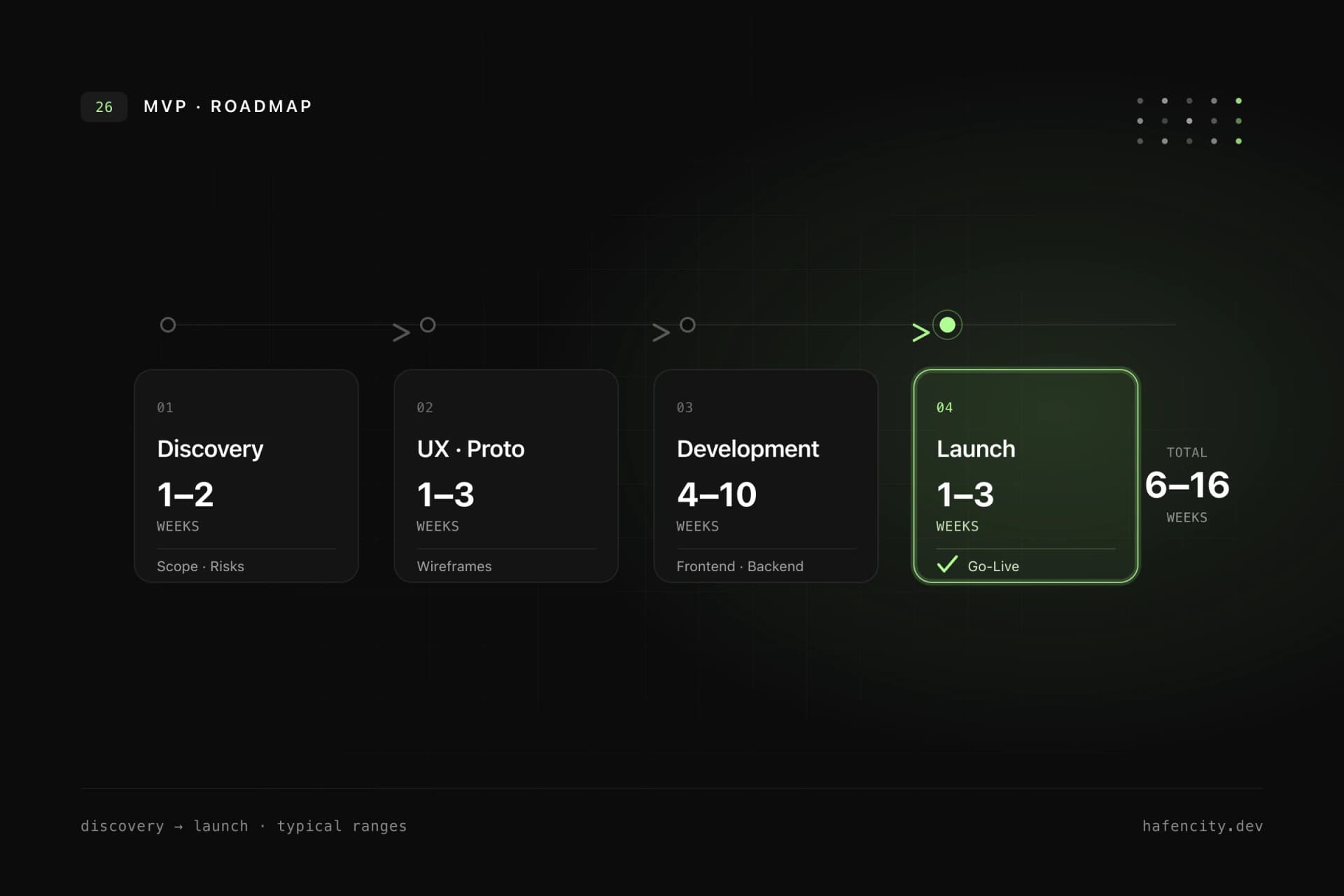
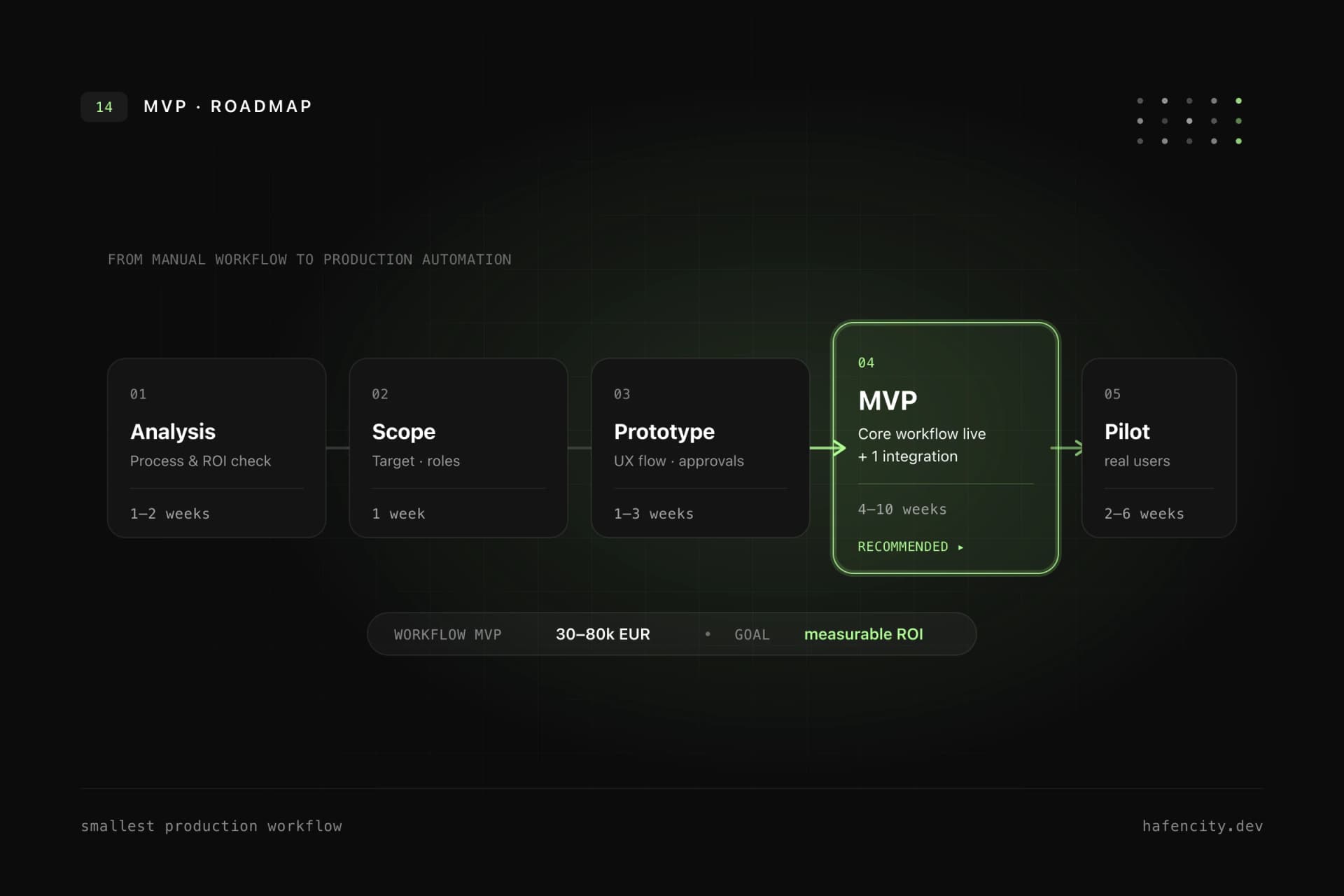
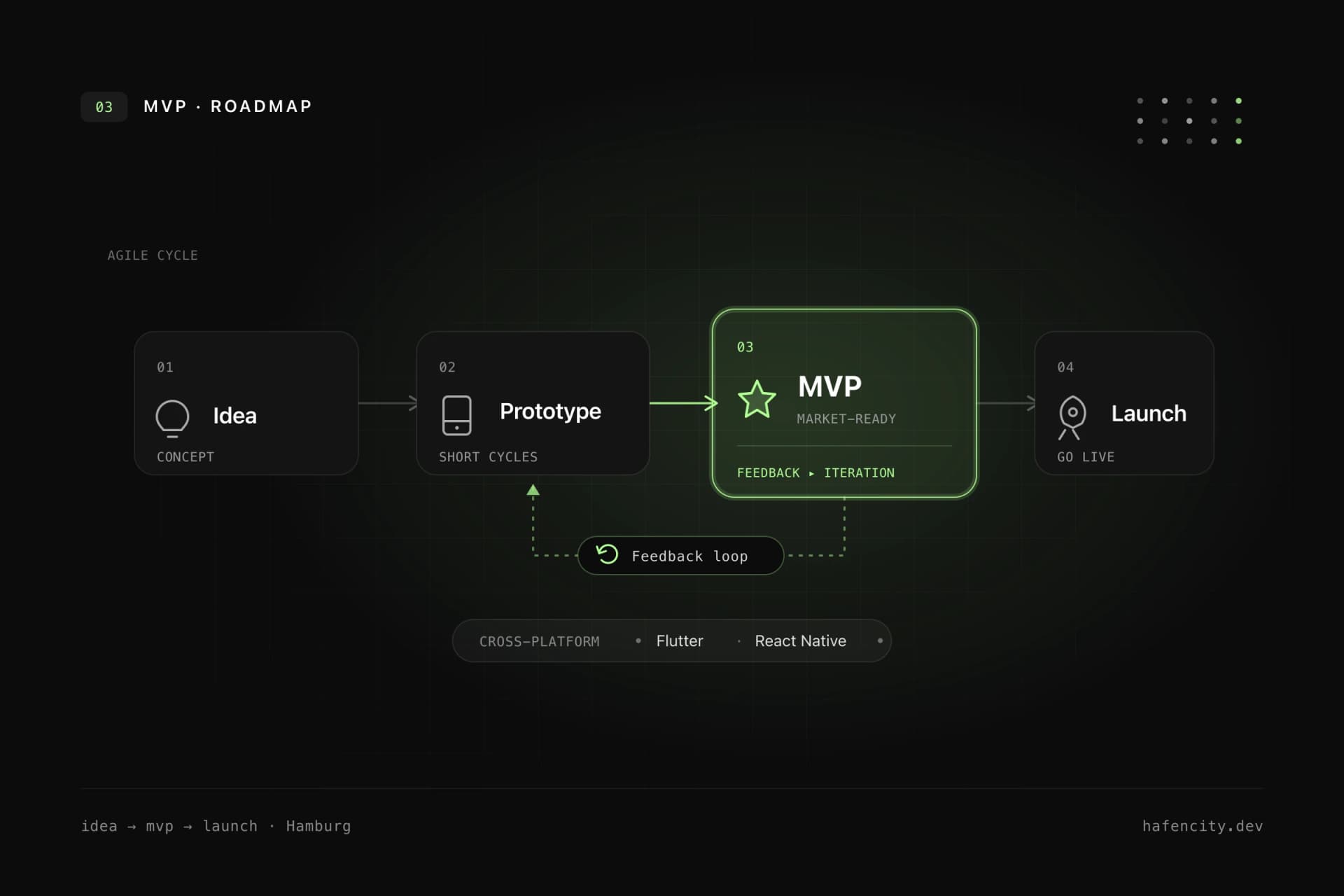
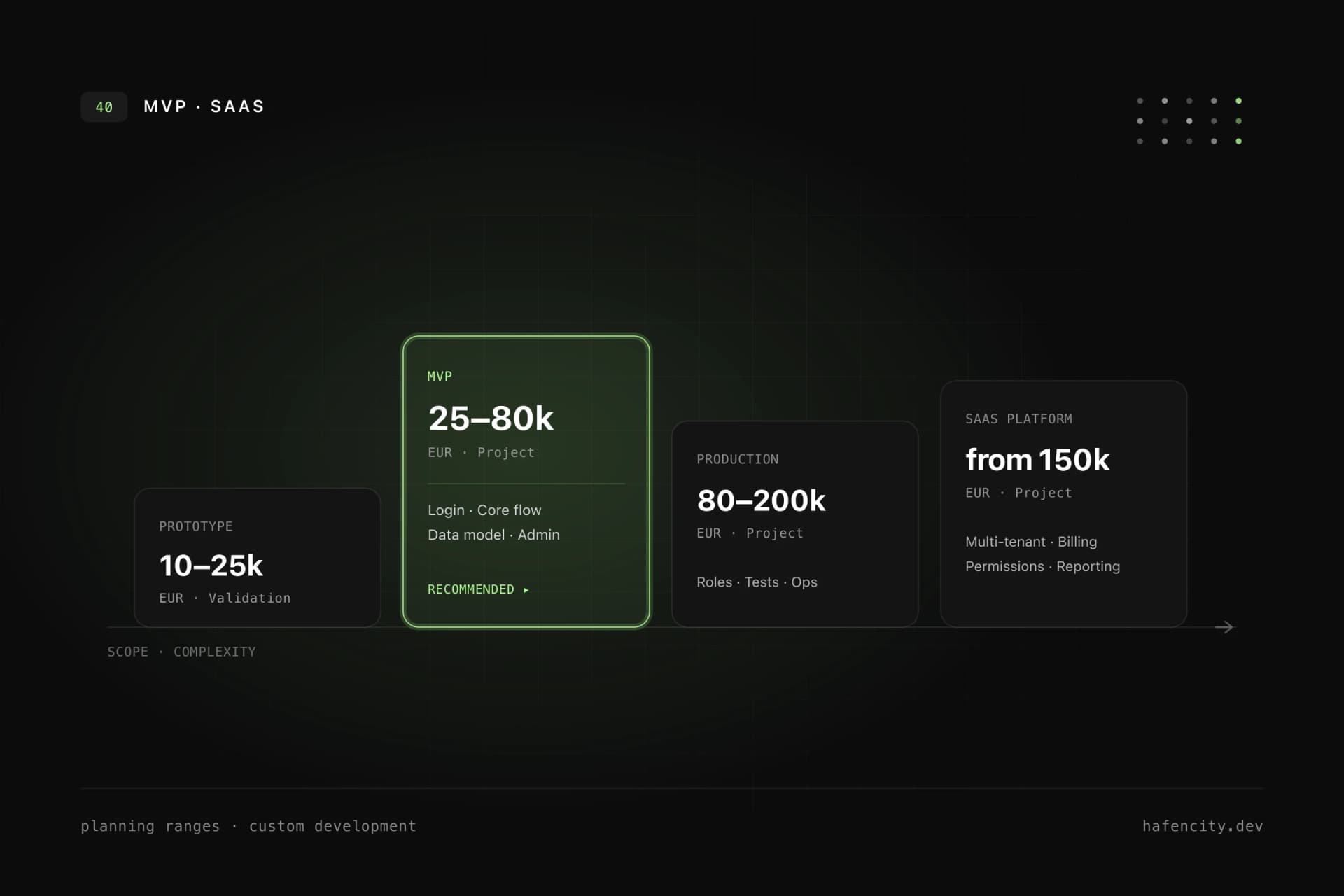
Most startups don't fail on technology — they fail on lack of market need. An MVP tests exactly that risk with minimal investment. With current DACH figures, we show what an MVP costs in 2026, how long it takes and what a roadmap from discovery to launch looks like.

Digitalization

Updated Jun 29, 2026

Automating Business Processes 2026: Cost, ROI and Examples

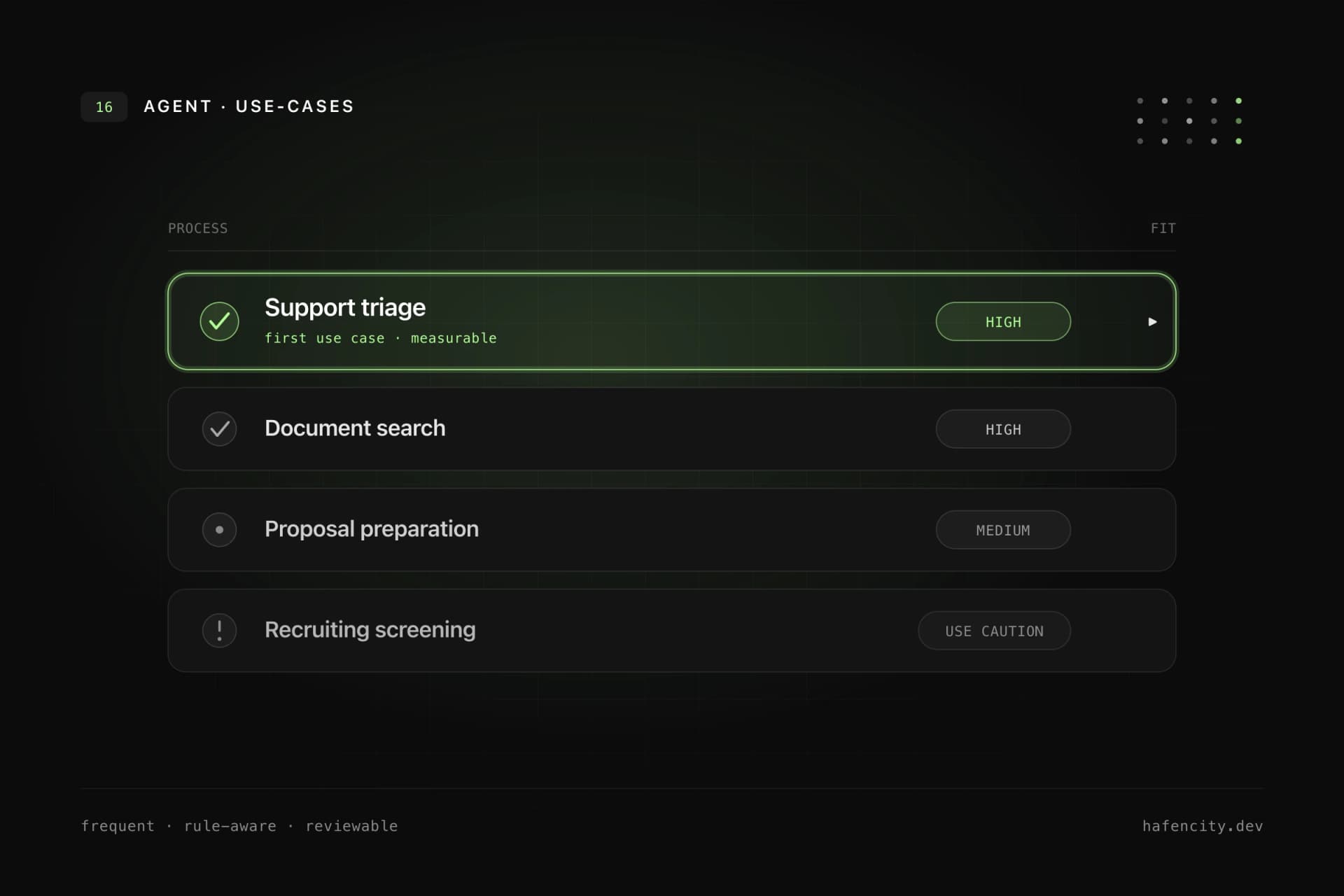
Not every process needs custom software — but the right one saves measurable time and errors. We show how to spot candidates, estimate ROI in five minutes, what to budget in 2026 and what a first workflow MVP looks like.

AI

Updated Jun 29, 2026

Enterprise Knowledge Chatbot 2026: RAG, GDPR, Cost

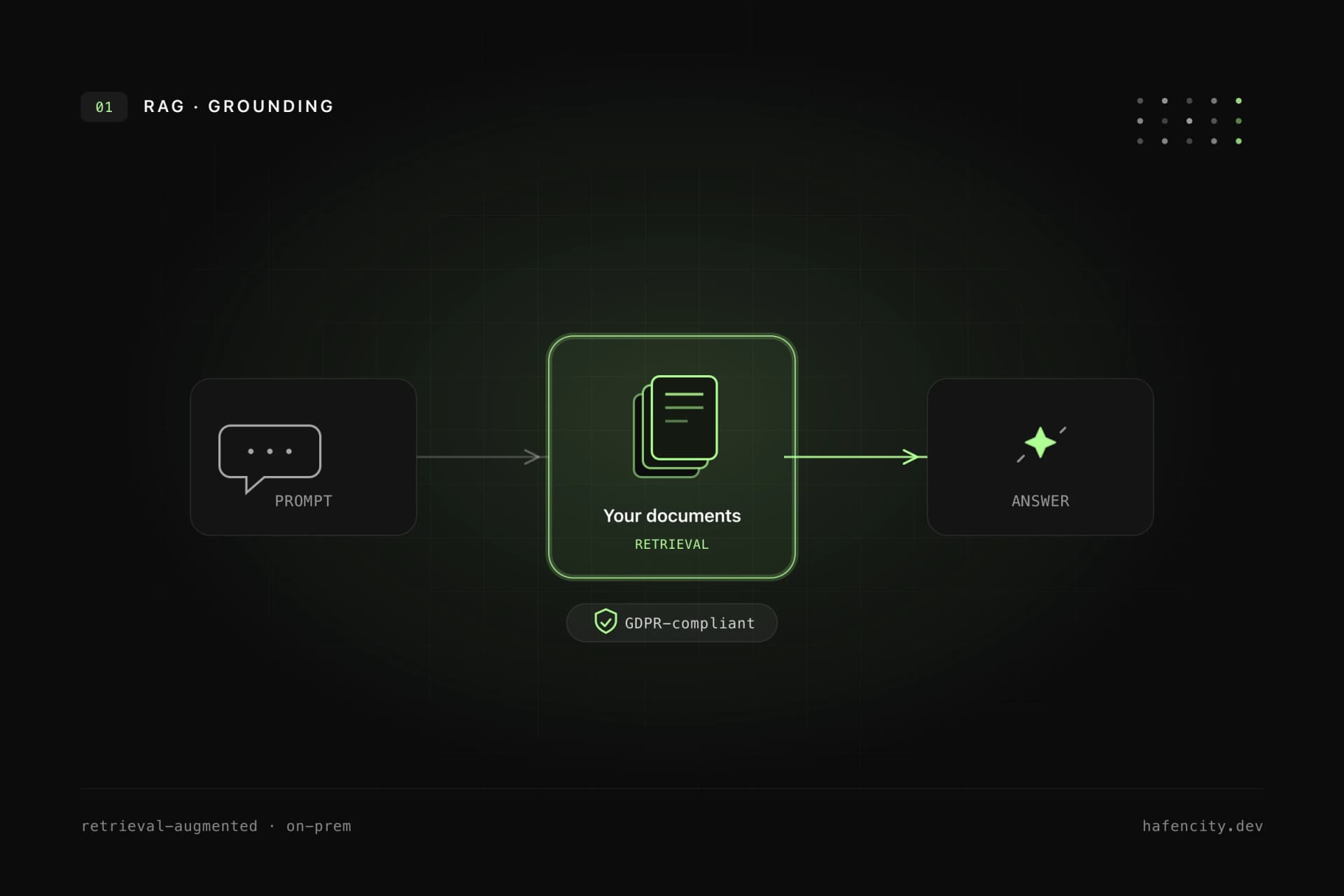
"ChatGPT with our own data" is the most common enterprise AI request in 2026. We show what turns a RAG chatbot from a demo into a production system: permission-aware architecture, data sources, the EU AI Act, security and honest cost ranges.

Web App

Updated Jun 29, 2026

Custom Customer Portal Development 2026: Cost, GDPR and MVP Roadmap

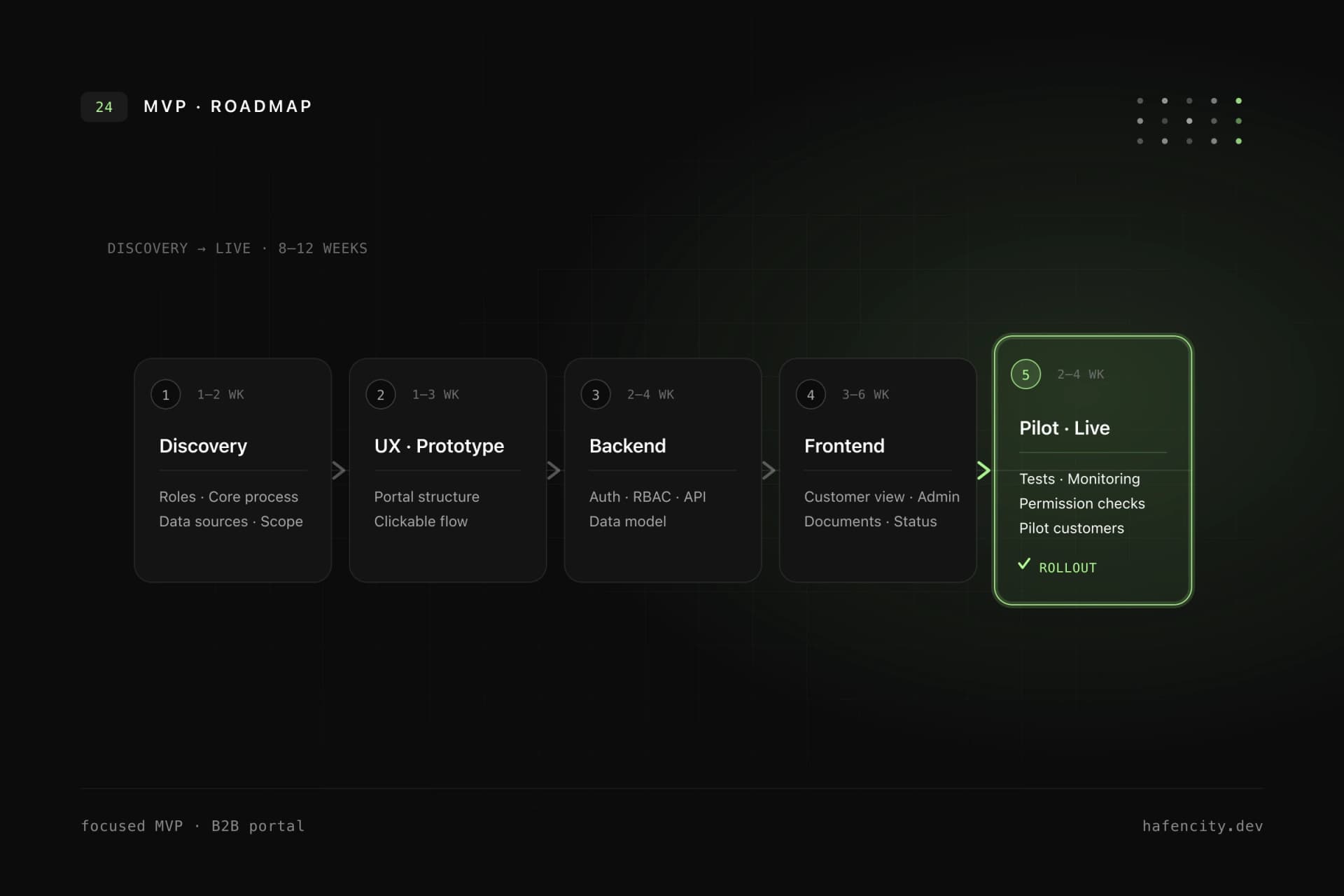
A customer portal is not a second website but a digital process channel with roles, documents, integrations and security. With current numbers, we show what a custom B2B portal costs in 2026, when it pays off and how a focused MVP in 8 to 12 weeks looks.

Accessibility

Updated Jun 29, 2026

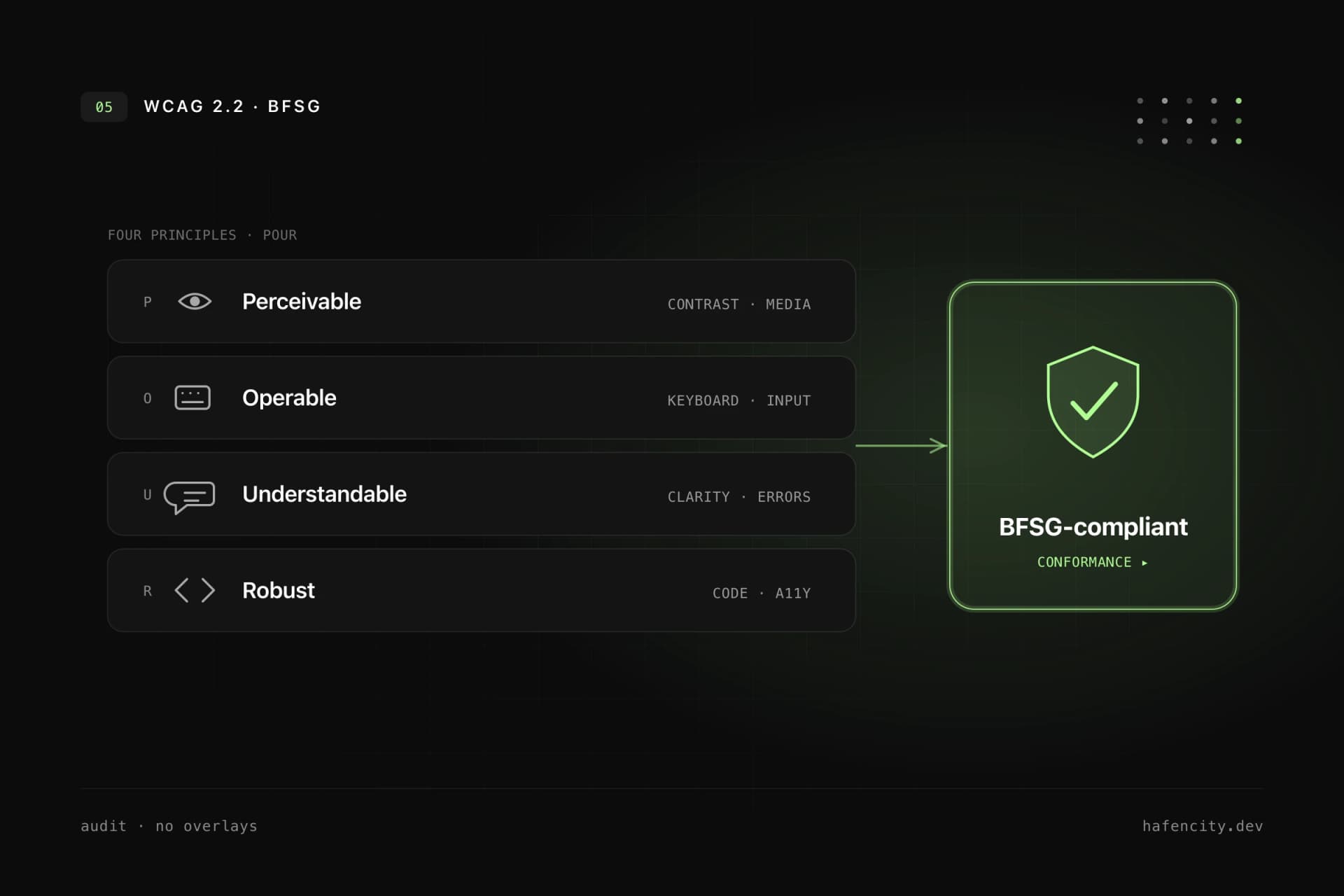
Website and App Accessibility: What Companies Should Implement in 2026

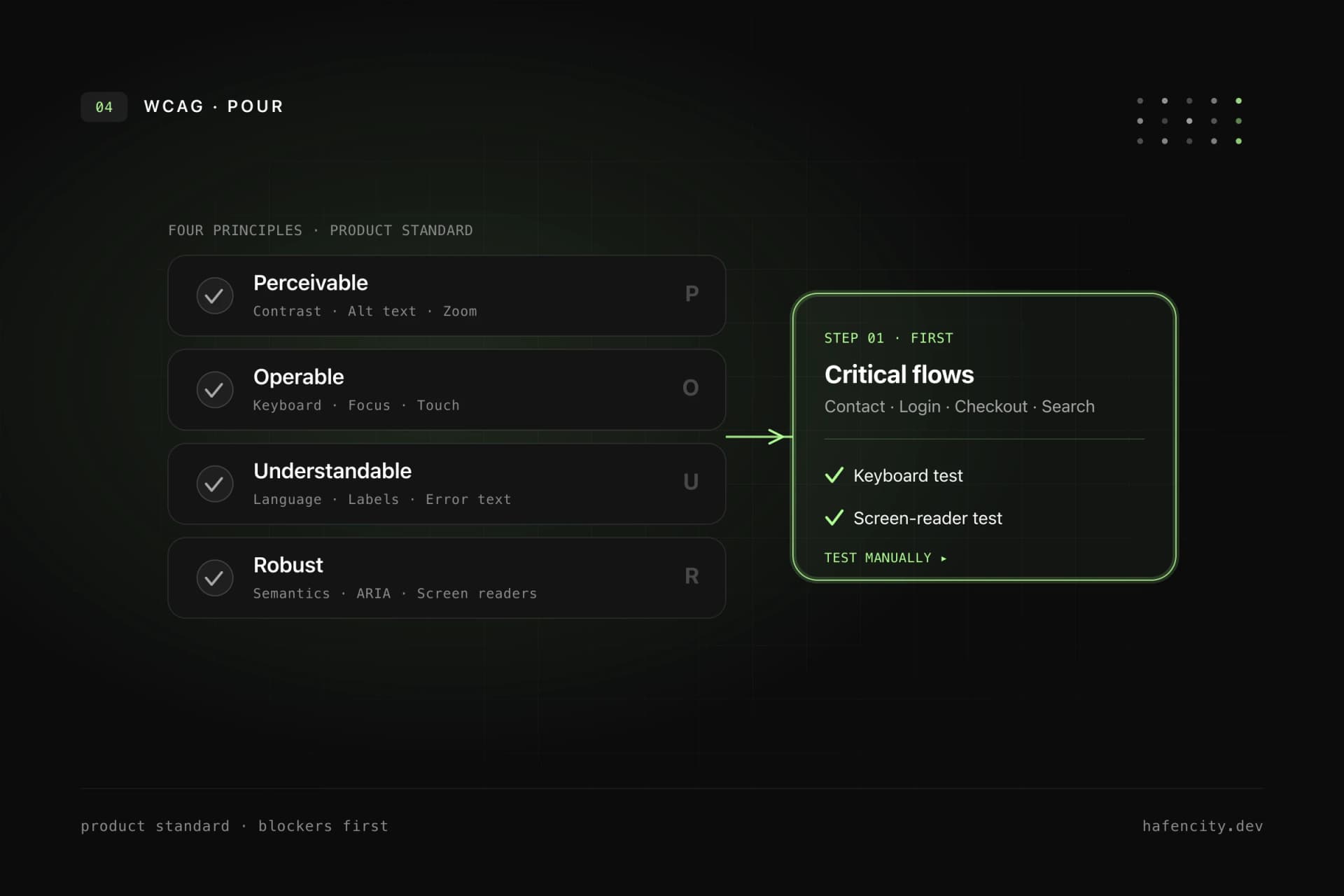
95.9 percent of the most-visited home pages fail WCAG — almost always on the same five issues. Since the BFSG took effect (28 June 2025), accessibility is mandatory for many digital services. We show what product, design, content and engineering teams should actually implement: WCAG 2.2 as the standard, keyboard, focus, forms, contrast, design system, testing — and in what order.

AI

Updated Jun 29, 2026

Codex, Claude and Cursor: AI Coding in the Agency 2026

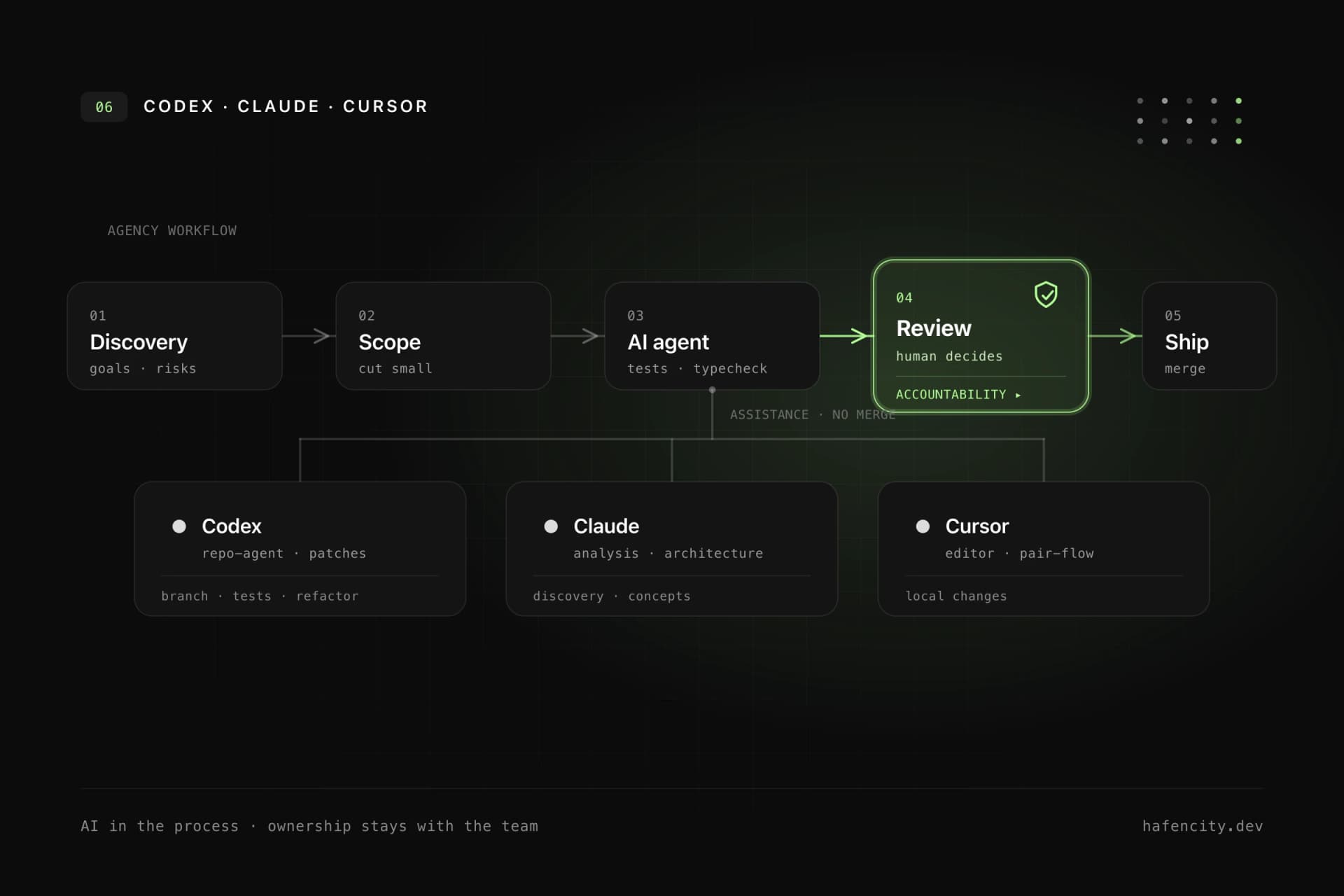
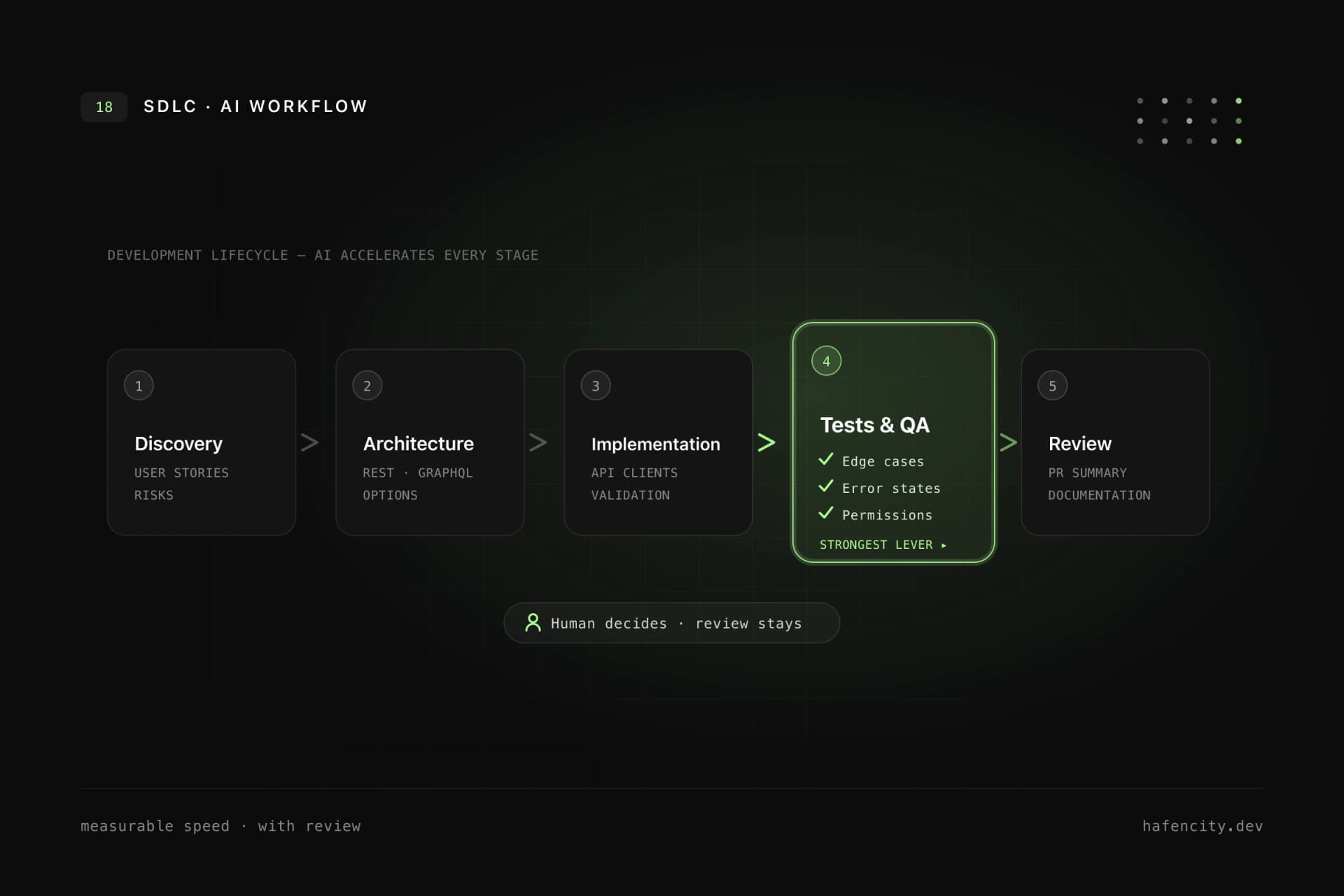
84% of developers use AI tools — yet only about a third trust the output. We show how software agencies put Codex, Claude and Cursor to work in 2026 across discovery, implementation, code review, tests and documentation, what the tools cost, and where accountability stays with the team.

Performance

Updated Jun 29, 2026

Core Web Vitals 2026: Performance Optimization That Matters

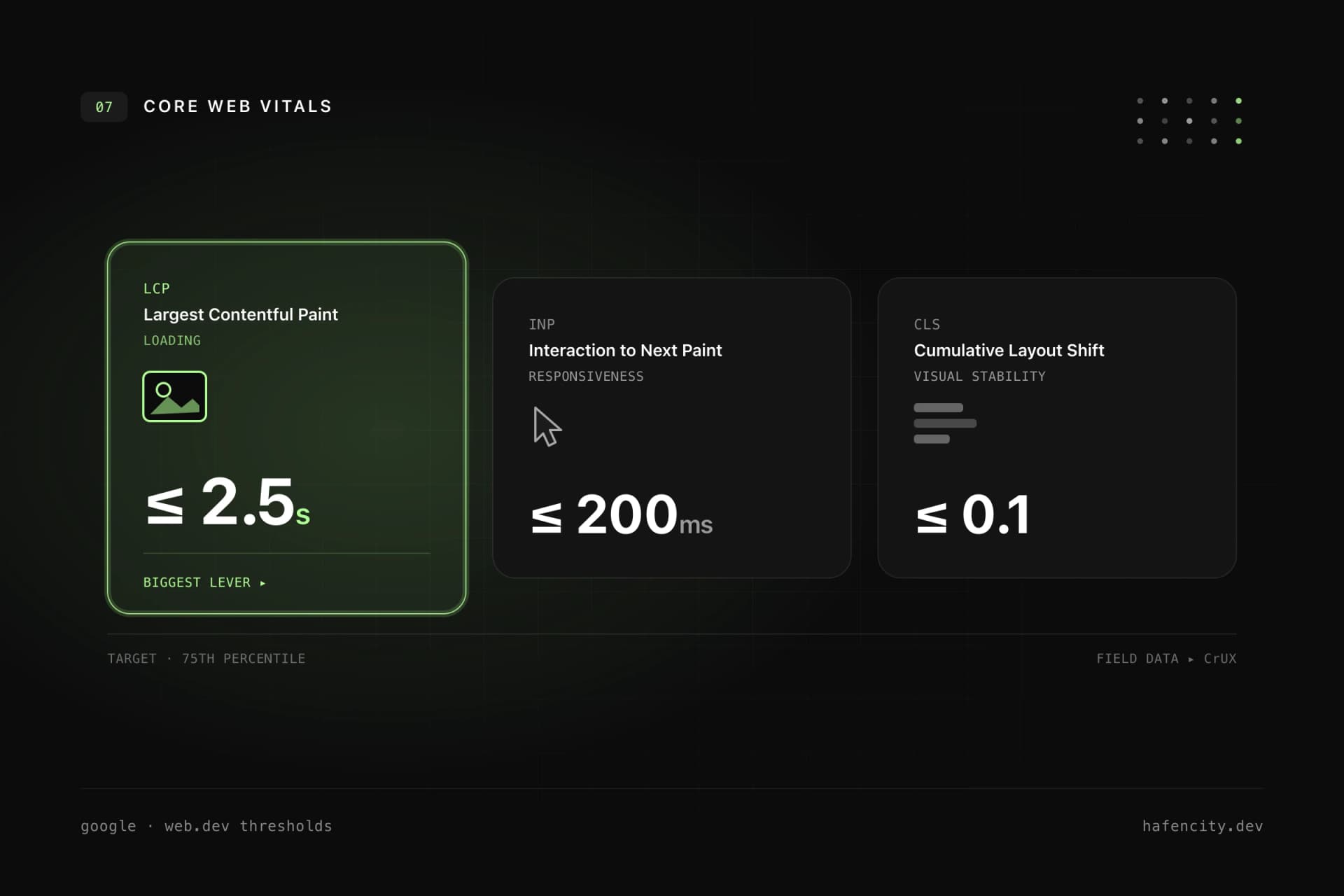
What LCP, INP and CLS really measure, why even 0.1 seconds of extra speed moves conversions, and how images, fonts, JavaScript, caching and third-party scripts make a website noticeably faster — with the current 2026 thresholds.

Hamburg

Updated Jun 29, 2026

Custom Software in Hamburg 2026: When Standard Software Falls Short

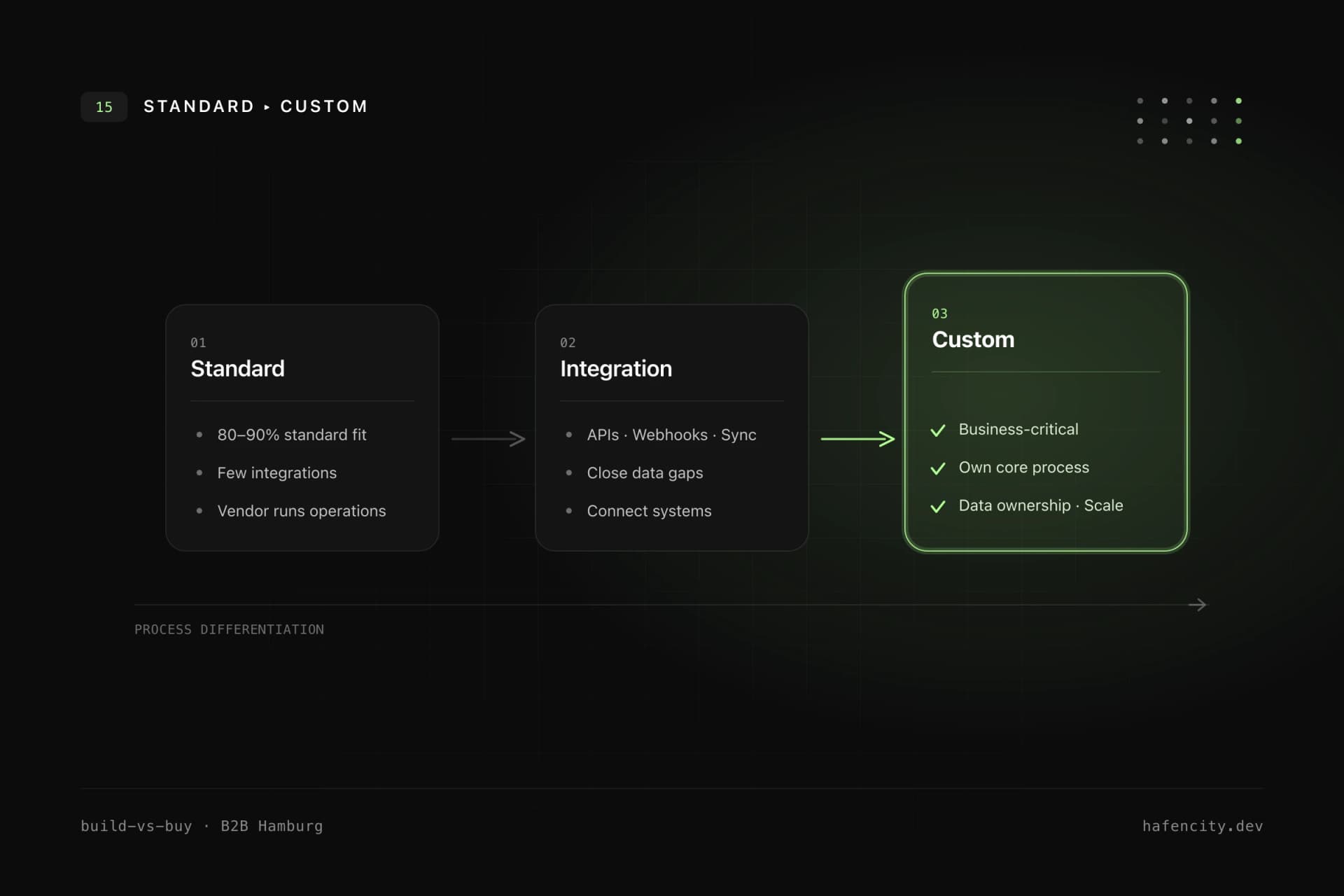
Standard software is often the right starting point — until the process gets permanently rebuilt around the software. With current numbers, we show when custom software becomes economical, what it costs, and how to plan integration and migration without a big bang.

AI

Updated Jun 29, 2026

AI Agency Hamburg: Start Realistic AI Projects (2026)

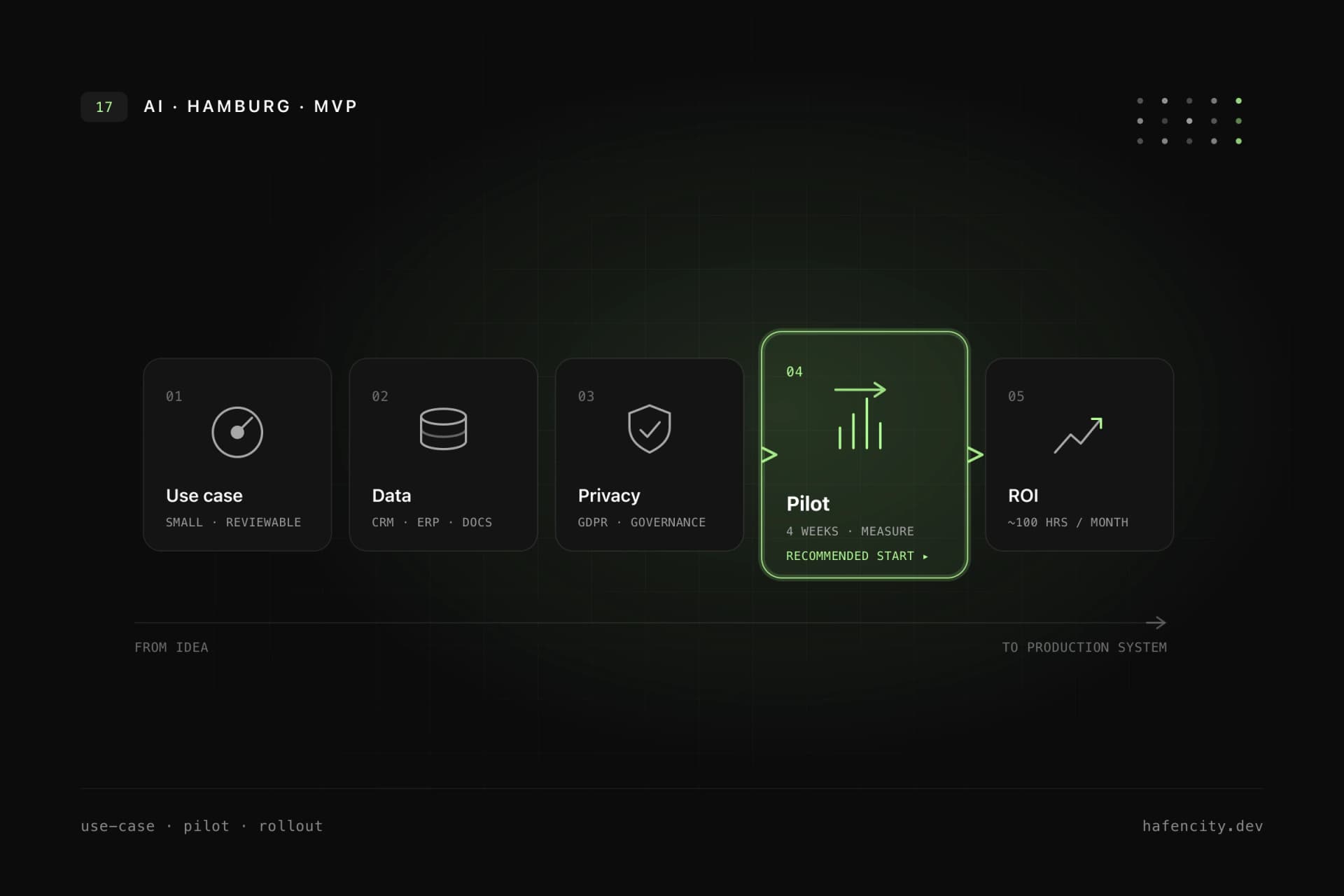
In 2026, 41% of German companies use AI — yet per MIT, 95% of pilots show no measurable impact on results. The difference is rarely the model: it's use case, data, privacy and measurement. This guide shows how Hamburg companies start AI projects that hold up in daily work.

AI

Updated Jun 29, 2026

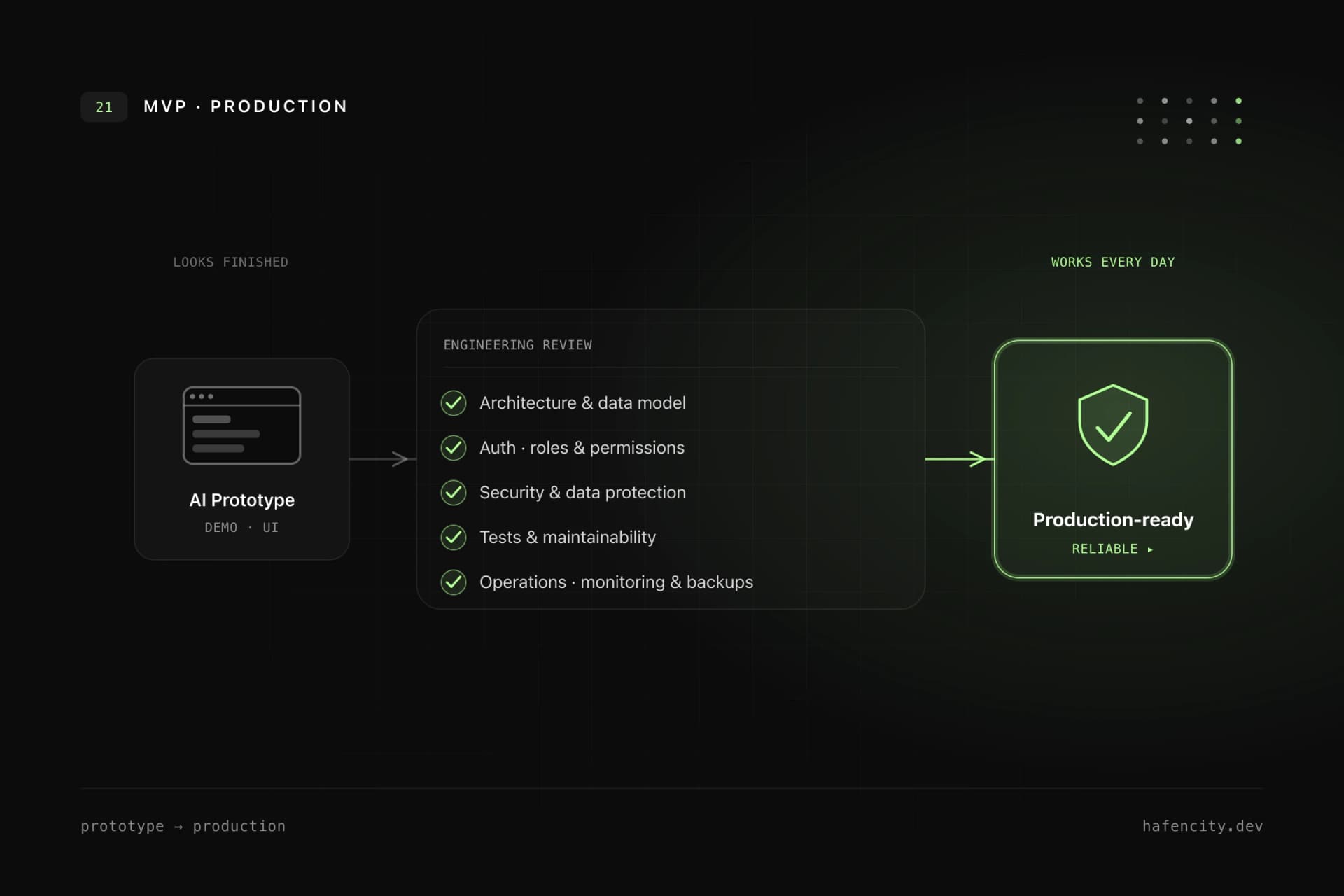
From AI Prototype to Production-Ready: What's Really Missing in 2026

An AI prototype looks like a finished product in days — and that is the trap. 84% of developers use AI, but 45% of the generated code takes the insecure path. With current numbers, we show what really sits between a convincing demo and production-ready software: architecture, data model, security, tests and operations.

AI

Updated Jun 29, 2026

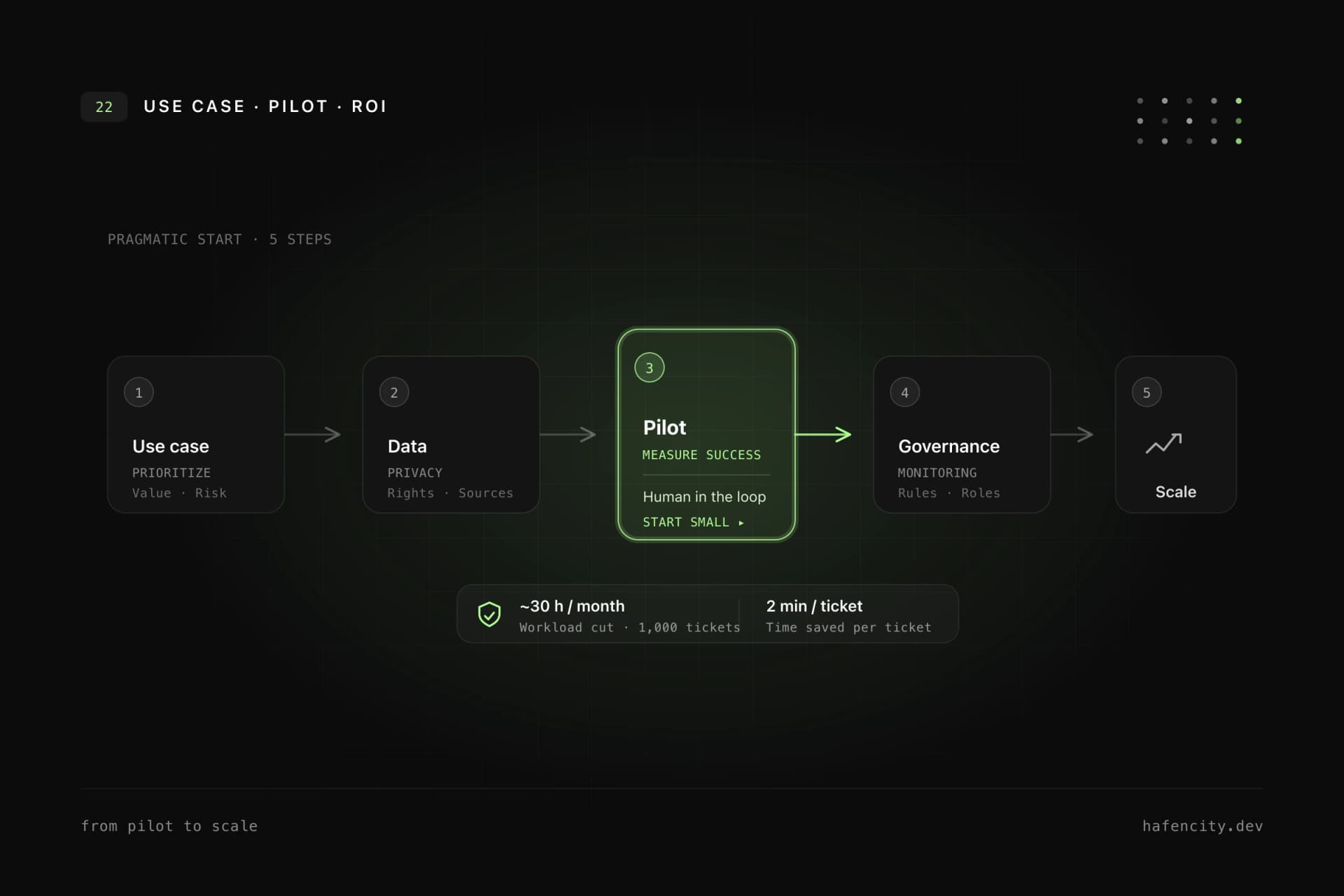
AI Use Cases for Companies: How to Start Realistically in 2026

41% of German companies now use AI, yet MIT found that 95% of GenAI pilots deliver no measurable P&L impact. The difference is not the model but the use case. We show which starting points actually work, where the ROI sits and how a pragmatic start succeeds, with current numbers.

Engineering

Updated Jun 29, 2026

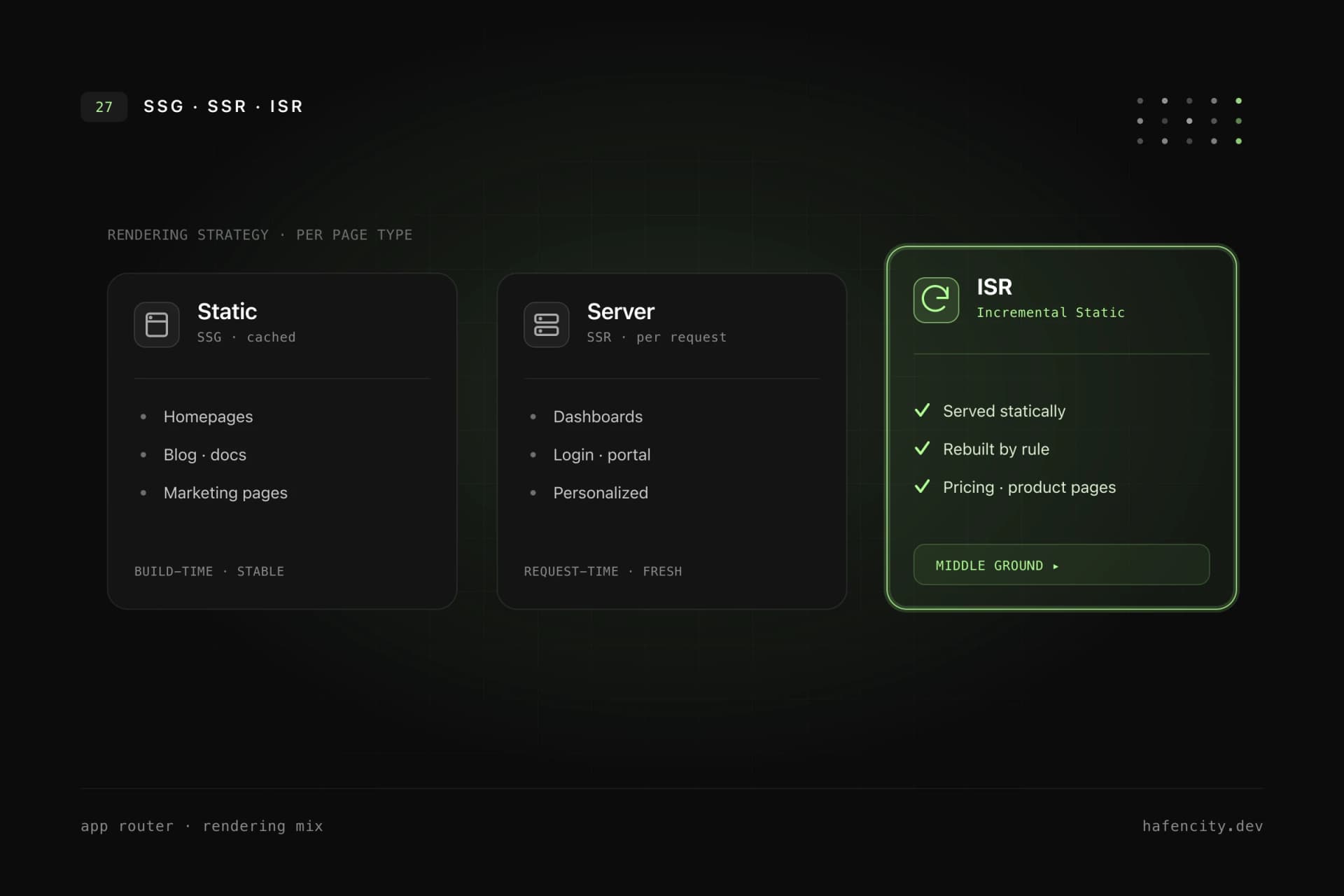
Next.js Agency 2026: When Is Next.js Actually Worth It?

Next.js 16, with the App Router, stable Turbopack and Cache Components, is the de facto standard framework for React projects. But not every project needs that architecture. We explain when Next.js is worth it, when it is overkill — and what a project realistically costs in the DACH market.

Hamburg

Updated Jun 29, 2026

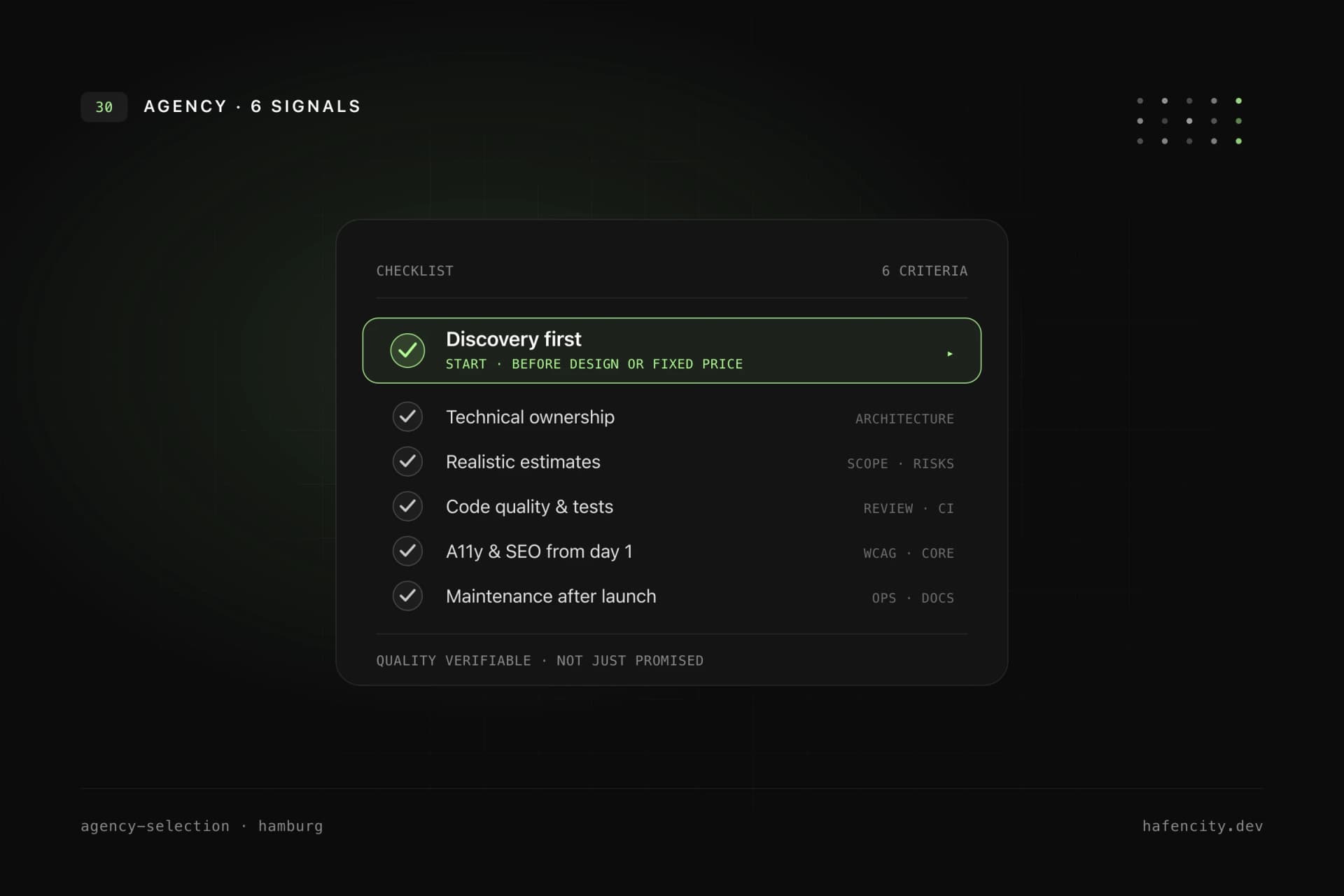
Software Agency Hamburg: How to Spot a Good One in 2026

Most software projects don't fail at the code — they fail at unclear requirements. The Standish CHAOS report puts the success rate at roughly 31%, which makes the agency you pick your single biggest risk lever. Here's how to recognize a good software agency in Hamburg in 2026: discovery, verifiable quality, honest pricing and ownership beyond launch.

SEO

Updated Jun 29, 2026

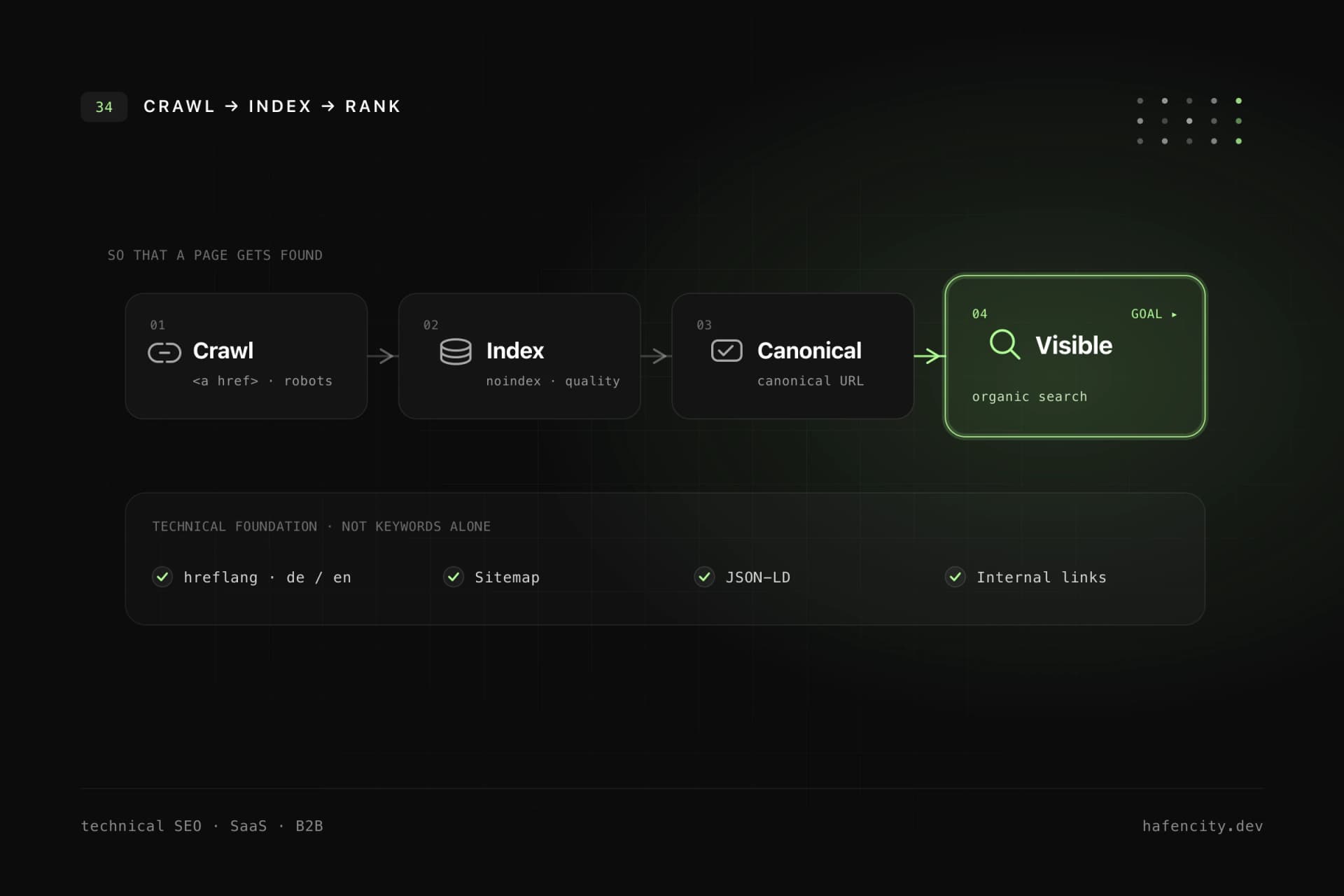
Technical SEO for Software Companies: Why Keywords Are Not Enough in 2026

For SaaS, B2B and software teams, technical SEO is more than keyword research — and in 2026 it matters more than ever. When roughly one in five searches now shows an AI summary, clicks on classic results drop from 15 to 8 percent. Visibility belongs to pages that are crawlable, cleanly indexed, fast and structured. We walk through the technical foundation — with current numbers.

Business

Updated Jun 29, 2026

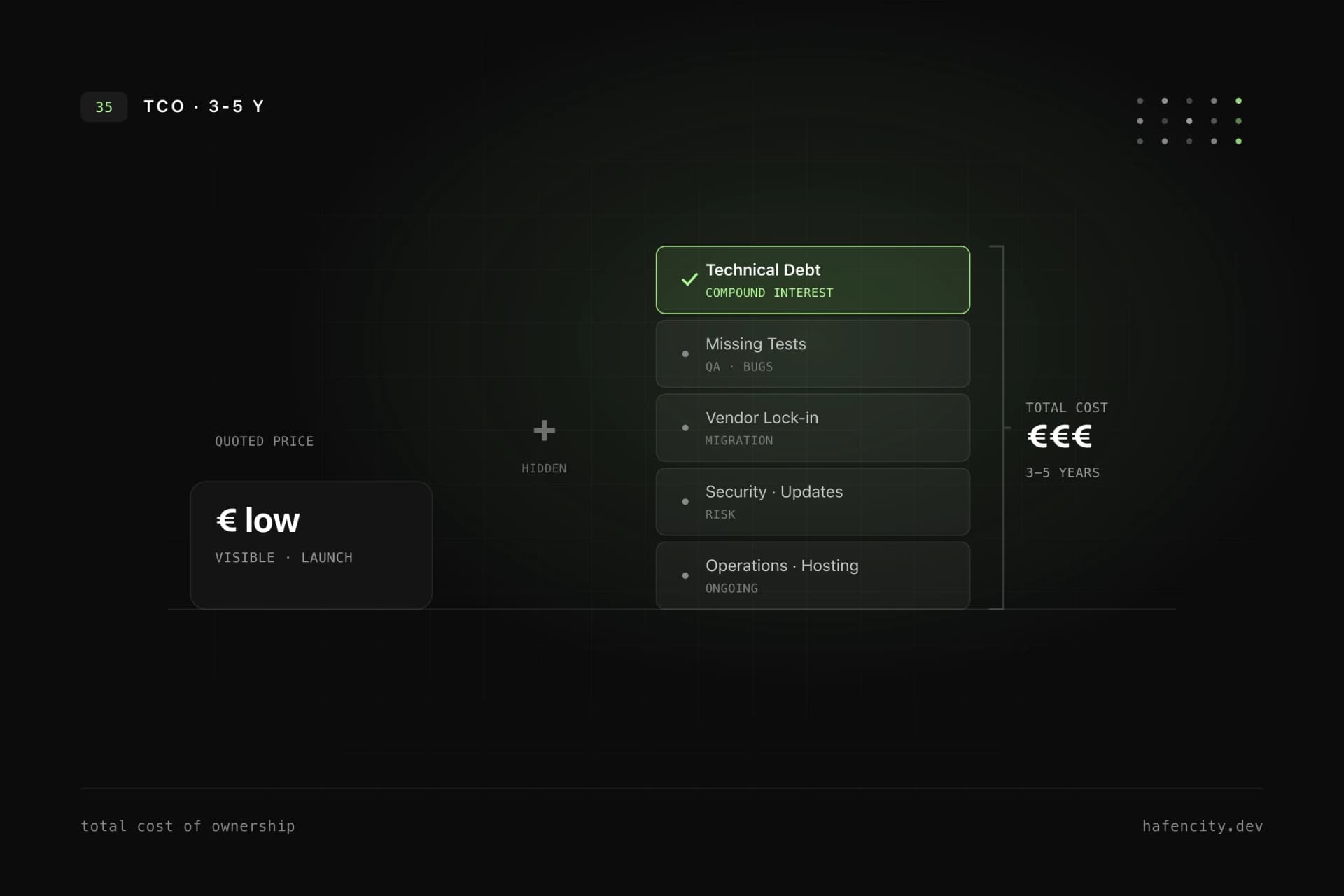
Why Cheap Software Becomes Expensive – the Real Cost

A low fixed price is tempting – but rarely the full bill. With current figures, we show why money saved on tests, architecture, security and operations comes back later, when a lean start is still right, and which questions to ask before you decide.

Hamburg

Updated Jun 29, 2026

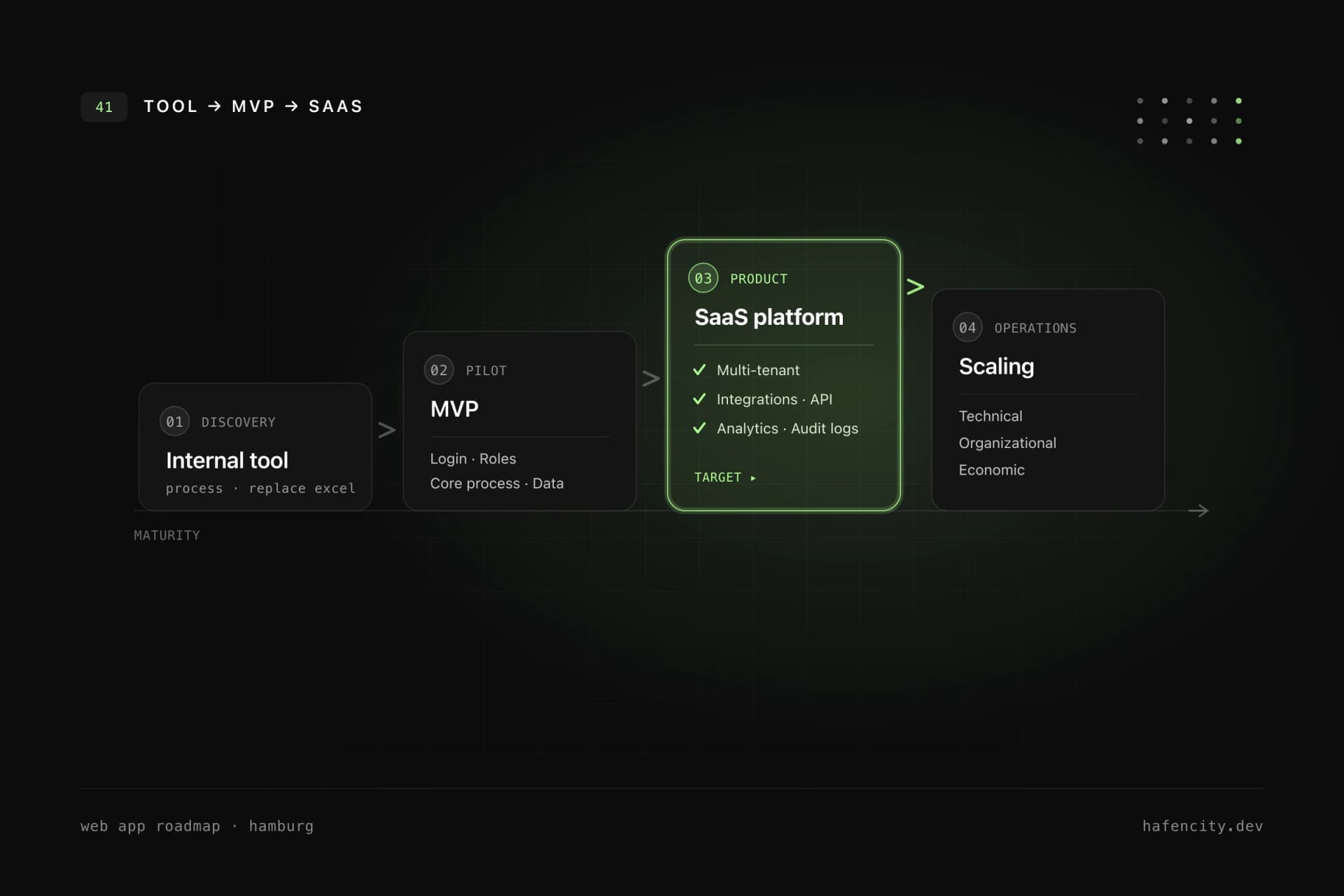
Web App Development Hamburg 2026: From Internal Tool to SaaS Platform

Few SaaS platforms start as platforms. They begin as an internal tool, a portal or an MVP — and grow from there. We map the path from prototype to a resilient SaaS platform: build stages, realistic DACH budgets, architecture and the BFSG accessibility duty in force since June 2025.

Web-App

Updated Jun 29, 2026

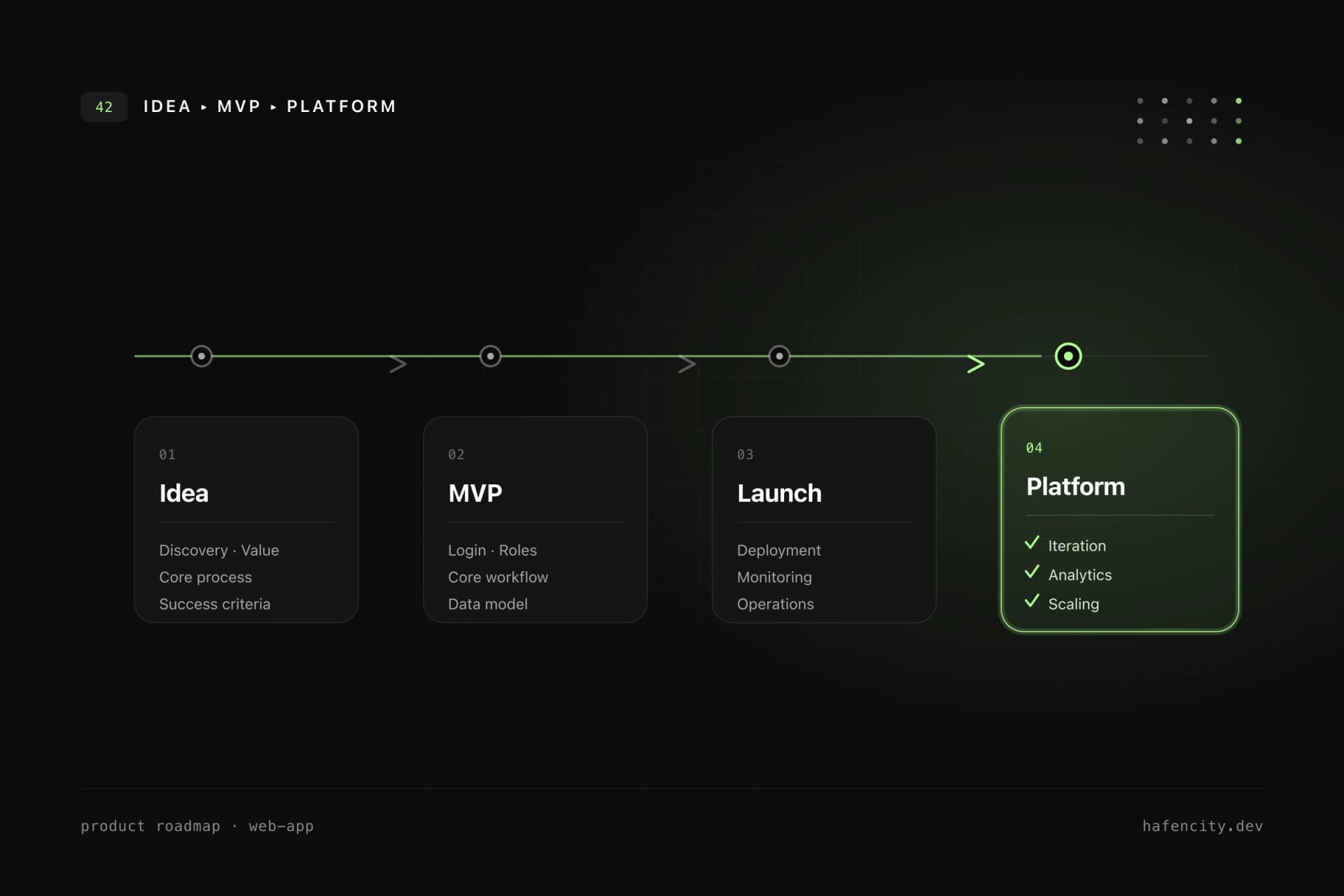
Web App Development 2026: From Idea to Platform

Only around 31% of software projects count as successful — small, tightly scoped releases win. We walk the path from idea to MVP to an operated platform: scope discipline, a solid foundation, accessibility compliance and an operating model that scales with you.

Business

Updated Jun 29, 2026

Website Cost in 2026: Agency, Freelancer, Builder or Team?

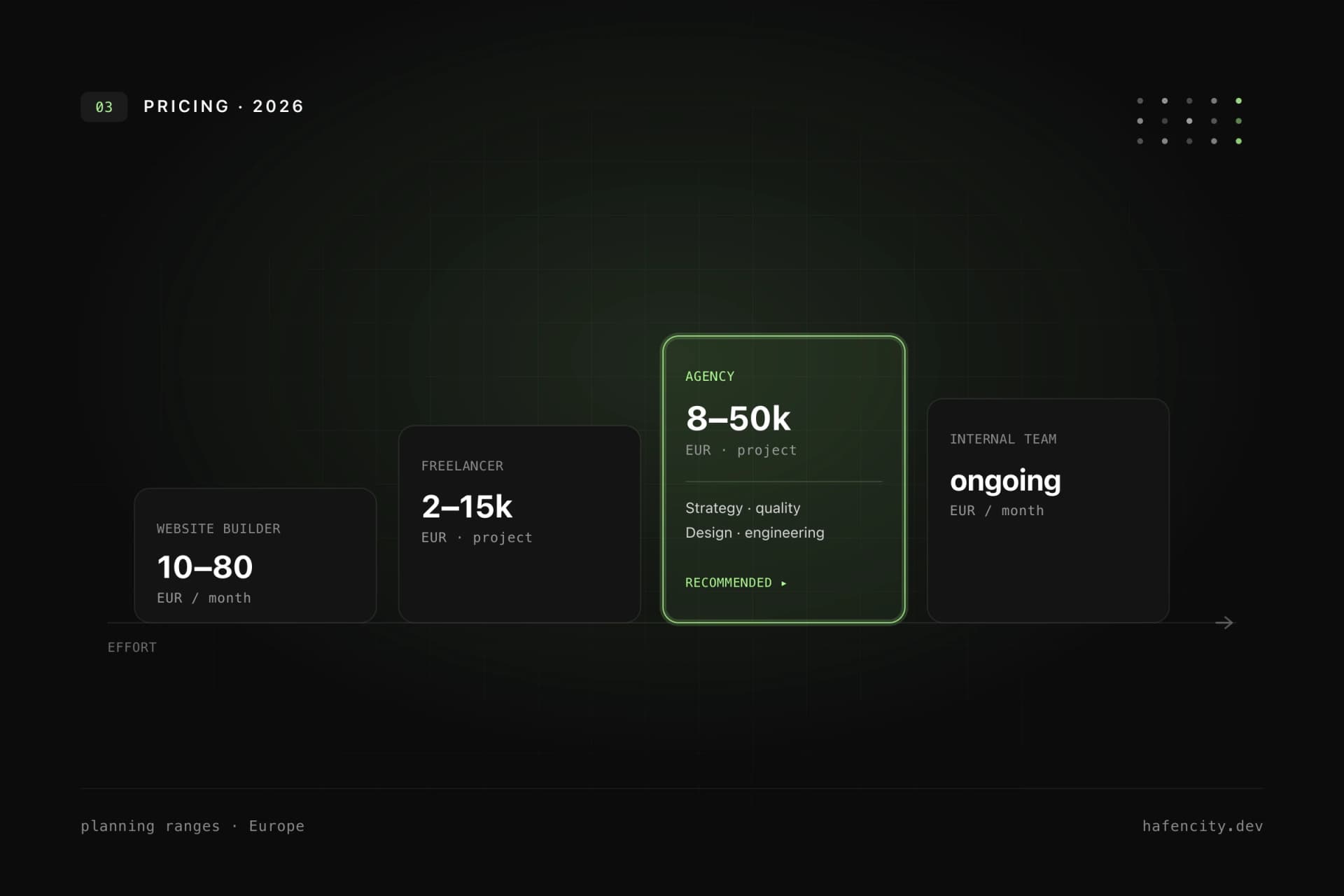
What a professional website realistically costs in 2026, how agency, freelancer, website builder and internal team budgets compare, and which line items most budgets miss — from hourly rates to the new accessibility obligation.

SEO

Updated Jun 29, 2026

Website Relaunch Hamburg: SEO, Performance & Tech in 2026

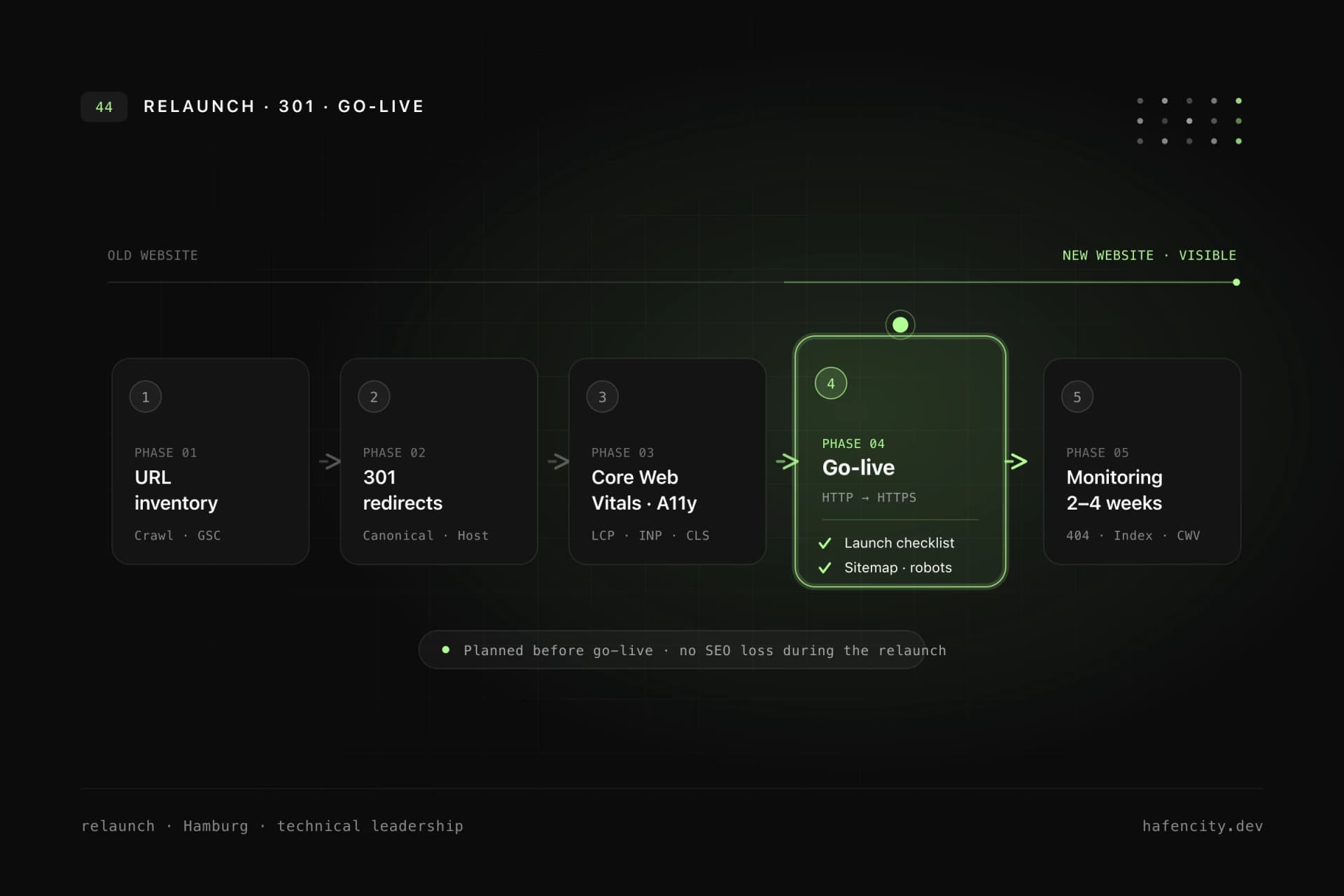
A website relaunch is not a design project, it is a technical SEO project. We show how to plan inventory, redirects, canonicals, Core Web Vitals, accessibility and monitoring before go-live, with current thresholds and sources for 2026.

SEO

Updated Jun 29, 2026

Website Relaunch Without Losing SEO: 2026 Checklist for Redirects, Sitemap and Monitoring

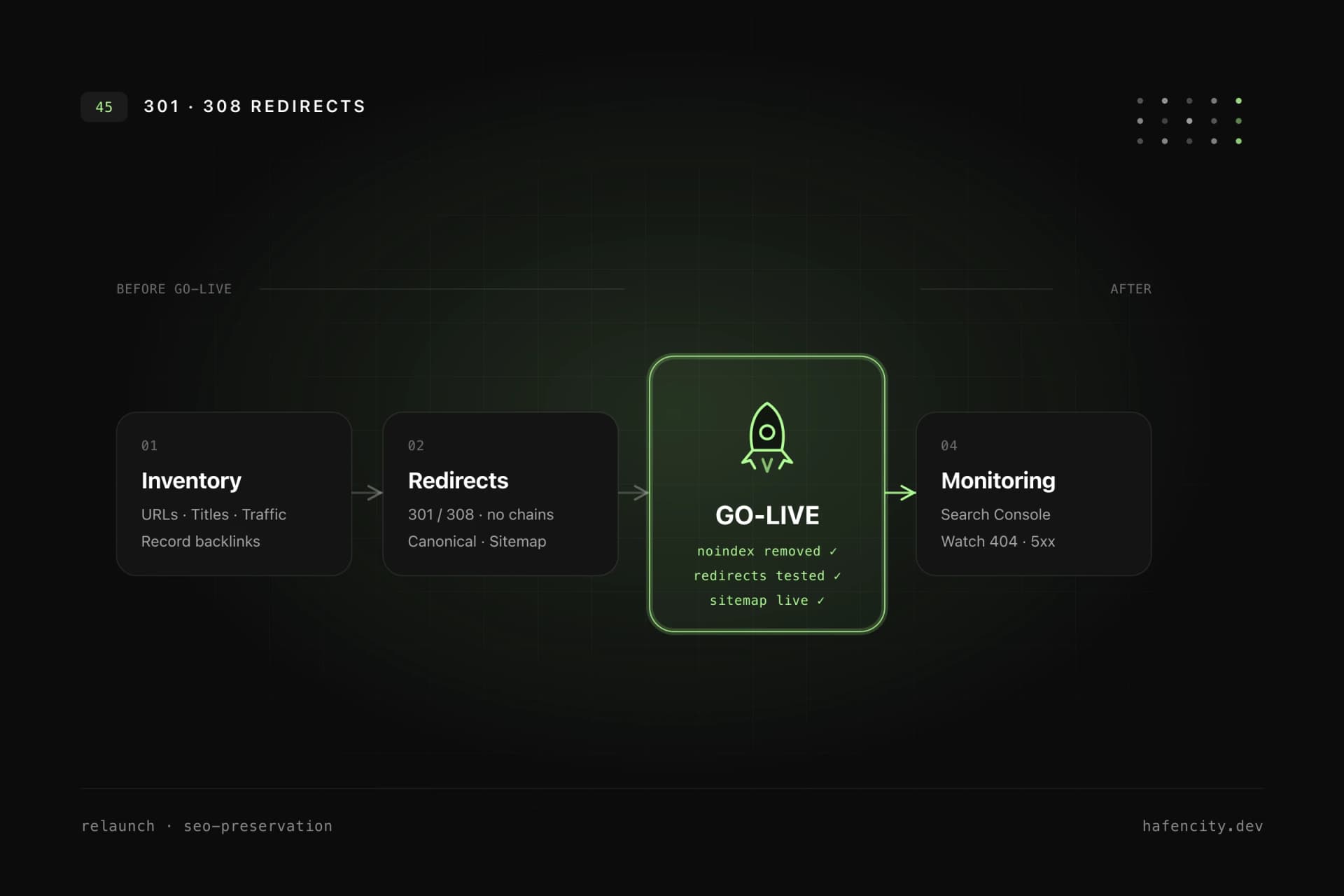
A website relaunch does not have to cost rankings. The critical work is a complete inventory, clean 301/308 redirects without chains, a clear canonical domain, a consistent sitemap and Search Console, plus disciplined monitoring in the first weeks after go-live.

Engineering

Updated Jun 29, 2026

Quality Is Measurable: Performance, Accessibility and SEO in 2026

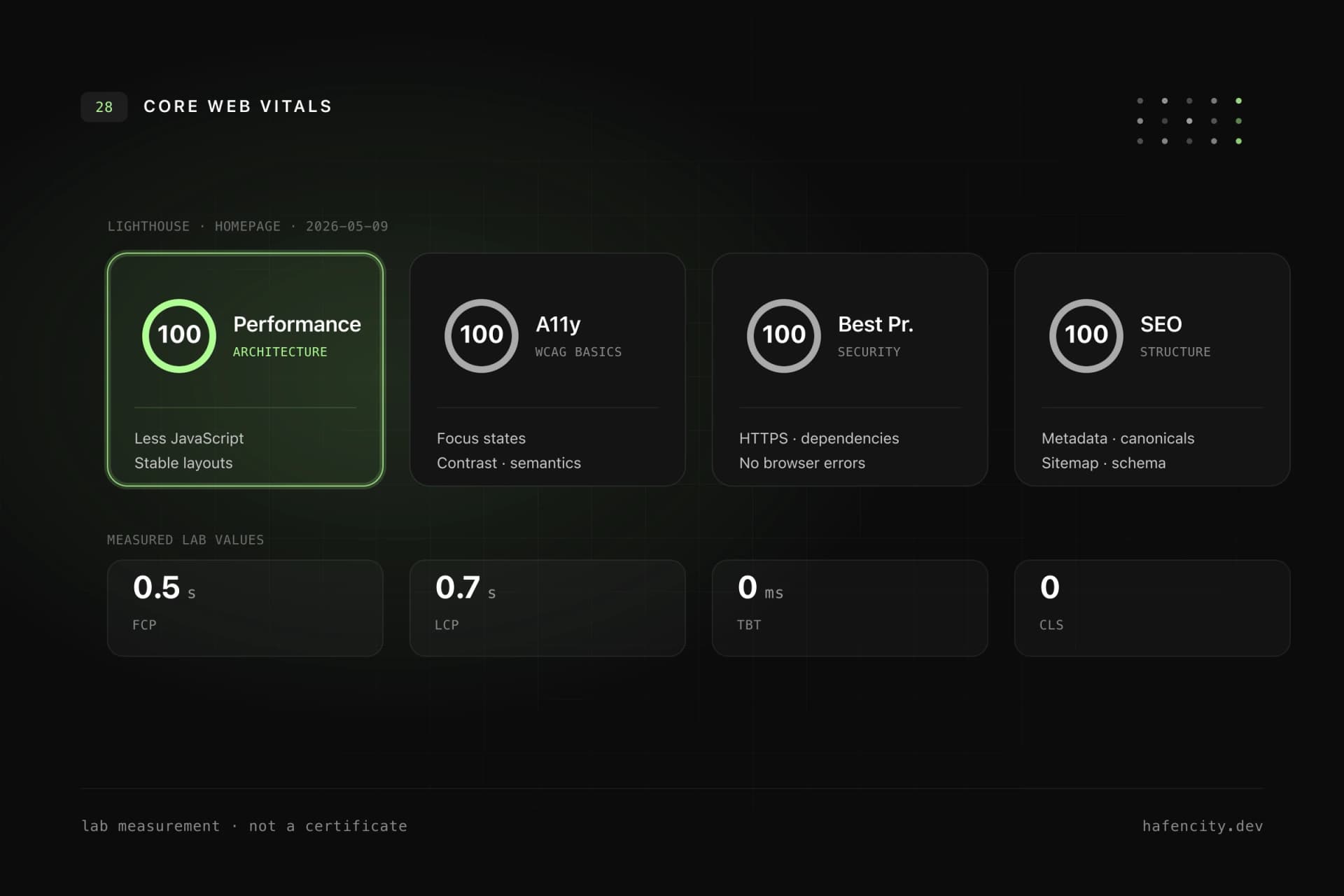
Many agencies claim performance, accessibility and SEO – few make them verifiable. We show the hard thresholds that define quality in 2026, why accessibility has been mandatory since June 2025 and what a Lighthouse score of 100 actually proves.

AI

Updated Jun 29, 2026

AI in Software Development 2026: Ship Faster

In 2026 around 90% of developers use AI daily and over 80% feel more productive – yet in a controlled trial experienced developers were 19% slower. Both findings are true. With current data, we show where AI really accelerates software development, where the bottleneck moves, and how to make the gain measurable.

AI

Updated Jun 29, 2026

AI Coding with Codex and Claude: A 2026 Field Guide

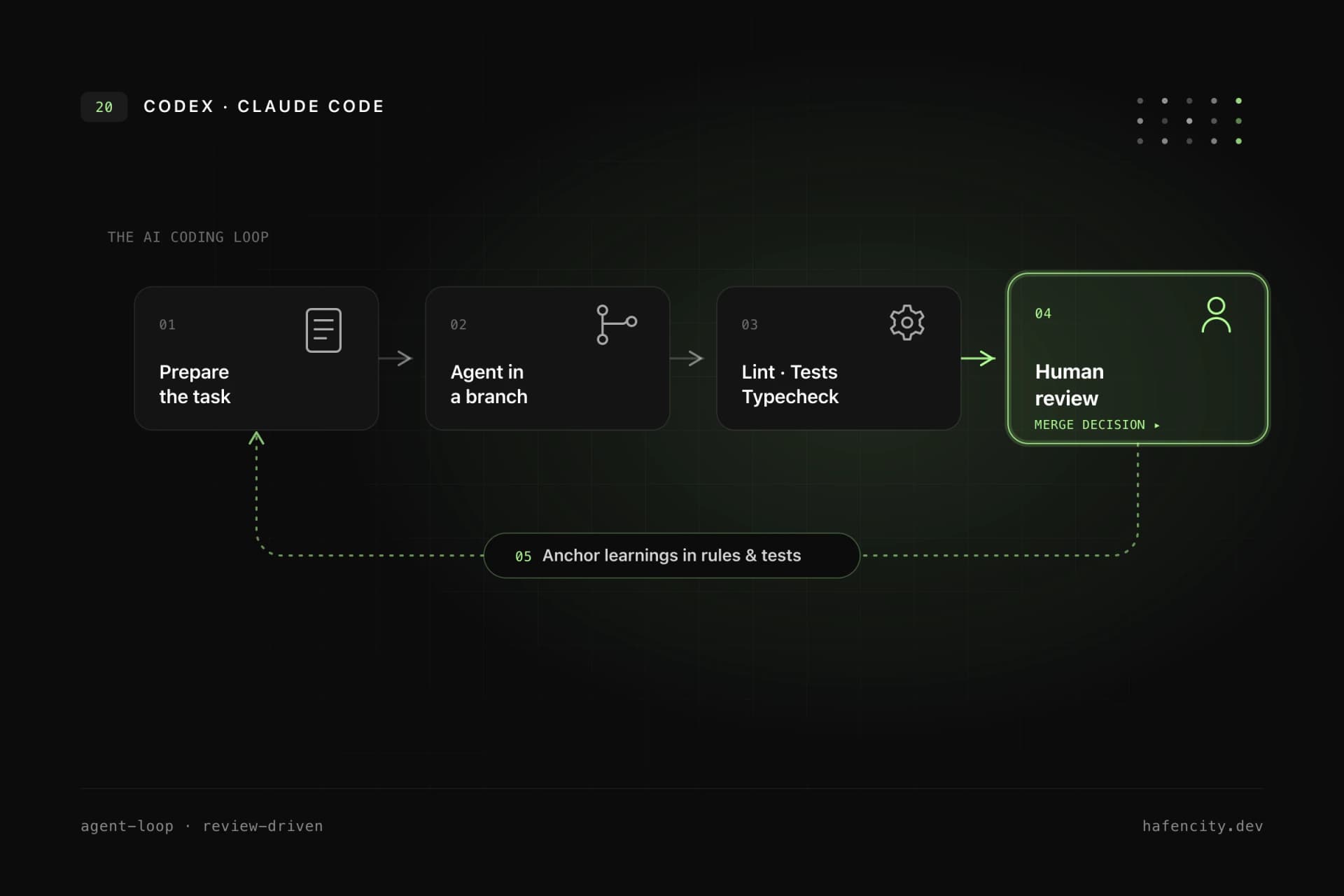
AI coding is the norm in 2026: around 90% of teams use AI in development. But the key DORA finding isn't "faster" — it's "amplifier". We compare Codex and Claude Code with current pricing, put the numbers in context, and show the workflow that combines speed with quality.

AI

Updated Jun 29, 2026

Managing AI Risk in Software Projects: Governance 2026

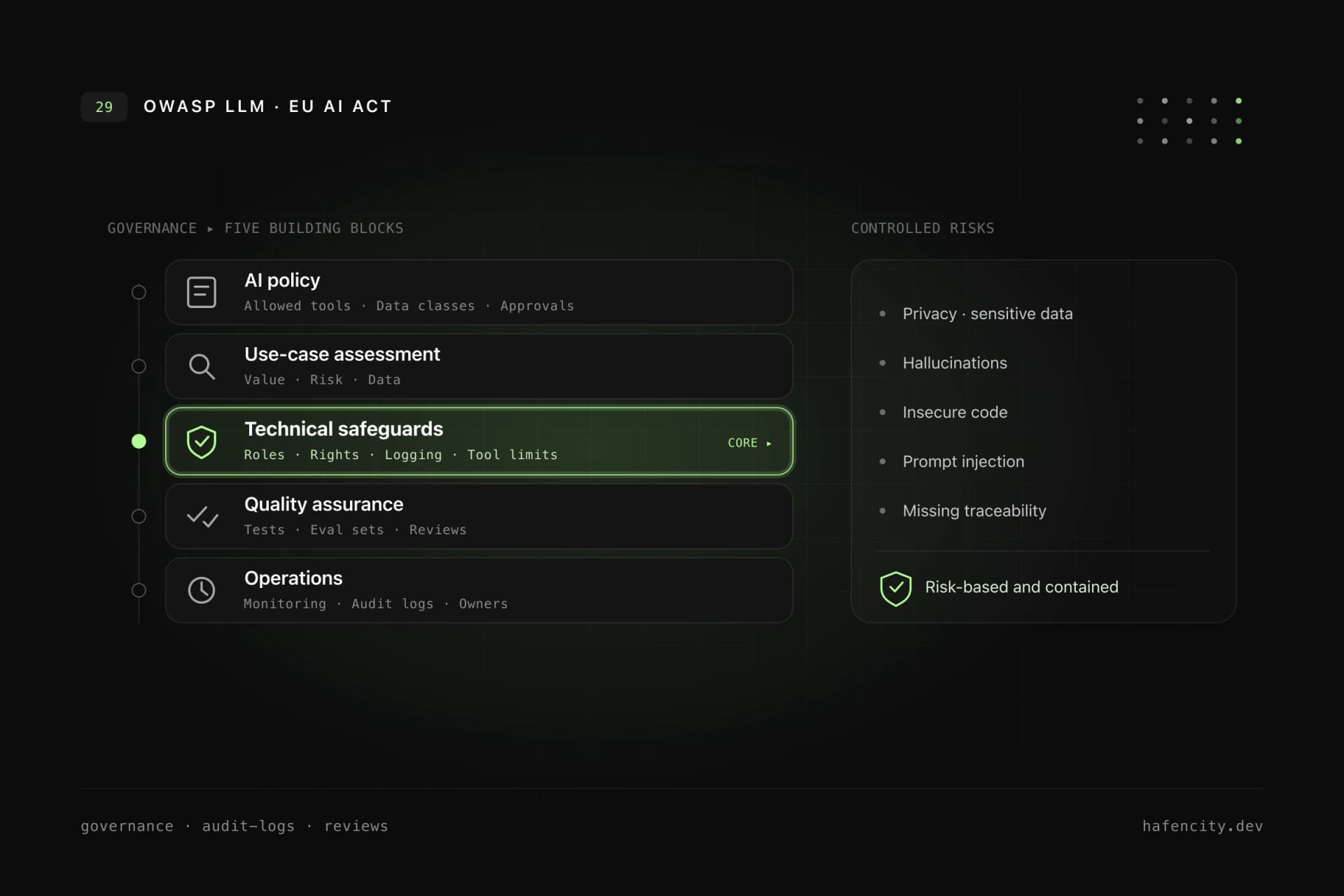
AI brings speed to software projects — and shifts the risk to places traditional processes rarely control: 45% of generated code carries a vulnerability per Veracode, and prompt injection tops the OWASP Top 10 for LLMs. We map the five risk categories, the updated EU AI Act timeline, and a governance model that works in daily practice.

AI

Updated Jun 29, 2026

Why Skipping AI Is Becoming a Business Risk in 2026

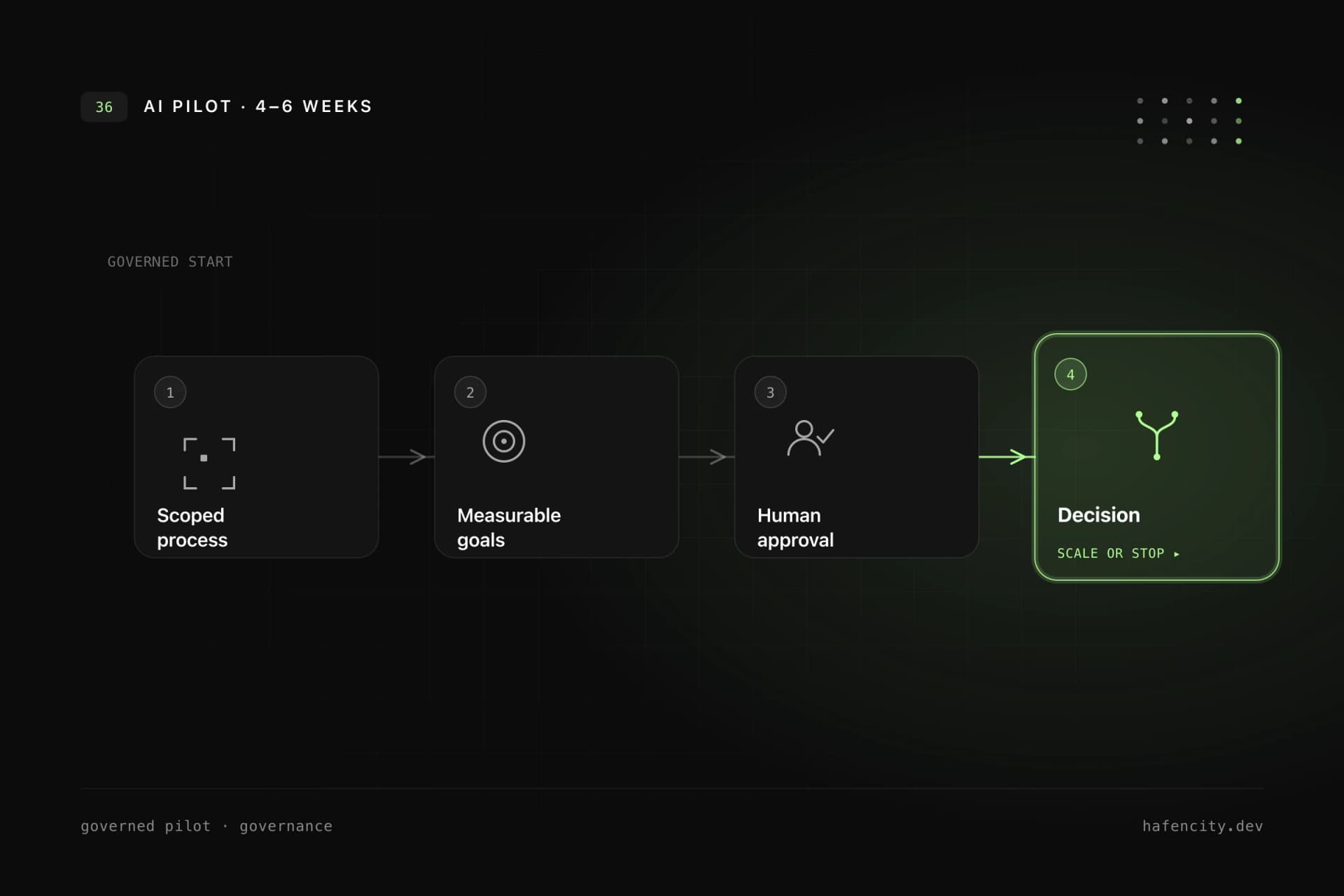
Avoiding AI can feel safe, but it is becoming a competitive risk. While companies wait, others build process knowledge, learning curves and governance routine. We show with current numbers where non-adoption gets expensive — and what a cleanly governed start looks like.

Accessibility

Updated Jun 29, 2026

BFSG 2026: Accessible Website & App – Your WCAG Checklist

Since 28 June 2025 the German Accessibility Act (BFSG) has been in force – and according to the WebAIM Million 2026, 95.9% of all home pages still fail automated WCAG tests. We show who is affected, why accessibility overlays don't solve the problem and how WCAG 2.2 sets the technical bar for real accessibility.

AI

Updated Jun 29, 2026

AI Agents in the Enterprise: Automating Processes in 2026

AI agents are at the peak of the hype in 2026 — and Gartner expects more than 40% of projects to be cancelled by 2027. We show which processes genuinely fit, what governance you need, what the Digital Omnibus changes about the EU AI Act, and how a serious start looks in 90 days.

Web App

Updated Jun 29, 2026

Custom Web App Development 2026: Cost, Timeline, Architecture

A web app is not a larger website project. It is a product with a data model, permissions and operations. With current DACH figures, we show what development costs in 2026, how long it takes and which architecture decisions shape the budget early.

App

Updated Jun 29, 2026

Agency vs. FlutterFlow 2026: When does custom development pay off?

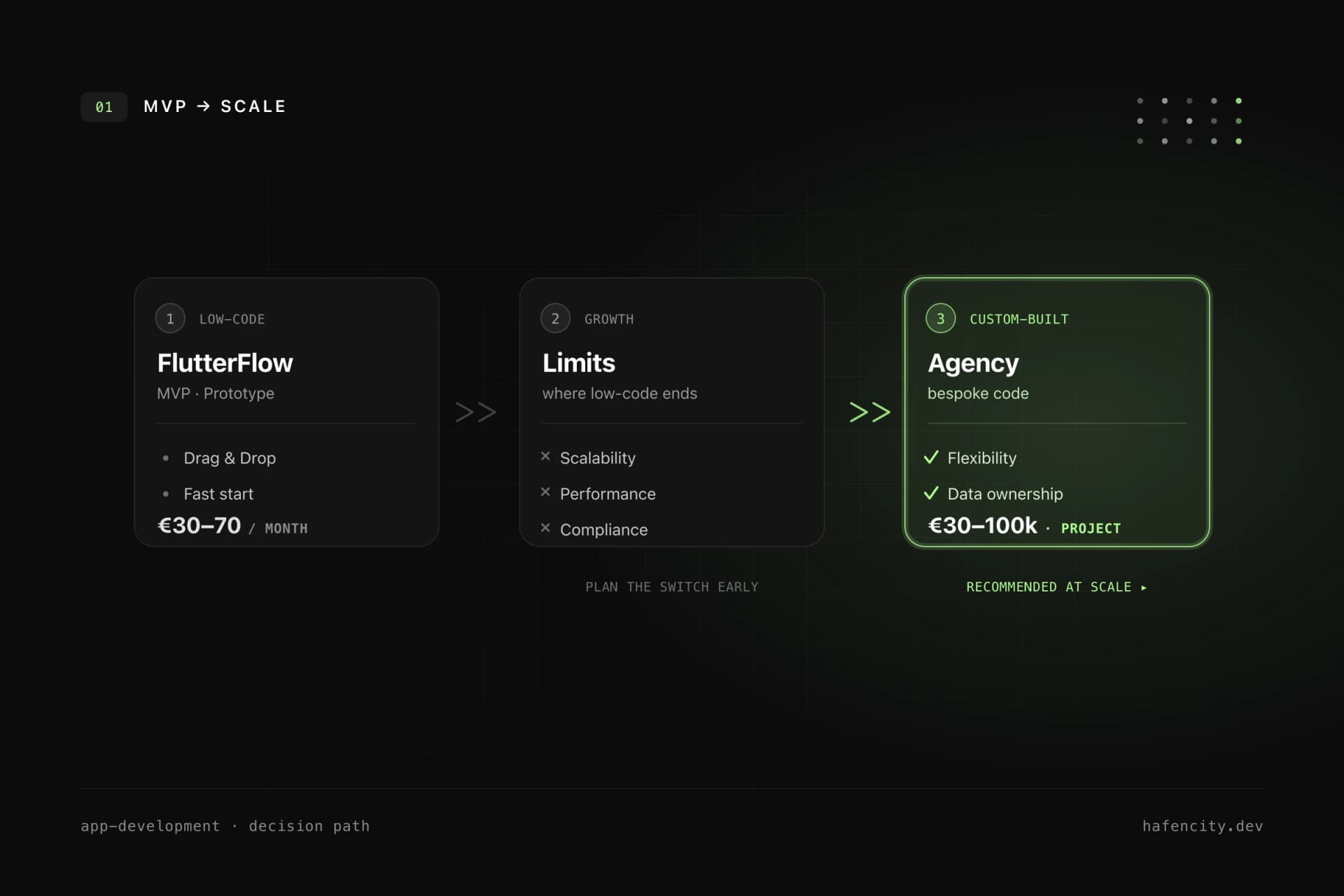
FlutterFlow is no longer a toy in 2026: the tool generates real Flutter/Dart code you can export. The honest question isn't "no-code or real code" but where the platform's leverage ends and custom development starts to pay off. We compare cost, lock-in, compliance and the pragmatic middle path — with current numbers.

App

Updated Jun 29, 2026

App Development in Hamburg 2026: How Startups Take Off with Local Expertise

Hamburg is Germany's third-largest startup ecosystem — with 1,540 active startups, targeted IFB funding and short distances. With current numbers, we show what app development really costs here in 2026, which stack fits, and why local proximity is a real lever.

App

Updated Jun 29, 2026

The Business Case for Flutter 2026: 5 Reasons for Companies

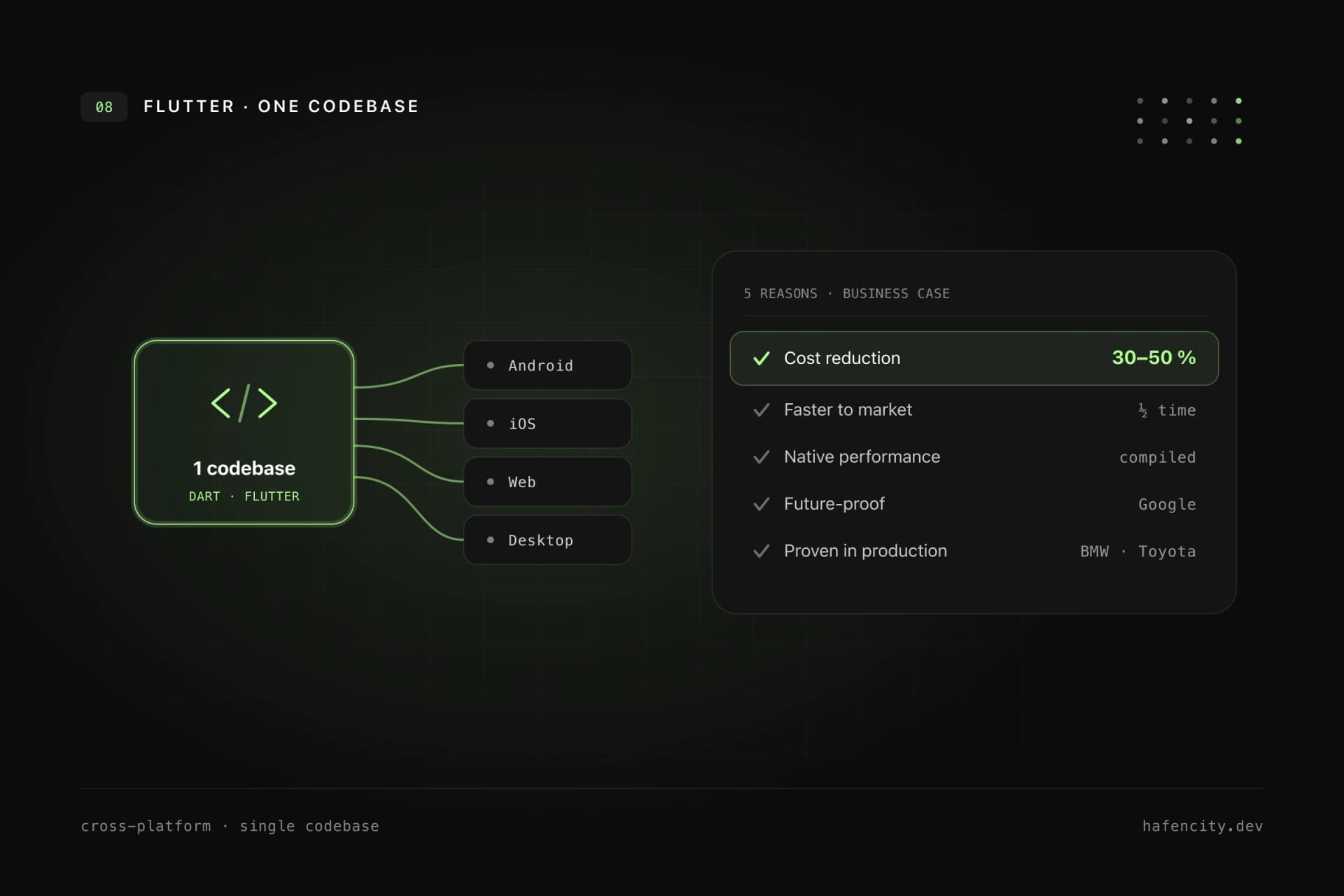
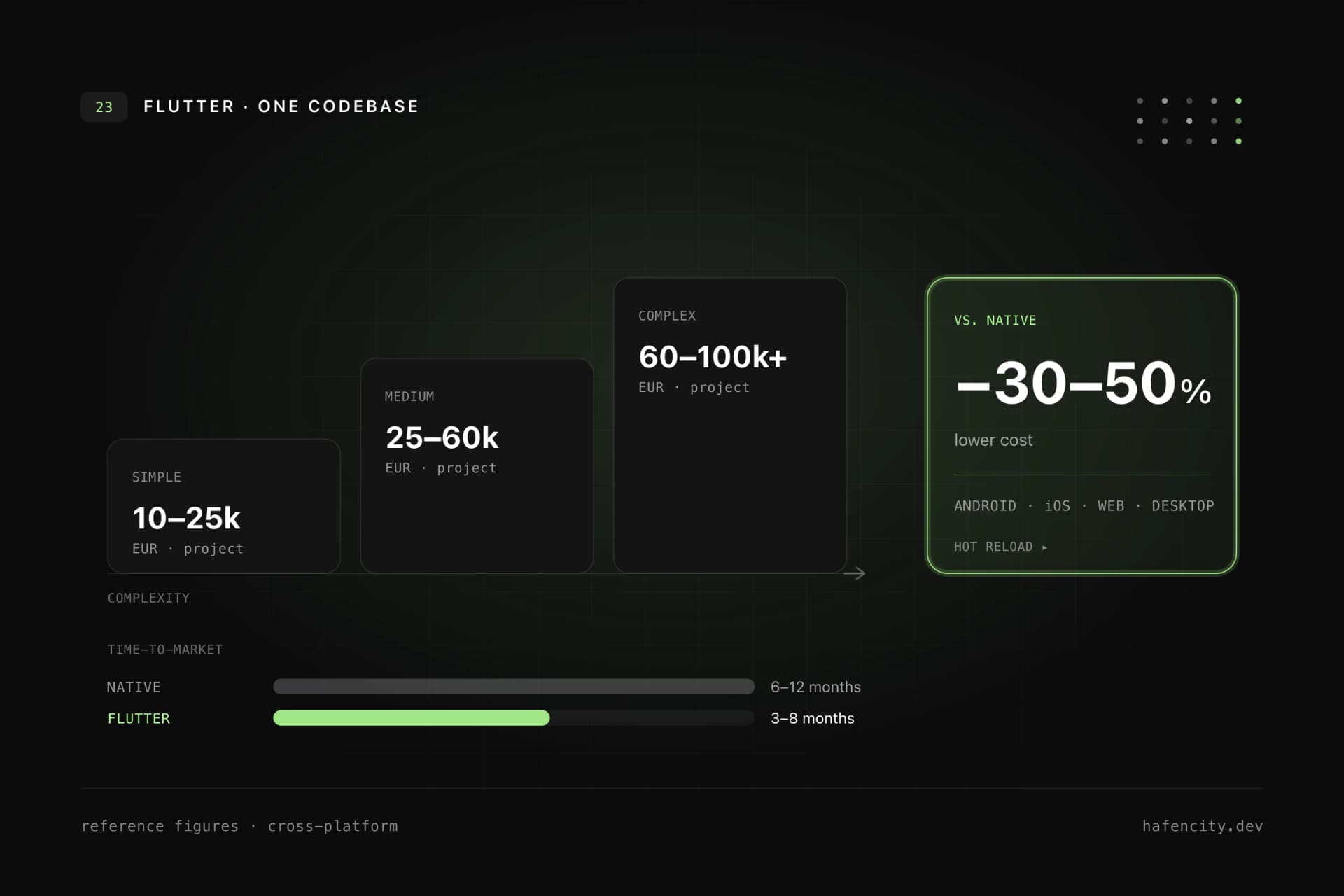
Flutter is no longer a gamble in 2026 — it's the most-used cross-platform approach. We work through the business case: how one codebase saves 30–50% in cost, why performance now matches native, and what Google Pay, BMW and Alibaba have actually achieved with it.

App

Updated Jun 29, 2026

The Best Firebase Alternatives 2026: 5 Strong Options

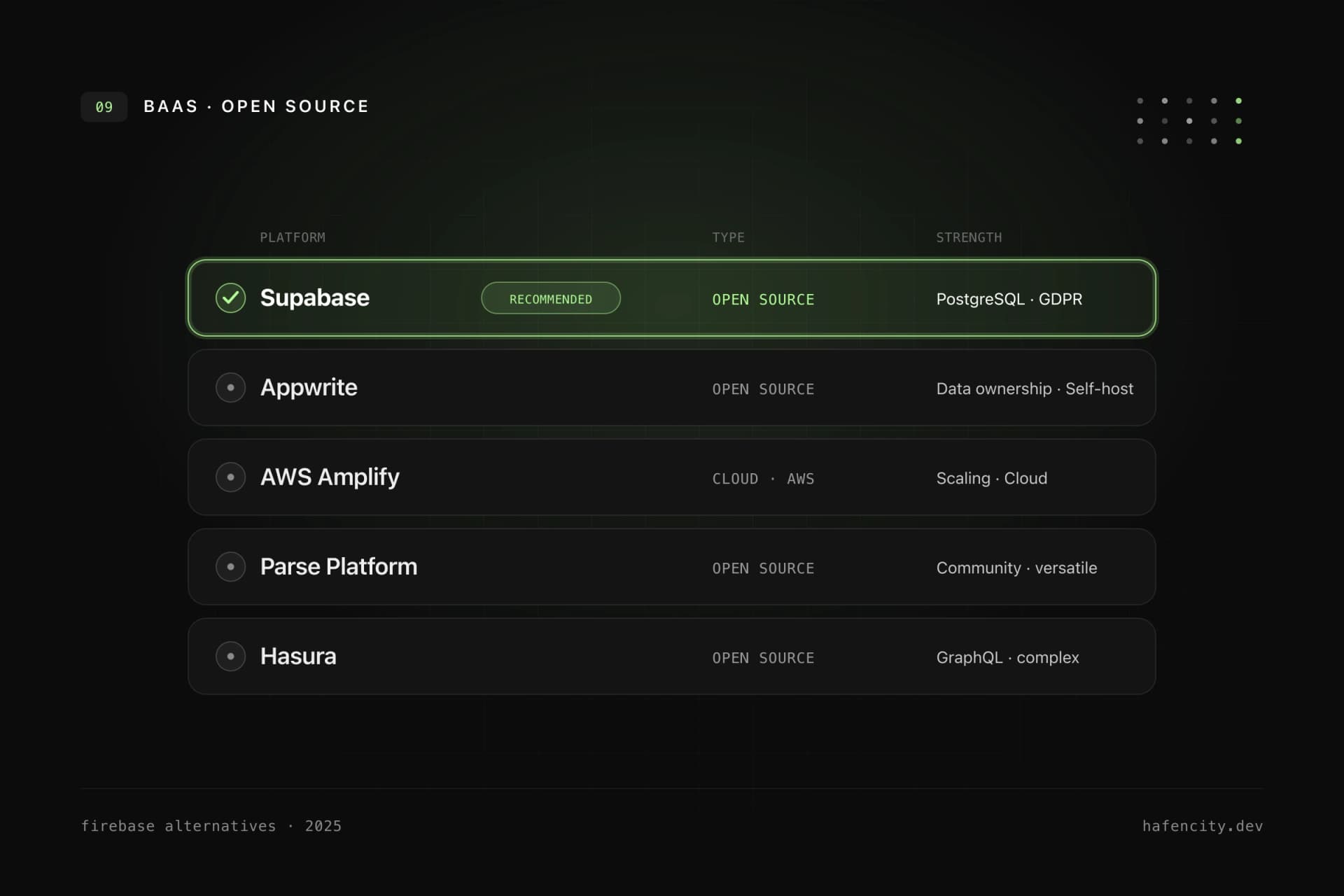
Firebase is quick to set up — but once cost, data sovereignty and scale come into play, it pays to look at alternatives. We compare Supabase, Appwrite, AWS Amplify, Convex and PocketBase with current pricing (as of June 2026) and say when each platform is the better choice.

Modernization

Updated Jun 29, 2026

The Time Machine: Why Digital Products Are Stuck in the Past

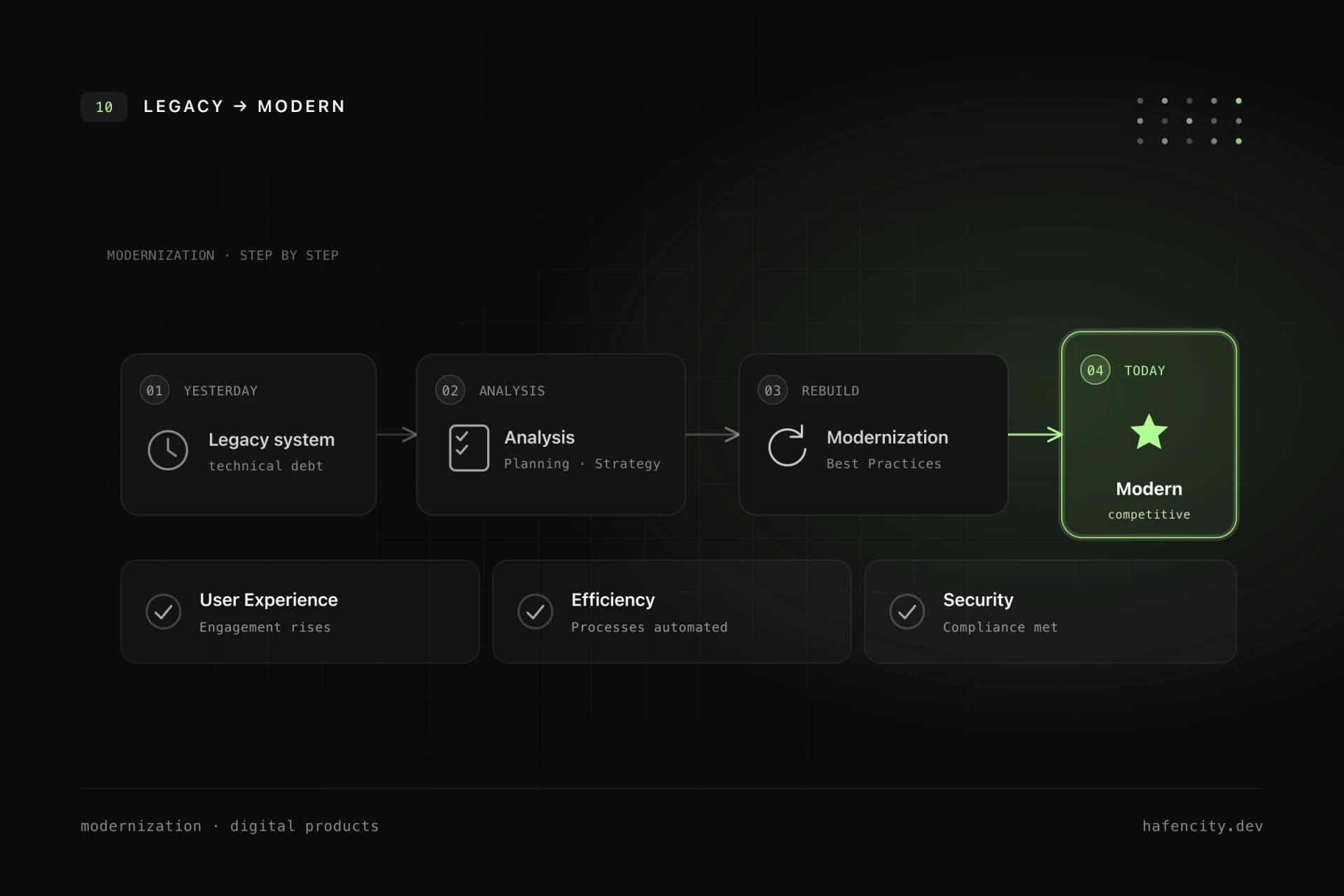
"It still works" is the most expensive assumption in product management in 2026. McKinsey puts technical debt at 20–40% of technology value, the BFSG and EU AI Act set hard deadlines — and a big-bang rewrite is rarely the answer. We show why digital products get stuck in the past and how incremental modernization actually works.

App

Updated Jun 29, 2026

Flutter in 2026: Where the framework really stands — and who it fits

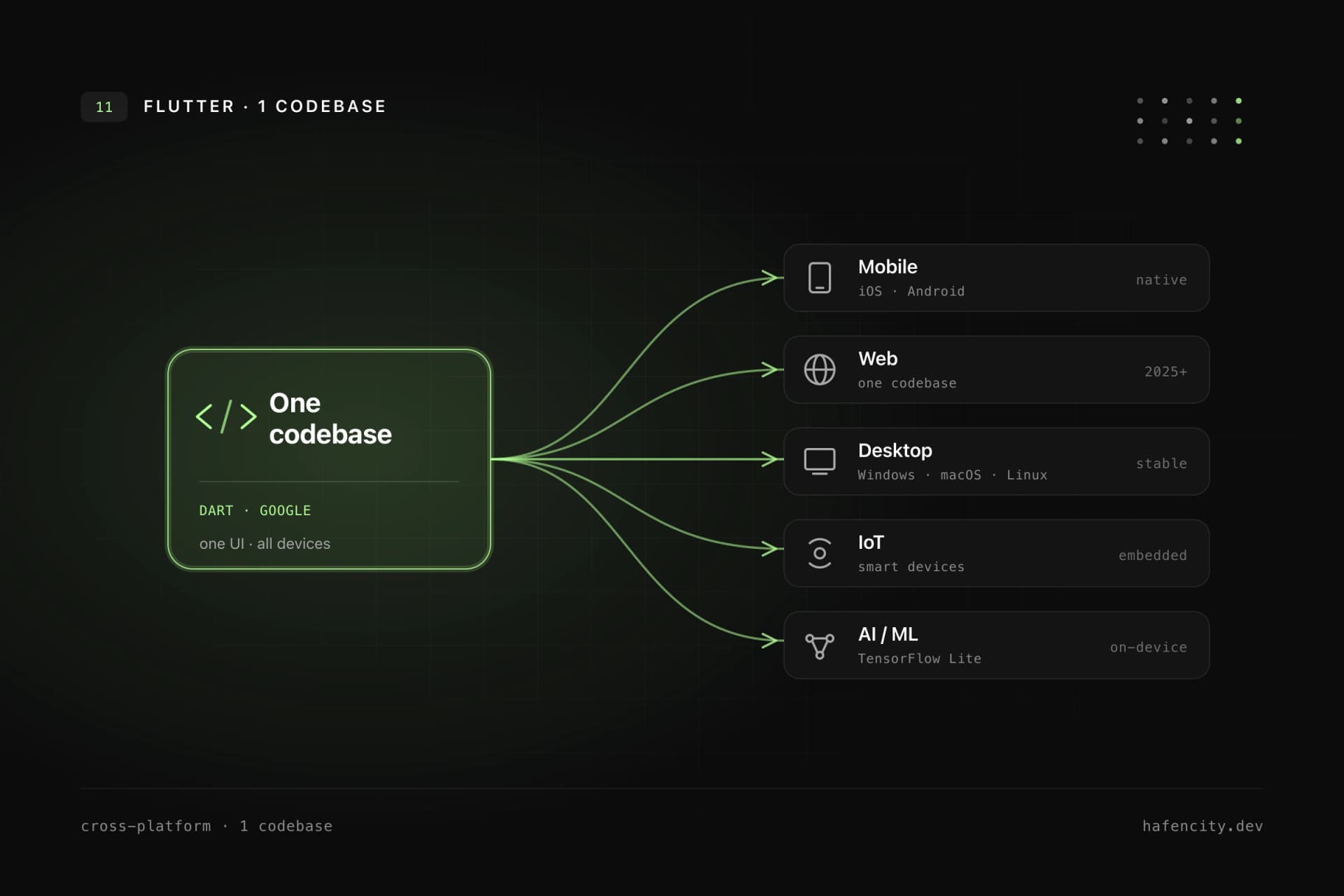
"Flutter is the future" was a marketing line for years. In 2026 the sober view is more useful: Flutter 3.44, production-ready web via WebAssembly, stable desktop and on-device AI. We show where Flutter is genuinely strong today, what it costs in the DACH market — and when React Native or native is still the better call.

Backend

Updated Jun 29, 2026

Firebase vs. Supabase 2026: Which platform fits your app?

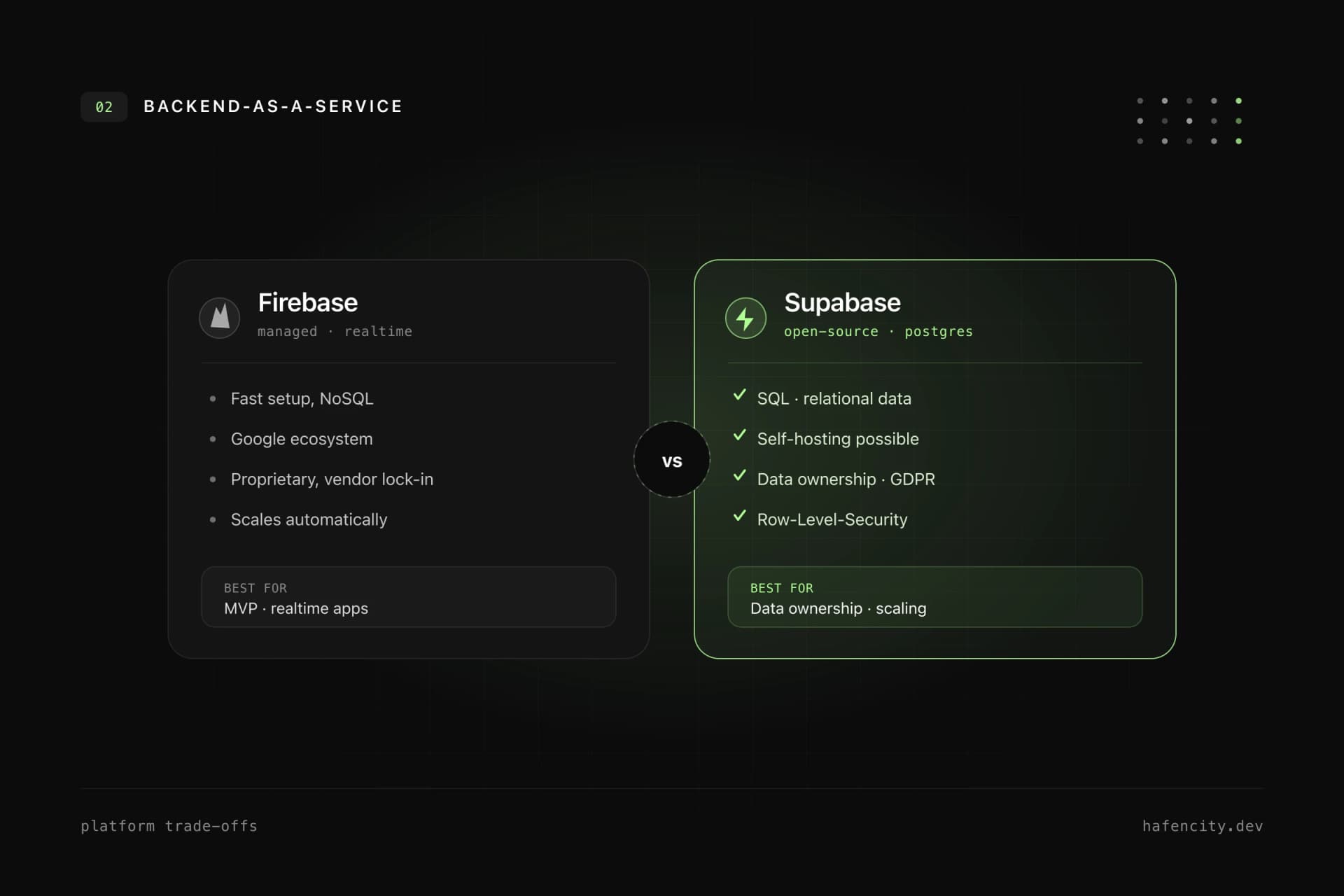
The old rule of thumb — "Firebase is NoSQL, Supabase is Postgres" — no longer holds in 2026: with Firebase SQL Connect there is now a full PostgreSQL database behind Firebase too. We compare data model, cost model and data sovereignty with current numbers — and say when each platform is the better choice.

App

Updated Jun 29, 2026

Flutter vs. React Native vs. Native 2026: Which one fits?

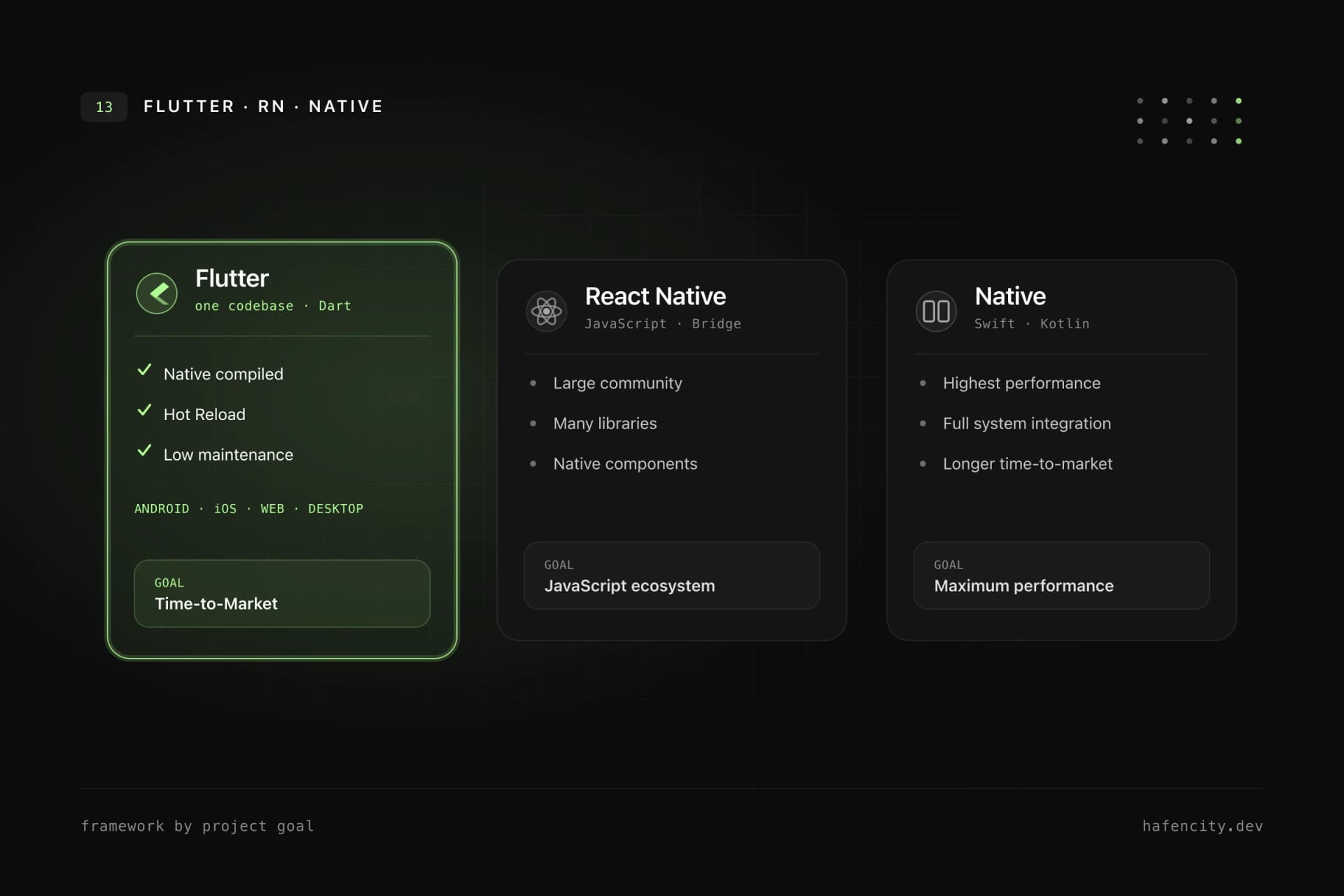
The old rule of thumb — "cross-platform is slower than native" — no longer holds in 2026: React Native has removed the bridge, Flutter renders with Impeller. We compare performance, cost and maturity with current numbers — and say when each technology is the better choice.

App

Updated Jun 29, 2026

What does a Flutter app cost in 2026? Cost and time savings

"Up to 50% cheaper" sounds great — but does it still hold in 2026? We do the honest math: realistic price ranges for a Flutter app in the DACH market, where the savings over native development really come from, and when a shared codebase loses its edge.

App

Updated Jun 29, 2026

Software Development Hamburg 2026: Web & App for Startups and SMEs

Hamburg is Germany's third-largest startup ecosystem after Berlin and Munich — with 1,540 active startups and a record year for new foundings. With current numbers, we show what web and app development really costs here, which stack holds up in 2026, and which obligations the BFSG now brings.

Backend

Updated Jun 29, 2026

What is Firebase? The complete 2026 overview

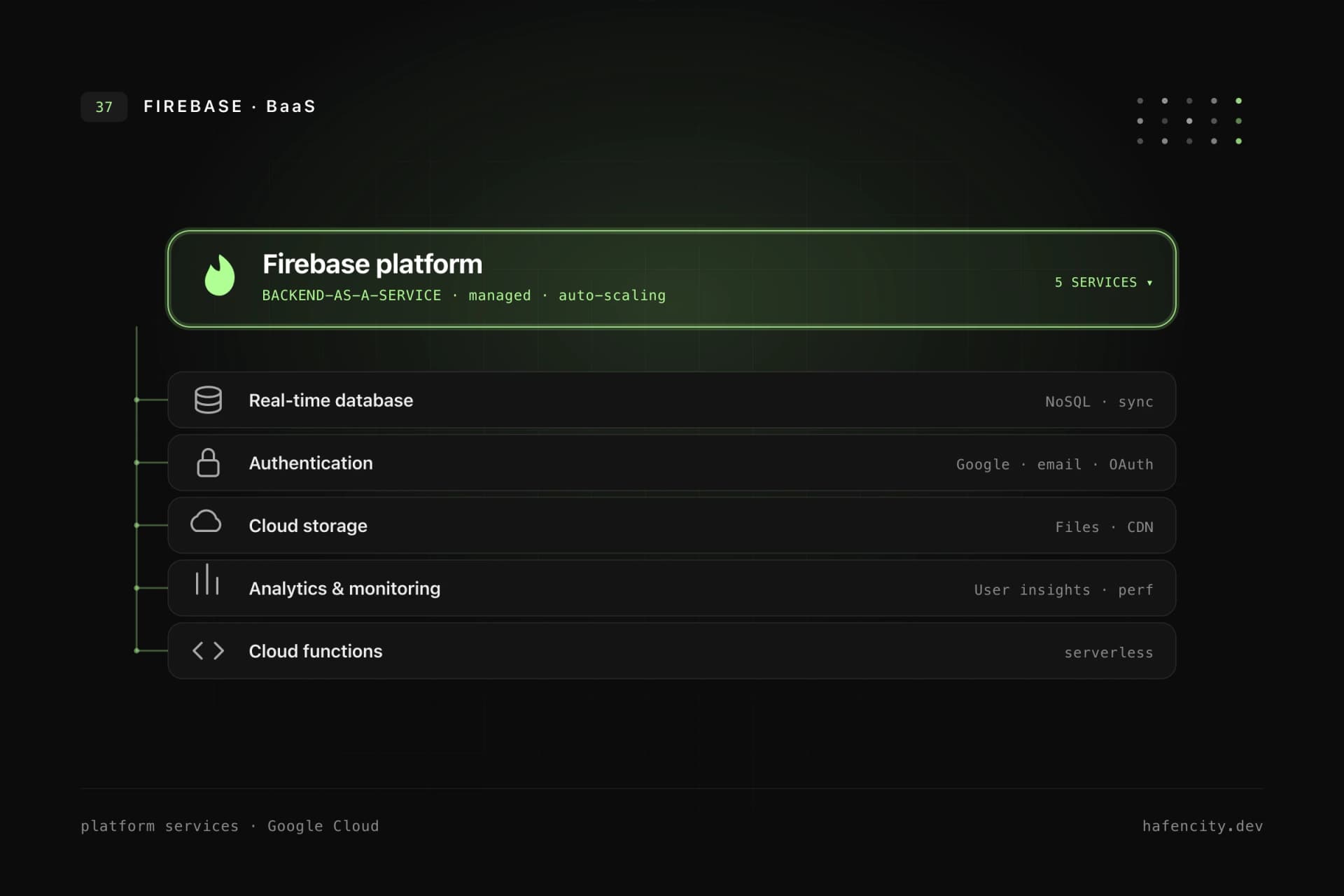
Firebase is Google's Backend-as-a-Service: ready-made building blocks for auth, database, storage and functions that get small teams live in hours instead of weeks. A lot shifted in 2026 — SQL Connect brings PostgreSQL, AI Logic brings Gemini, and the AI builder Firebase Studio is being sunset. We explain what Firebase really is, what it costs and when it fits.

App

Updated Jun 29, 2026

What is Flutter? Apps for every platform in 2026

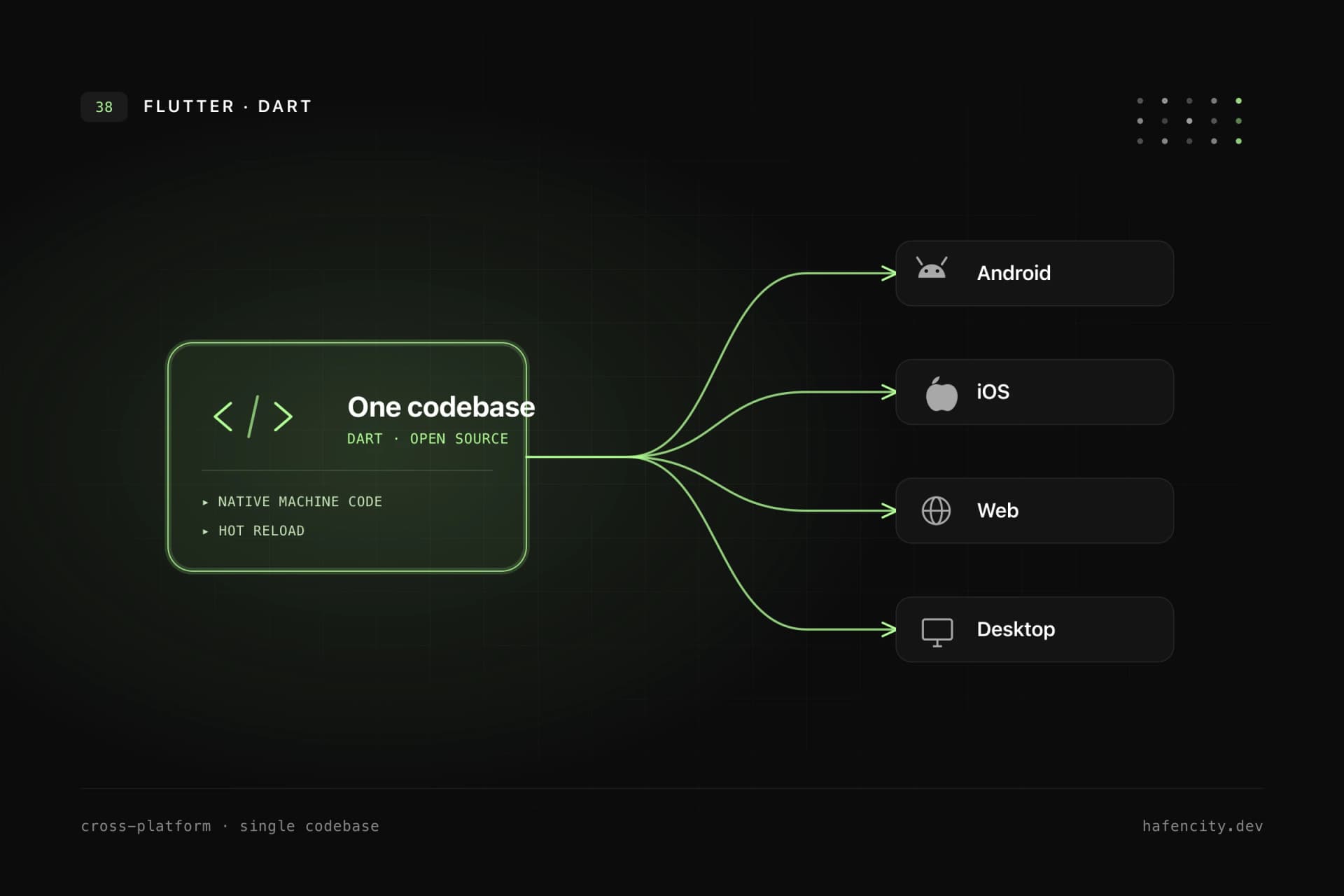
Flutter is Google's open-source framework for apps on iOS, Android, Web and desktop — from a single codebase. We explain what actually matters in 2026 with Flutter 3.44: platform reach, realistic costs in the DACH region, and the limits worth knowing before you start.

Backend

Updated Jun 29, 2026

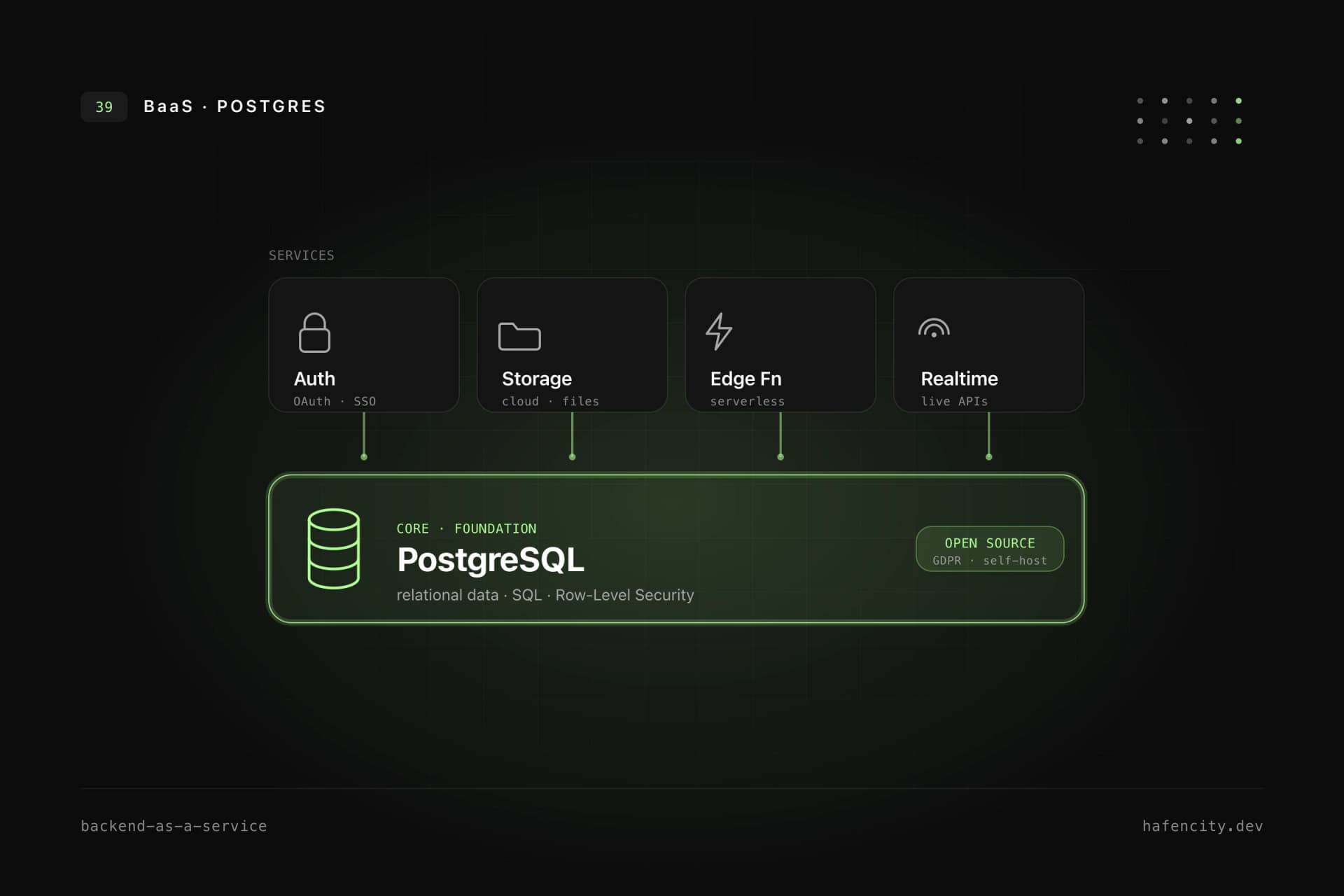
What is Supabase? The open Postgres platform explained

Supabase is no longer an insider tip in 2026: an open-source platform that wraps a full PostgreSQL database with ready-made building blocks — auth, APIs, storage, realtime and edge functions. We explain the components, the current pricing and the data sovereignty story — and say when Supabase is the right call for your project.

App

Updated Jun 29, 2026

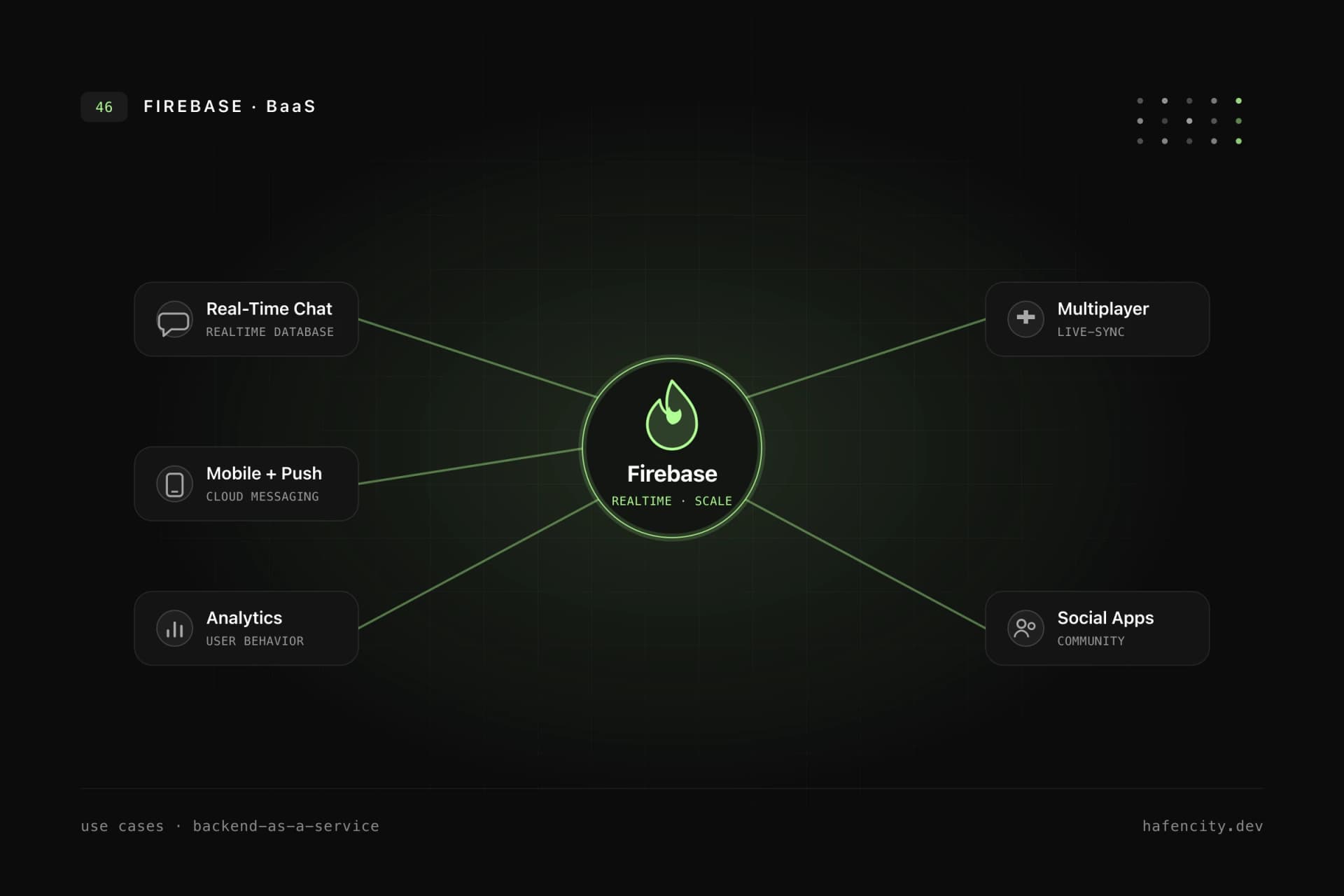
What Is Firebase Used For? Use Cases in 2026

Firebase isn't a single product but a bundle of more than 15 managed services. We walk through the use cases Firebase genuinely solves well in 2026 — real-time, auth, push, analytics and new AI features — and where a different architecture is the more honest choice.

Next steps

Let's talk about your project

Book a 30-minute discovery call. We'll review your goals, surface unknowns, and outline how we would run the engagement.

Schedule a call

Booking calendar (Cal.com)

This area embeds the external service Cal.com. By loading it you agree that a connection to Cal.com is established and data may be transferred to the USA.

Privacy policy