
Most digital products don't fail on technology — they fail on the market: according to CB Insights, lack of market need is one of the most common reasons startups fail, at around 35 percent. An MVP is built to test exactly that risk — before the entire budget goes into a product nobody needs.
An MVP, or minimum viable product, is the smallest product-like version that can test a specific risk. Not every feature that might exist later belongs in this first version. What matters is what needs to be proven: Do users want the product? Does the process save time? Does the integration work? Is the business model viable? This article shows, with current numbers, what an MVP costs in 2026, how long development takes and what a sensible roadmap with a software agency looks like.
What an MVP really is — and what it is not
An MVP is a first usable product version with deliberately limited scope — not a cheap or unfinished copy of the final product. It contains only the functionality needed to test an assumption: a web app, a mobile app, a portal or an internal workflow with real backend logic.
The key distinction is between "minimal" and "unfinished". An MVP can be small, but it must work reliably. Users should understand the value, data should be stored cleanly, and critical flows should not be improvised. A focused MVP with login, a core feature and a clear user experience is usually more valuable than a large demo that breaks in daily use. The difference from a pure prototype: a prototype simulates the experience, while an MVP has to hold up with real users.
An MVP is therefore not:
- a quickly assembled presentation without real usability
- a reason to ignore privacy, security or maintainability
- a compressed version of every feature on the wish list
What does an MVP cost in 2026?
Cost depends on scope, data model, integrations and quality expectations — not on a fixed price list. In the DACH market, agencies usually bill senior rates of €80 to €140 per hour. As a rough orientation for professional custom development:
| MVP type | Typical scope | Range 2026 |
|---|---|---|
| Validation prototype | clickable flow, some real logic, few core screens | €8,000–20,000 |
| Product MVP | login, core feature, data model, admin view | €20,000–45,000 |
| Web app MVP | roles, backend, database, email flows, deployment | €40,000–90,000 |
| Integration MVP | API connection, permissions, data import, monitoring, tests | €60,000–130,000 |
These figures are planning ranges. The trend is notable: back in 2023/24 a full web app MVP often cost €50,000 to €80,000 according to decivo. AI-assisted development has noticeably lowered entry prices since — we describe how in how AI accelerates software development. Cost still rises with sensitive data, payment logic, multiple roles or ERP integration. The important point is to budget not only design and development, but also discovery, testing, deployment and evaluation.
How long does MVP development take?
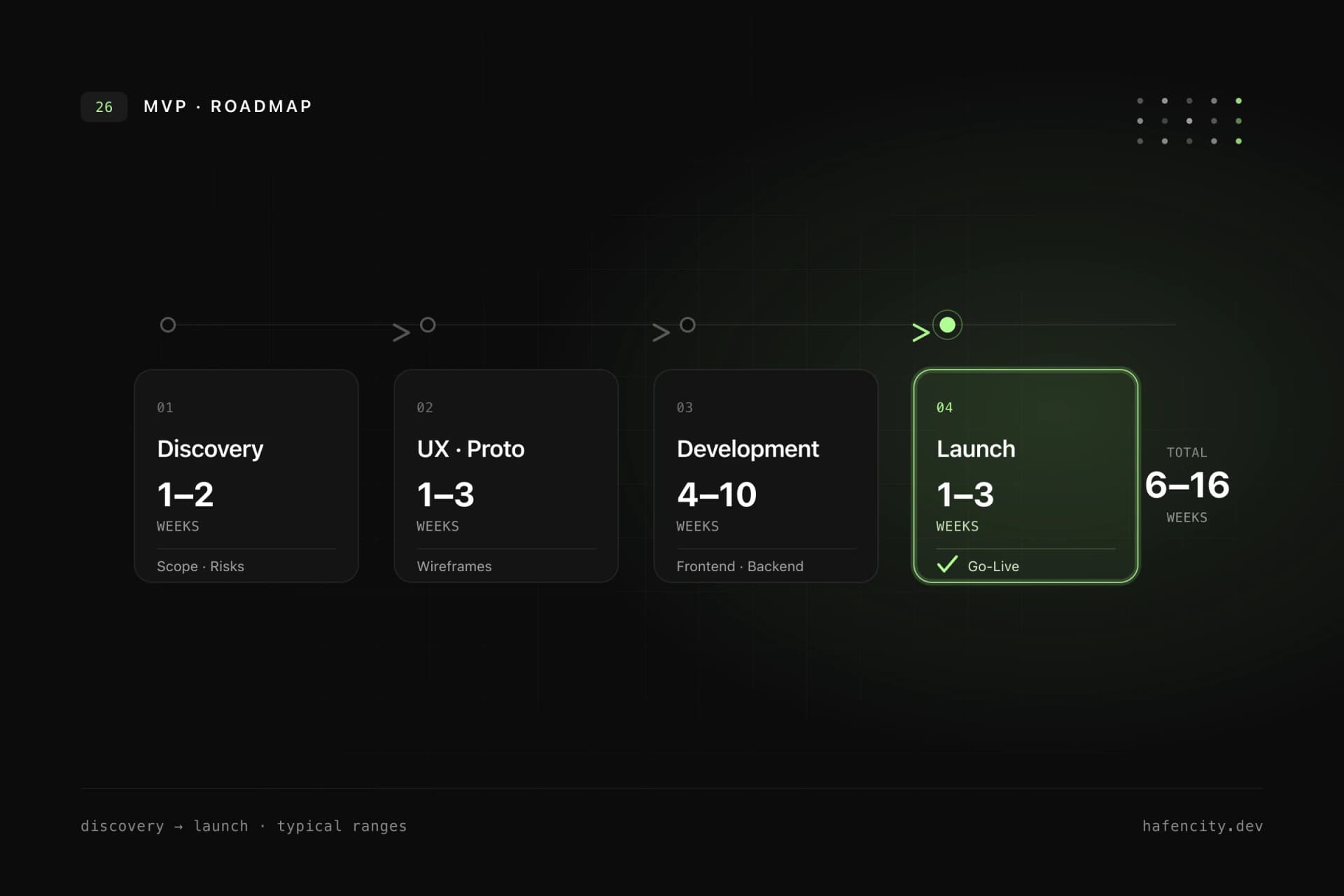
A realistic timeline often ranges from six to sixteen weeks. Small validation prototypes are faster; production-ready MVPs need more time because they must not only look good but also run reliably.
| Phase | Duration | Result |
|---|---|---|
| Discovery | 1–2 weeks | target users, problem, scope, risks, success criteria |
| UX and prototyping | 1–3 weeks | user flow, wireframes, clickable prototype |
| Development | 4–10 weeks | frontend, backend, data model, core features |
| Testing and launch | 1–3 weeks | QA, deployment, tracking, feedback plan |
The timeline becomes shorter when decisions are made quickly, data sources are available and the scope stays genuinely small. It becomes longer when the MVP also has to solve a brand relaunch, CMS, complex integrations and multiple stakeholder groups at the same time.
Cutting scope well: build less, learn more
The most important step is not technology, but prioritization — because a large share of built features is never used. Standish Group research has shown a constant pattern for years: around 64 percent of the features in typical software are rarely or never used. So every feature that doesn't need to be in the MVP saves twice — development time now and maintenance later.
A good scope definition starts with three questions:
- Which assumption does the MVP need to prove?
- Which feature is absolutely necessary for that proof?
- What can be left out, handled manually or added later?
Example: a B2B customer portal does not need every document type, role and automated notification in the MVP. Often login, a project overview, a document area and a simple status flow are enough first. If customers use this and support requests drop, the central assumption has been tested. How that first version grows into a robust platform is covered in custom web app development: cost, timeline, architecture.
A technical foundation that doesn't become a dead end
Even a small MVP needs a foundation that stays extendable after successful validation. For many web app MVPs, a stack of Next.js, React, TypeScript, a relational database, authentication and clean deployment is a solid choice. Next.js 16 has been stable since October 2025, with Turbopack as the default bundler and support for the React Compiler — whether the effort pays off for your project is covered in Next.js agency: when is Next.js worth it?. For mobile products, cross-platform or hybrid approaches often fit.
The architecture should stay simple, but not arbitrary. The essentials are:
- a clear separation of UI, business logic and data access
- an understandable data model and secure authentication
- simple deployments and tests for critical flows
- monitoring from the first real user onward
An MVP can be deliberately pragmatic. But if the product is expected to grow, the foundation should remain solid.
The most expensive MVP mistakes — and how to avoid them
Most MVP projects fail not on technology, but on decisions made before the first sprint. Three patterns appear again and again:
- Too much scope. The MVP really wants to be a complete product. The result: late feedback, spent budget, an untested core assumption.
- No clear metric. Before launch, it must be clear how success is measured — activation, repeat usage, completion rate, time saved or willingness to pay.
- Too little real usage. Internal opinions don't replace real behaviour. A short user test before development often saves more than a large correction cycle later.
Together these three mistakes cost more than any technology choice. Avoiding them means not only cheaper development, but faster learning.
Next steps
Three questions tell you whether your project is ready to start:
- Assumption: which single risk must the MVP prove — demand, process value or technical feasibility?
- Metric: how will you measure success after launch?
- Scope: which feature is truly decisive, and what can wait?
Once these are clear, an agency can develop faster and make better decisions during the project. Unsure where to start? Take a look at our web app development or book an intro call directly — we cut the scope together with an eye on roadmap and budget.