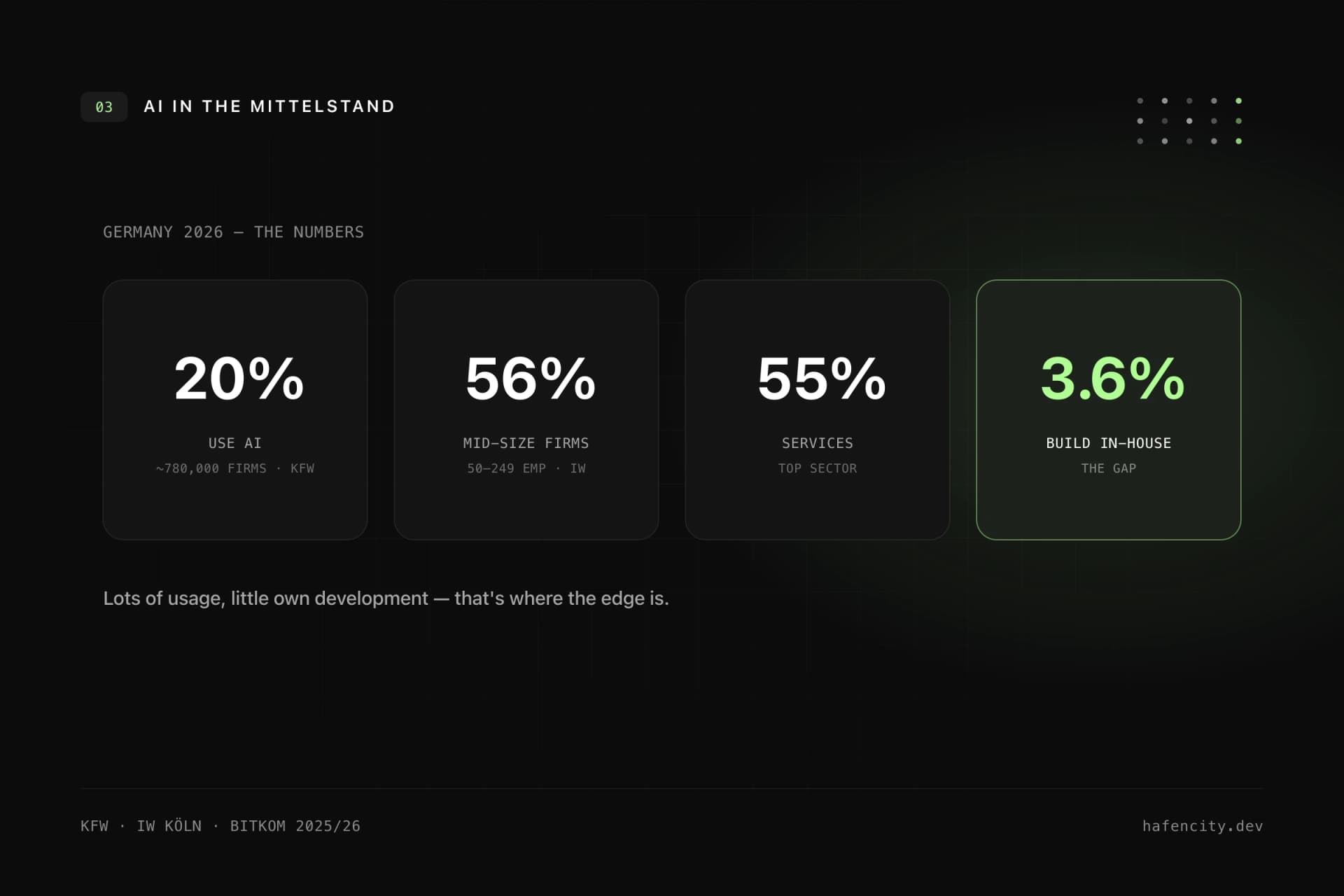

Every digitalisation decision in the Mittelstand starts with the same question: buy it, build it, or bring in a partner? The numbers show how cautiously German firms answer it. According to IW Köln, 29.3% of firms use free AI tools, only 13.0% buy AI as a service — and just 3.6% build AI in-house. For classic software the picture is similar: standard tools are installed quickly, but the firm's own differentiating product never gets built.
There is a reason, and it is rarely the budget. The most common barrier to digitalisation is, according to KfW Research, the skills shortage — missing capacity and competence, not missing money. The "build, buy, or agency" decision is therefore not a matter of belief but of choosing the right route for the job at hand.
The three routes: buy, build, or partner
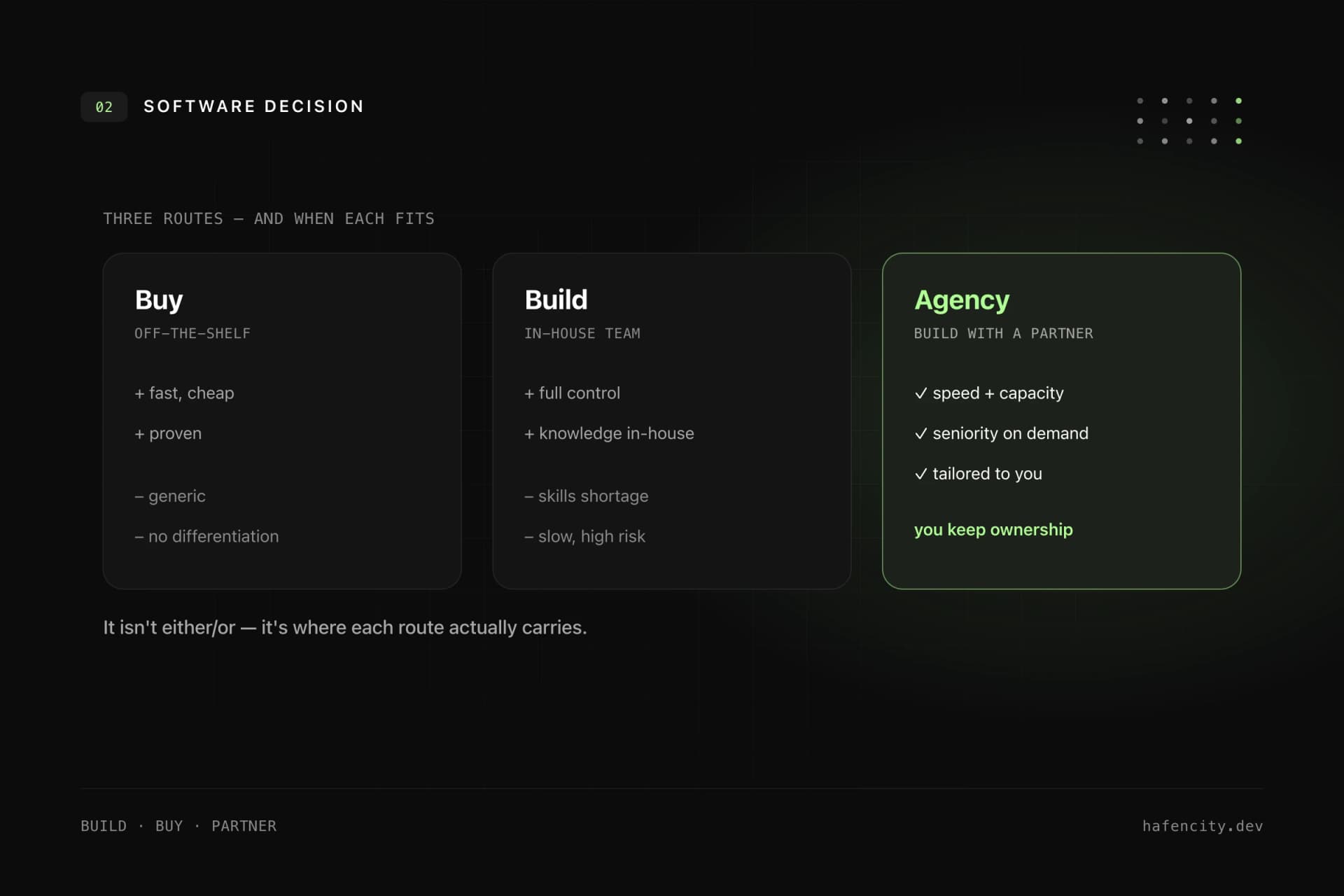
The most useful correction first: there are three options, not two. The classic "make or buy" question hides the fact that "make" does not have to mean "with your own team." You can have differentiating software built and still own it. That shifts the question from "buy or do it ourselves?" to "which route fits this specific system?"
| Dimension | Buy (standard) | Build (in-house) | Partner (agency) |
|---|---|---|---|
| Speed to go-live | high | low (build a team first) | high |
| Capacity | immediate | depends on recruiting | on demand |
| Differentiation | low | high | high |
| Ownership / IP | low (licence) | high | high |
| Ongoing risk | vendor roadmap | key people | governed by contract |
The matrix makes the core visible: buy and build each have one strong and one weak side. The partner route is attractive because it combines the strong sides — speed and capacity like buying, differentiation and ownership like building.
Why pure buy hits its limits
Standard software is the right choice for everything interchangeable — and the wrong one for what makes you unique. Financial accounting, email, office, standard ERP: here in-house build would be waste. These processes look the same in thousands of firms, and an established product is cheaper, safer and available immediately.
The limit is where software should reflect a process that sets your business apart. That is exactly the area growing fastest: according to KfW Research, digitalising the firm's own offering grew the most — around 20% more firms drive it than in 2014–2017, well ahead of customer contact (+9%) and internal workflows (+7%). That is the worst place for standard software: what makes you unique, by definition, cannot be bought off the shelf. Firms that try anyway model their advantage with workarounds and keep paying into a foreign vendor's roadmap. Why that gets expensive over time we explore in Custom software in Hamburg: when standard software isn't enough.
Why pure build rarely works in the Mittelstand
In-house build is not slow because Mittelstand firms couldn't do it — it is slow because they lack the capacity to build the team. Pure in-house building assumes a settled engineering team. That is the scarcest resource in the market: the skills shortage is, per KfW, the most common barrier to digitalisation. Bitkom puts numbers to it: 53% of firms name missing technical know-how, 51% too little staff as a hurdle.
There is also a structural effect: AI and software competence is strongly tied to research and qualification intensity. Per KfW, firms with continuous R&D adopt AI at 38%, while firms with neither graduates nor innovation activity adopt at just 8%. A firm without that level in-house cannot hire it overnight — senior engineers and AI specialists are contested, and onboarding takes time. Building a whole team for a single differentiating product also ties up capital: investing Mittelstand firms invest on average around €204,000 per year in total — across all investment categories, not software alone (KfW-Mittelstandspanel 2025). Pure build pays off when software is your core business and you keep the team fully loaded. For one or two strategic systems it is usually the slowest and riskiest route.
The agency route: speed, capacity — and ownership stays with you
An agency is how you deliver differentiating software without building a team you can't staff. Capacity, seniority and AI competence arrive on day one, not after a year of recruiting. And unlike with standard software, ownership is created along the way: source code, IP and infrastructure are yours, and the handover is part of the engagement.
The often underestimated point is scoping discipline. That one third of AI-using firms report higher costs than expected (Bitkom, 2026 — the figure refers to the roughly 41% of firms already using AI, not to all firms) is rarely about the hourly rate and usually about unclear scope. A good partner cuts the first step small and verifiable instead of betting on a big first throw. That keeps ownership with you and the budget under control. What to look for when choosing is in Software agency in Hamburg: how to spot a good one; how AI speeds up delivery is in AI in software development: faster and better with an agency.
A heuristic for the decision
Three questions get you to the right answer faster than any vendor comparison. They separate commodity from differentiation and capacity from competence:
- Does this system differentiate your business? No → buy. Yes → build or partner.
- Do you keep a settled engineering team fully loaded? Yes → build is viable. No → partner.
- Do you need the result in months, not years? Then the agency route is the fastest path to capacity — with ownership of the result.
The most common mistake is forcing everything into one box — either buy everything or build everything. In practice the best architecture is almost always a mix: buy commodity, build the differentiating part with a partner, and connect it cleanly via APIs. Keeping that first slice small is not penny-pinching but risk management — how an MVP is scoped is in Custom MVP development: cost, timeline, roadmap.
Next steps
Three questions clarify the direction faster than any tool demo:
- Differentiation: Which process makes your business unique — and runs today on standard software with workarounds?
- Capacity: Could you even hire the developers and AI specialists you'd need — and how long would it take?
- Scope: Which small, verifiable first step would show the business case holds?
Once these are clear, the decision is usually obvious. We regularly help separate buy, build and partner cleanly — pragmatically and with an eye on roadmap and budget. See our software development and web app development, or book an intro call directly.