
Around 90% of surveyed developers now use AI at work, according to the DORA report 2025 – a median of roughly two hours a day. That settles the question "should we use AI in software development?". The honest, more important question is: who actually turns this speed into better software – and not just more code?
Because the evidence is genuinely double-edged. AI measurably makes strong teams faster, but it can push inexperienced or undisciplined teams straight into instability. The core of this article: AI amplifies what is already there. An agency that uses AI with discipline delivers more value per euro – faster and safer. That discipline is the product.
Where AI genuinely helps in software development
AI is strongest where context is missing or work is repetitive – and weakest where deep domain knowledge matters. That isn't a marketing line; it maps to concrete tasks. AI assistants speed up scaffolding new features, boilerplate, tests, migrations, explaining unfamiliar code, standing up an API or a prototype, and the first pass of debugging. Here a team recovers real hours.
AI gets weaker the more specific the context becomes: a grown, idiosyncratic codebase, subtle business rules, architecture decisions with long-term consequences. Confuse the two and you either leave speed on the table or manufacture risk. An experienced agency knows where in a project AI is an accelerator and where it merely returns a confident but wrong answer. How this effect plays out across a whole project we go deeper into in AI accelerates software development.
What the numbers really say: amplify, not autopilot
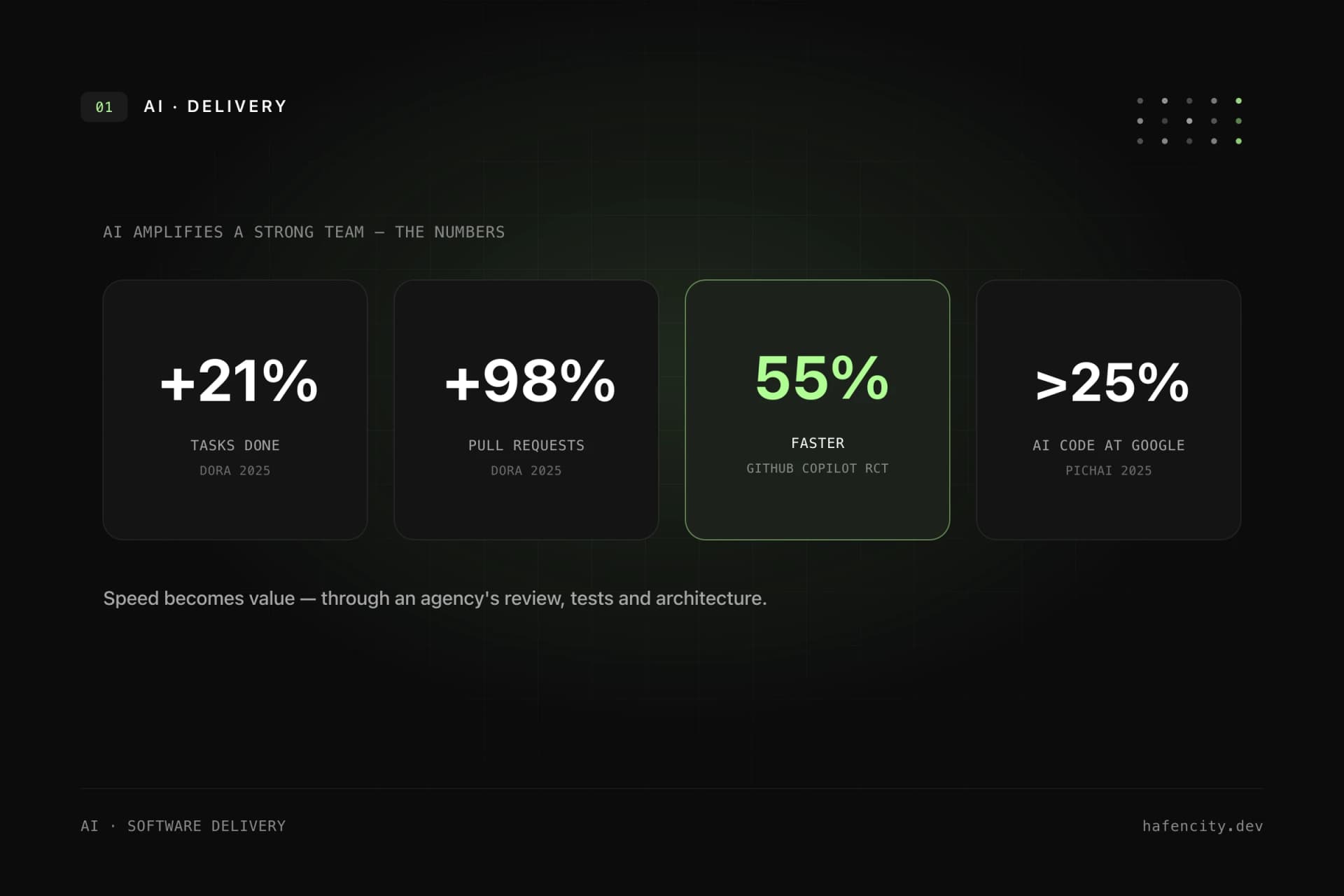
The robust studies all show the same pattern – large acceleration on well-scoped tasks, no autopilot for a whole product. In GitHub's randomized controlled trial, developers solved an HTTP-server task with Copilot in 1 hour 11 instead of 2 hours 41 – 55.8% faster. The DORA report links AI to +21% tasks and +98% pull requests, but deliberately frames its central thesis as "AI amplifies what's already there".
The counter-check matters just as much. A study by METR found that 16 experienced open-source developers working on their own mature projects were 19% slower with AI – while believing they were about 20% faster. And per the Stack Overflow Developer Survey 2025, 84% use or plan to use AI tools, yet trust in their accuracy has fallen to around 29 to 33%; 66% are frustrated by answers that are "almost right".
| Source | Finding | What it means |
|---|---|---|
| DORA 2025 | +21% tasks, +98% PRs | AI amplifies output – if practices hold |
| GitHub Copilot RCT | 55.8% faster | large effect on a well-scoped task |
| Google / Microsoft | 25–30% of code AI-generated | AI is routine; it's still reviewed |
| METR 2025 | experienced devs 19% slower | AI helps least on familiar code |
| Stack Overflow 2025 | 84% use AI, trust ~29–33% | "almost right" must be verified |
The takeaway: AI is a lever, not a substitute for judgement. It produces more options faster – which of them hold up is still an engineering call. How the leading tools work together here we describe in AI coding with Codex and Claude.
Why an agency turns speed into outcomes
DORA 2025's decisive finding is often skipped: AI adoption has a negative relationship with delivery stability – except where strong testing, version control and fast feedback already exist. Translated: more speed without discipline ships more defects faster. More speed with discipline ships more value faster. The difference isn't the model; it's the engineering practice around it.
This is exactly where an agency's value sits, and AI has made it more important, not redundant. Mandatory code review catches plausible-looking but wrong AI suggestions. Automated tests and CI/CD keep more pull requests from becoming more regressions. Architecture ensures fast-generated code fits a maintainable whole. And seniors decide where AI is used and where it isn't. An agency that refuses AI leaves speed and quality on the table; one that uses AI naively becomes dangerous. The value is in the middle – use AI aggressively and verify its output rigorously. How we build those practices into projects is shown in our software development, and where the concrete risks lie we cover in the risks of AI code generation.
What changes for you as a client
For you, AI mostly shifts three things: more iterations per budget, faster prototypes, and more senior time for product thinking instead of assembly-line work. When a team gets scaffolding, tests and routine done faster, more time is left for the questions that actually decide success: what should the product do, for whom, and in what order? You get something tangible sooner, learn faster on the real system, and can correct more cheaply.
What doesn't change: quality, security and maintainability stay human work. AI lowers the barrier to a prototype – the distance from demo to a production-grade, resilient system is precisely what engineering is. That a good agency therefore becomes more important, not redundant, we go into in Will AI replace your software agency?. Concretely, AI-native work means for you: the same standards, shorter paths – and a team that openly explains where AI helped and how the result was verified.
Next steps
Three questions quickly show how much AI will really accelerate your project:
- Task type: is most of it new ground and routine (AI amplifies strongly) or deep, grown domain knowledge (AI helps less)?
- Discipline: is there review, automated tests and fast feedback – the conditions that keep speed from tipping into instability?
- Data boundaries: which code may go to which models, and how is the result safeguarded?
If you want to use AI as a real accelerator without risking quality, talk to us. We apply AI with discipline in every project – more on that in our AI integration or directly in an intro call.