
Since Andrej Karpathy coined the term “vibe coding” in February 2025, almost anyone can assemble a working demo in an afternoon — by voice prompt, without writing a single line. That is impressive, and it is the right way to start a prototype. The obvious conclusion is still often wrong: “If AI can do this, why do we still need an agency?”
The honest answer is uncomfortable for any slow agency and good news for everyone else: AI lowers the floor radically — and at the same time raises the bar for a production-ready product. The distance between a demo and a system you entrust with customers and data has not shrunk. It has become more visible. And that is exactly where senior engineering lives.
What AI made easy — and what it didn't
AI radically sped up producing a first working version — but not building a product. That is not a contradiction, it is a clarification. In a controlled GitHub study, developers solved a scoped programming task 55.8% faster with Copilot (1h11 instead of 2h41). The DORA 2025 report confirms the pattern at scale: AI is associated with more tasks completed (+21%) and substantially more pull requests merged (+98%). Its central thesis is sober and important: AI amplifies what is already there.
That is exactly why the picture is more nuanced than the demo videos suggest. In a randomized METR study, experienced open-source developers working on their own, well-known repositories were actually 19% slower with AI — while believing they were faster. AI helps most where context is missing and least in code someone already knows deeply. The lesson for a product: speed is context-dependent, and the demo is the easy part.
The 70% problem
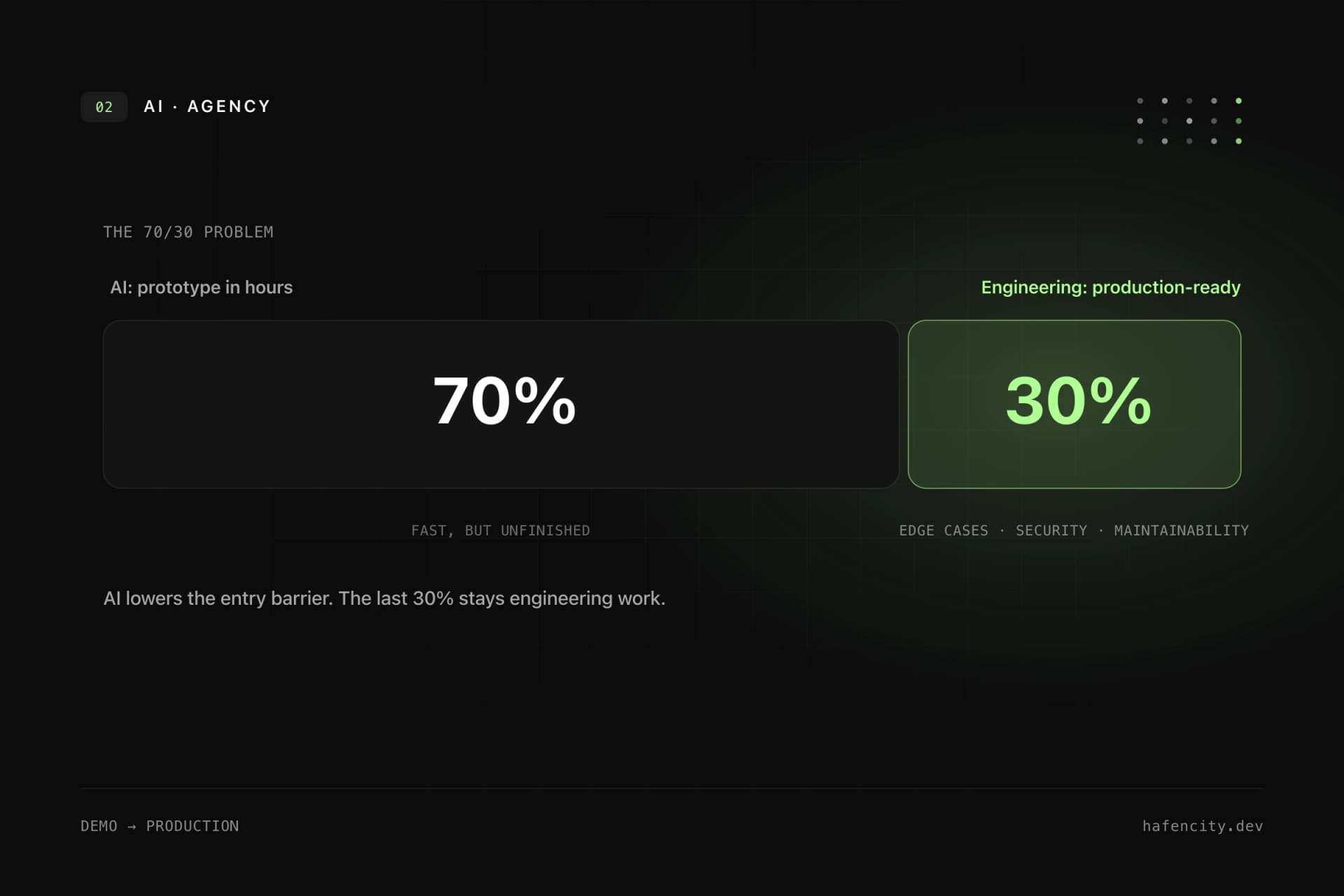
AI gets you to roughly 70% fast — the last 30% is the actual software engineering. Google engineer Addy Osmani described this as the 70% problem, and it matches what we see in projects every day. The first 70% — the visible UI, the happy path, the first features — comes together with AI surprisingly fast. The last 30% is invisible and expensive: error handling, edge cases, security, performance under load, accessibility, maintainability, and the question of whether the system is still changeable in two years.
The catch: those 30% are not 30% of the effort — they are often the bulk of it. A demo that works in the living room is not the same as a system that survives 10,000 users, invalid input, traffic spikes and attackers. Treating the 70% as “almost done” means planning past the actual project.
From demo to production: the real distance
The distance between a convincing demo and a system you entrust to customers is exactly where senior engineering lives. And that distance now shows up in the numbers, too. Per the Stack Overflow Developer Survey 2025, 84% of developers use or plan to use AI tools — but trust in their accuracy has fallen: only about a third trust the accuracy, and 46% actively distrust it. The most telling figure: 66% are frustrated by “almost right” AI answers, and for around 45% debugging AI code takes longer than writing it themselves.
“Almost right” is more expensive in production than “obviously wrong”, because it slips past shallow tests. That shows up in incidents: in an August 2025 survey, 16 of 18 CTOs reported production incidents caused by AI-generated code. The DORA report names the mechanism behind it: AI adoption has a negative relationship with delivery stability — unless strong testing, clean version control and fast feedback absorb the added speed. Speed without discipline produces instability, not value.
Build it yourself with AI, or hire an AI-native agency?
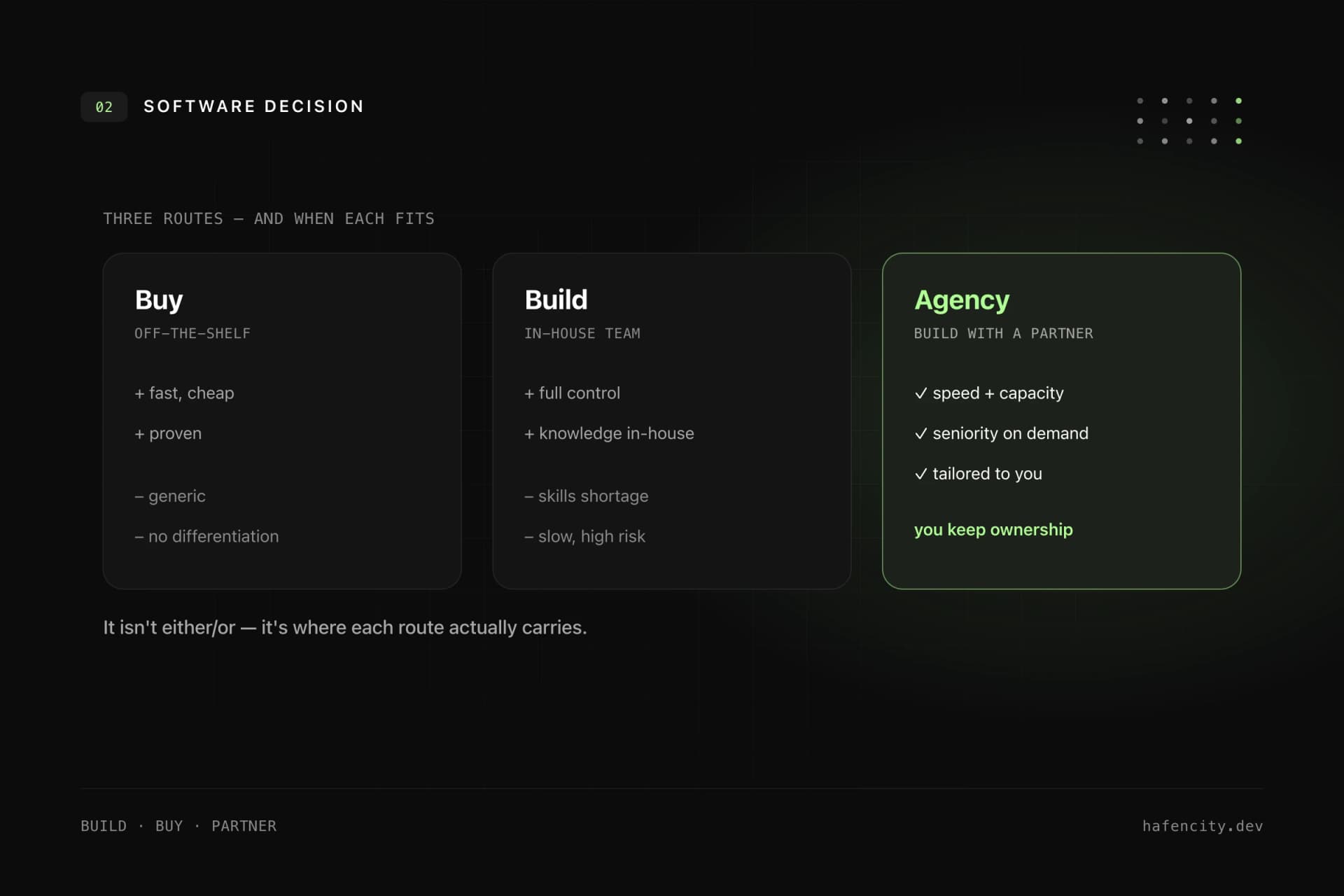
The honest counter-question isn't “AI or agency” — it's “who reliably closes the last 30%”. The objection “we'll just build it ourselves with AI” is legitimate — and for a prototype, an internal tool or market validation it is often the right call. That is exactly what vibe coding is good for. It gets risky the moment the prototype is meant to become a product, one that customers, revenue and personal data are entrusted to.
| Dimension | Build it yourself with AI | AI-native agency |
|---|---|---|
| First demo | hours to days | hours to days |
| Last 30% | open, ad hoc | systematically closed |
| Code review & tests | rare | standard |
| Security | mostly unchecked | review, SAST, hardening |
| Maintainability & handover | tech-debt risk | documented, handoverable |
| Accountability on incident | yours | contractually defined |
Important: the left column is not “dumb” and the right one is not “magic”. Both start fast today because both use AI. The difference is not the speed of the first 70%, but the discipline of the last 30%. An AI-native agency passes the speed on to you — and invests the time it saves into review, tests and architecture instead of even more unreviewed code. What that transition from prototype to a reliable system looks like in practice, we describe in From AI prototype to production-ready system.
What you actually pay an agency for now
You no longer pay for typing code — you pay for the judgment that turns AI speed into a safe product. That is the real shift. A large part of an agency's value used to sit in the craft of writing code. Today it sits in the decisions around it: which architecture holds up in two years? Where does AI-generated code fail subtly? Which tests prove it actually works? Which data must never leave the building?
That work has not gotten smaller — it has gotten more valuable, because AI produces more code, faster, and therefore more surface that needs review, tests and security. A modern agency must therefore use AI excellently itself; refusing AI leaves speed and quality on the table. The case that disciplined AI use ships faster and better, we make in AI in software development: faster and better. The flip side — which new risks AI code brings and how to contain them — we cover in The risks of AI code generation. How we fold AI into our development without giving up control is exactly this third path: AI plus engineering rigor, together as the product.
Next steps
Three questions settle faster than any tool debate whether you build it yourself or need support:
- Maturity: is this a prototype for validation — or a product that customers and data are entrusted to?
- The last 30%: who reliably owns security, tests, scaling and maintenance once the demo stands?
- Accountability: who is liable if AI-generated code causes an incident in production?
If the answers point toward “real product”, a conversation is worth it. We build fast with AI — and close the last 30% with the discipline that makes a product reliable. Take a look at our software development or book an intro call directly.