
"Could we actually get our software checked for security — for free?" Many managing directors ask themselves this the moment their gut turns uneasy: the system has grown over years, an outside agency built it, or news of a data breach in the sector is making the rounds. A paid software audit quickly starts in the four-figure range — so a free security check sounds like the low-risk first step.
And it is — if you know what it can and cannot do, and how to tell a genuine offer from a disguised sales pitch. That's exactly what this article is about: an honest framing, so you use a free IT security check well instead of lulling yourself into false security.
What a free security check can do — and what it can't
A free security check is honestly a first look, not a deep dive — but that first look finds the risks that are most often actually exploited in practice. Because the most consequential gaps are rarely exotic. They are outdated libraries with publicly documented flaws, access keys forgotten in shipped JavaScript, endpoints without authorisation checks, or passwords in plain-text logs. It's no coincidence that the OWASP Top 10:2025 still list "Broken Access Control" — missing or wrong access control — as the single biggest risk. An experienced developer spots such mistakes in a short time.
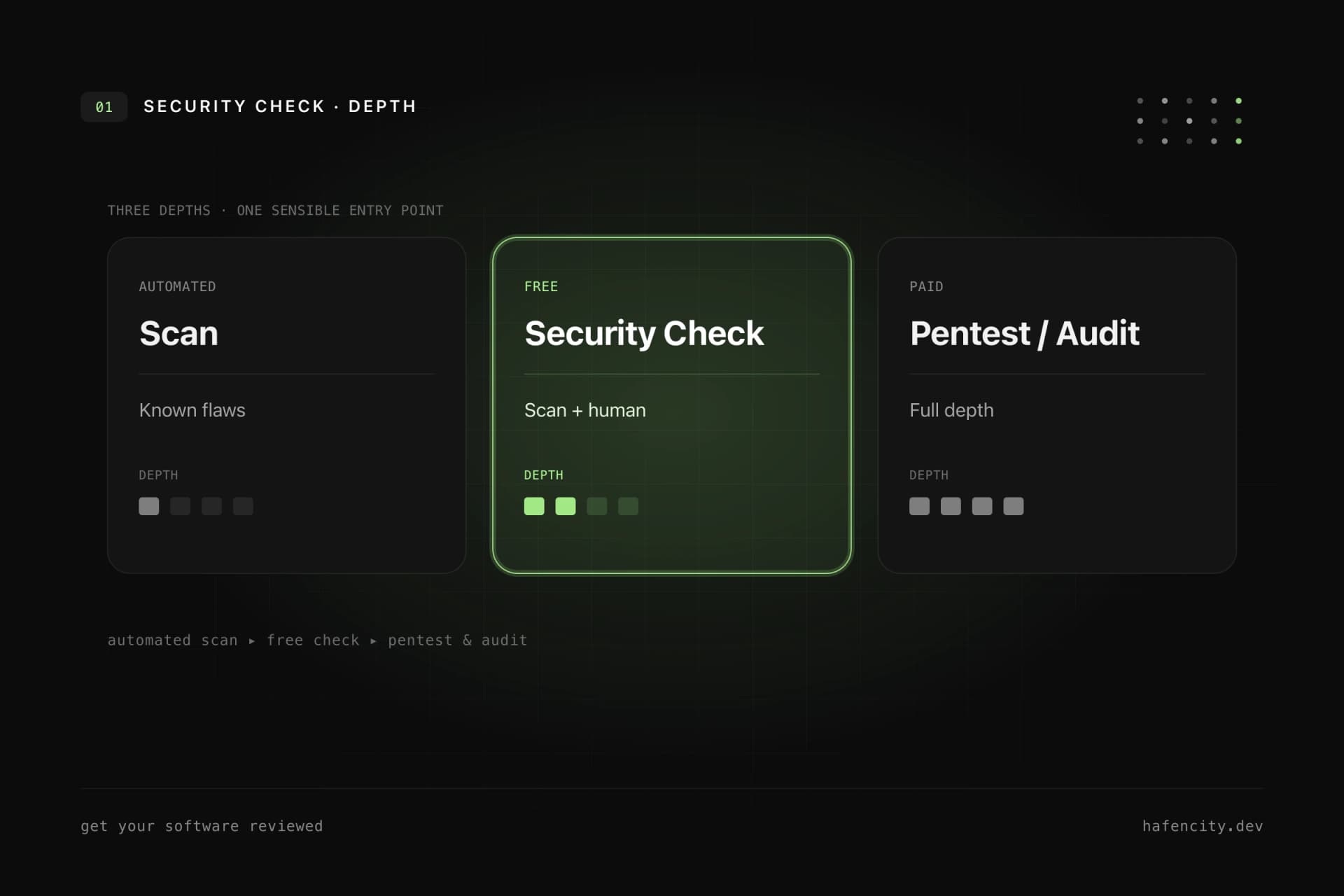
What matters is keeping the depths apart. A pure automated scan is cheap to free but only finds known patterns. A free security check combines a scan with a human's manual look at the critical spots. A paid penetration test or a full software audit goes considerably deeper — with its own scope, attack simulation and a formal report.
| Review | What it delivers | Limits | Cost |
|---|---|---|---|
| Automated scan | Known vulnerabilities, outdated packages, obvious misconfiguration | No context, no understanding of permissions or business logic | free–low |
| Free security check | Scan plus a manual look at critical code, permissions, data flows; prioritised report | No full scope, no attack simulation, no certificate | free |
| Pentest / full audit | Deep review, attack simulation, architecture, formal report | Time and budget, preparation required | four-figure and up |
A free check therefore does not replace an audit when a business-critical decision — a takeover, a large investment, a certification — has to be soundly de-risked. But it is the right first step to even know whether, and how deeply, you should have things reviewed.
Genuine offer or disguised sales pitch?
The difference between a genuine free check and a thinly veiled sales appointment isn't the price — both are free — but transparency and openness of outcome. A genuine provider says up front what is and isn't examined, works with the minimum access needed, and delivers a concrete, verifiable report at the end: every weakness with location, severity and plain-language risk. It turns dubious when the "check" is merely the hook to sell you a contract as fast as possible — with vague horror stories instead of traceable findings.
Concretely, you recognise a trustworthy offer by these points:
- A clear scope up front: the provider describes what is examined (code, dependencies, configuration, data protection) and what isn't — instead of promising "all-round security".
- Minimal access: read-only access or an export is enough; nobody demands admin rights on your production environment, and an NDA is available on request.
- Verifiable findings, not panic: every finding is concretely traceable — with a location and an explanation, not dramatic claims without evidence.
- The report is yours: you get the result in writing, even without a follow-up engagement, and may pass it on — to your team or your current agency.
- No sales pressure: one review, one report, one conversation — no subscription, no fine print, no weekly follow-up calls.
Which leaves the honest question: why would anyone do this for free? The candid answer is that it pays off — and a provider should be open about that. We too offer a free security review, and some findings are relevant enough that clients then commission us with the fix. That very incentive is what makes us put real effort into finding something. The difference from a dubious offer isn't the business model but the attitude: the report stays honest, it belongs to you, and you're obliged to nothing. How to assess a service provider more generally is something we go into in how to spot a good software agency.
Who benefits most from a free check
A free security check delivers the most value in two situations — and neither has anything to do with acute panic, but with uncertainty that blocks a decision. The first is software that grew over years: a system that runs, but has been extended, rebuilt and patched under deadline pressure many times over. The original developers are often gone, dependencies haven't been updated in ages, and nobody dares touch an update because it's unclear what might break. How to assess and modernise such legacy systems is a topic of its own — but the first step is always to know the current state soberly.
The second situation is the independent second opinion. An agency or freelancer built it for you, the invoice is paid — but is the result secure, clean and maintainable? Especially before you invest further or take over a project, a neutral look is worth a great deal. A genuine reviewer names technical facts, not culprits. For both cases we offer our free security review; if you'd like to gauge your own blind spots first, you'll also find an anonymous 2-minute self-check there with eight honest questions that runs entirely in your browser.
The process and what a good report contains
A good free check follows a clear process — and ends not with a raw list of defects, but with a prioritised, readable report. The typical path: you describe your system in a few sentences, scope and, if you wish, an NDA are agreed, then an automated analysis runs across dependencies, secrets and configuration, complemented by a manual review of the critical code — exactly where scanners are blind. At the end there's a written report that a good provider walks through with you.
So that review time goes into real assessment rather than groundwork, a little preparation pays off. Sort out three things beforehand:
- Access: read-only access to the repository or a code export — as much as you want to share, no more.
- Context: a short description of the system and its key user flows (login, payment, data export).
- Question: the one decision you want to de-risk — such as "Is a takeover justifiable?" or "Where are our biggest risks before the next expansion?".
A sound report contains four things for every weakness: location, severity, plain-language risk and a prioritised recommendation. Critical means: act now. High, medium and low order the rest. And crucially — the report is readable for engineering and management, clearly distinguishes "critical", "important", "later" and "consciously acceptable", and answers your original question at the end. If a finding is severe enough to demand lasting protection right away, it flows seamlessly into maintenance and ongoing operations. What a deeper, paid audit additionally covers — architecture, data model, operations, roadmap — you can read in the article on the software audit.
Next steps
Three questions quickly show whether a free security check is the right next step for you:
- Trigger: has your software grown over years, or do you want an outside agency independently double-checked?
- Uncertainty: is a lack of oversight on security, GDPR or maintainability currently blocking a decision?
- Preparation: can you provide read-only access or an export and name the one question you want answered?
If you say yes twice here, a free check is the cheapest way to gain clarity. Request your prioritised report through our free security review — confidential, non-binding, with an NDA if you wish. Or start with the 2-minute self-check first: eight questions, your blind spots in plain language, without sending us any data at all.