
Many companies know that their software is business-critical, but not how healthy it really is from a technical perspective. The application runs, but new features get slower, bugs appear more often, and nobody can say with confidence whether the architecture still holds. This is not a fringe issue: according to McKinsey, one in three CIOs believes that more than 20% of the technology budget is diverted to servicing technical debt. That is exactly when a software audit becomes useful.
A software audit is a structured technical assessment of an existing application. The goal is not to label code as "good" or "bad" in general, but to answer concrete questions: How maintainable is the system? Which security risks exist? Where is technical debt accumulating? And is it worth continuing to build – or should parts be rethought?
When a software audit really pays off
An audit pays off precisely when technical uncertainty blocks a business decision. As long as everything runs and nobody wants to invest, you can wait. But as soon as money, responsibility or risk is on the table, a neutral assessment is cheaper than a gut feeling. Typical triggers include:
- Existing software needs to be taken over by a new agency.
- A web app or platform is becoming slower to develop.
- An MVP needs to become a production platform.
- A legacy system creates high maintenance cost.
- An investment, acquisition or technical due diligence is coming up.
- Internal developers warn about technical debt, but there is no neutral assessment.
The economic lever is large: when technical debt ties up engineering time – Stripe's Developer Coefficient report puts it at around 42% – every deferred decision pushes cost into the future. An audit is especially valuable before large budgets are committed. Understanding risks before modernization is cheaper than discovering halfway through a project that the data model, tests or architecture cannot support the plan.
What an audit checks: eight dimensions
A good audit is broad but never shallow – it examines the system where risk and business value meet. The exact scope depends on the system: a public website needs different checks from a B2B customer portal, a mobile app or a SaaS platform. These eight areas are almost always part of it:
| Area | What it checks |
|---|---|
| Code quality | readability, structure, duplication, error-prone areas, conventions |
| Architecture | layering, modularity, dependencies, scalability |
| Security & supply chain | authentication, permissions, secrets, dependencies, known vulnerabilities |
| Data model | consistency, migrations, integrity, performance, future readiness |
| Tests & CI/CD | coverage of critical flows, automated builds, manual risk |
| Operations | deployment, monitoring, backups, logs, rollback, ownership |
| Performance | loading times, database queries, API latency, frontend bundles |
| Maintainability | documentation, setup, onboarding, technical debt |
The result should not be a long list of abstract criticism. A good audit prioritizes: What is critical? What should be fixed soon? What belongs on the roadmap? And what can deliberately stay as it is? For the code review, that means looking at clear responsibilities in modules, understandable naming, error handling, unnecessary duplication, and the mixing of UI, business logic and data access. Especially in web app development, it is less the framework choice than the interplay of data, permissions, processes and operations that decides whether a system can grow.
Security and supply chain: the underrated risk in 2026
In 2026, security is no longer only a question of your own code, but of the entire supply chain. The OWASP Top 10:2025 – the first update since 2021 – still lists "Broken Access Control" as the biggest risk, but add "Software Supply Chain Failures" as a new category covering compromised dependencies, build systems and distribution channels. That is justified: according to Sonatype, more than 450,000 new malicious open-source packages were discovered in 2025 – up roughly 75% year over year.
On top of that comes regulatory pressure. Germany's NIS2 implementation act has applied since December 2025 without a transition period and obliges around 29,500 companies to implement risk management, incident reporting and, explicitly, supply chain security. The EU Cyber Resilience Act brings its core obligations – security by design, a software bill of materials, vulnerability management – into effect in December 2027. An audit therefore checks not only login and roles, but also: are secrets sitting in the repository? Are packages current and traceable? Can every user really only see the data that belongs to their role? How exactly these points come together in a lean, free security check is something we walk through in have your software reviewed for free. How these topics are anchored in day-to-day operations is something we describe in our piece on software maintenance.
What a software audit costs
The biggest cost driver is not system size, but the depth you want. Prices depend on technology, documentation, access and ambition. Since an experienced architect in the DACH market charges around 110–160 EUR per hour according to the Freelancer-Kompass 2025, these are the rough ranges:
| Audit type | Typical scope | Realistic range |
|---|---|---|
| Quick check | repository, setup, rough risks, short report | 3,000–8,000 EUR |
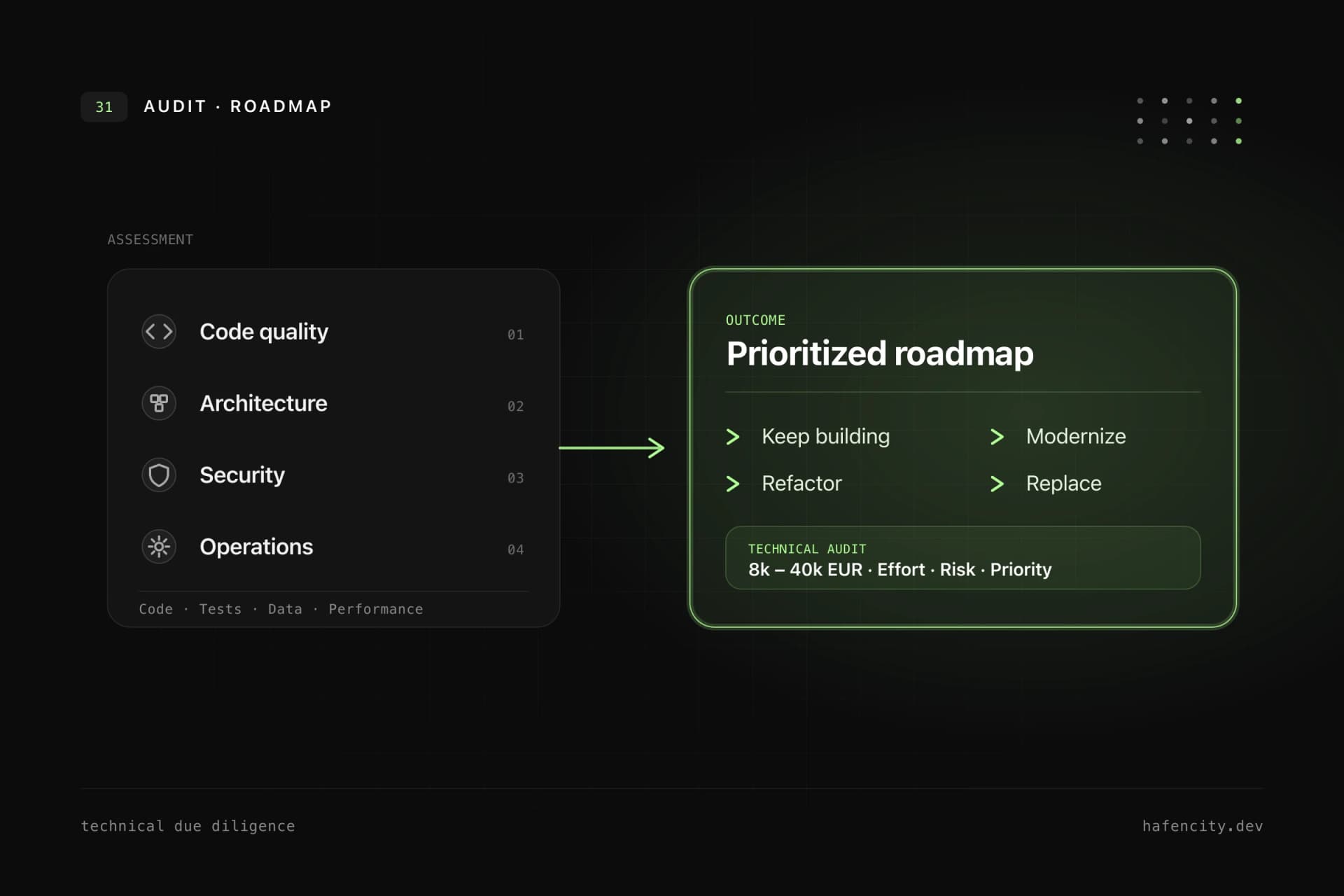
| Technical audit | code, architecture, dependencies, tests, operations, roadmap | 8,000–20,000 EUR |
| Security & architecture audit | permissions, APIs, infrastructure, data model, risk analysis | 15,000–40,000 EUR |
| Due-diligence audit | technical assessment before investment, purchase or takeover | from 20,000 EUR |
A cheaper audit is useful for an initial assessment. For business-critical decisions, it should be deep enough to evaluate risks reliably. The best investment is preparation: anyone who provides repository access, documentation, a list of important user flows and a clear decision question wastes no budget on groundwork – and gets more real assessment for the money.
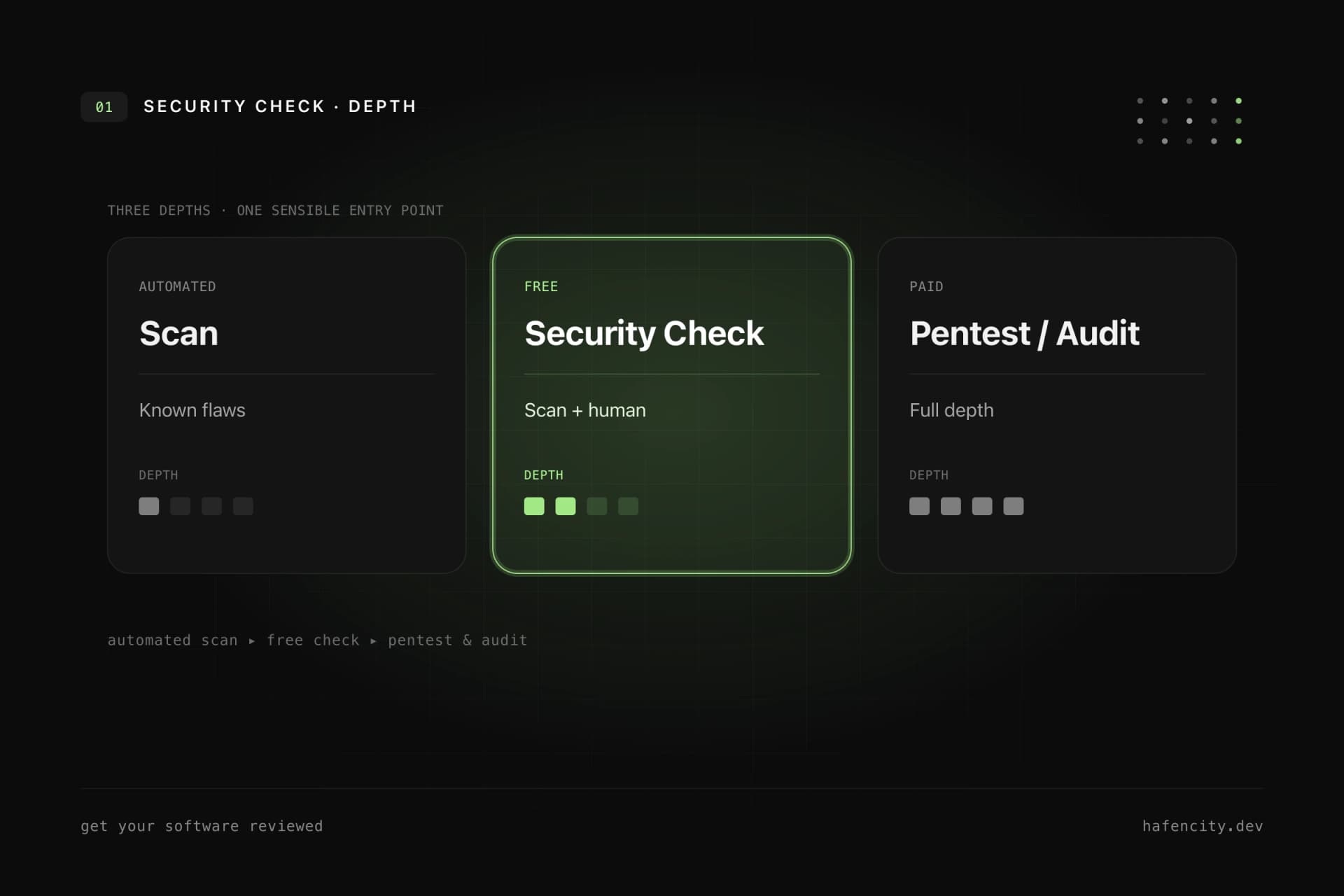
Before you budget for a full audit, a smaller first step usually pays off: our free security review shows, in compact form, whether and where a deeper assessment is even worth the investment – built for mid-sized companies with grown legacy software or as a neutral second opinion on your own agency, including a short self-check.
From findings to roadmap: continue, refactor or replace
An audit is not modernization – it is the basis for a decision. The most important part is therefore not the list of findings, but the recommendation on what makes sense next. This usually leads to one of four paths:
| Finding | Useful next steps |
|---|---|
| System is stable | maintenance, add tests, small improvements |
| System has technical debt | roadmap for refactoring, documentation, better tests |
| System blocks growth | step-by-step modernization, new architecture, migration |
| System is high risk | replacement strategy or controlled rebuild |
Especially with legacy software, an audit is a better first step than an immediate rebuild. Poor code does not automatically mean everything must be rebuilt – often it is enough to stabilize critical areas, add tests and decouple modules before deciding what really gets replaced. A good result is understandable for both engineering and leadership and clearly distinguishes between "critical", "important", "later" and "acceptable with awareness".
Next steps
Three questions clarify how deep your audit should go:
- Decision: Is this about a takeover, a modernization, an investment or a new feature roadmap?
- Risk: Are security, supply chain or regulatory obligations (NIS2, CRA) a concrete topic?
- Preparation: Are repository access, documentation and the key user flows ready?
Unsure whether your system should be developed further, modernized or rethought? We assess software neutrally on a regular basis – pragmatically and with an eye on roadmap and budget. The lowest-threshold way in is our free security review: a first read in just a few minutes on whether a deeper audit is worth it at all. From there, take a look at our backend development or book a first consultation directly.