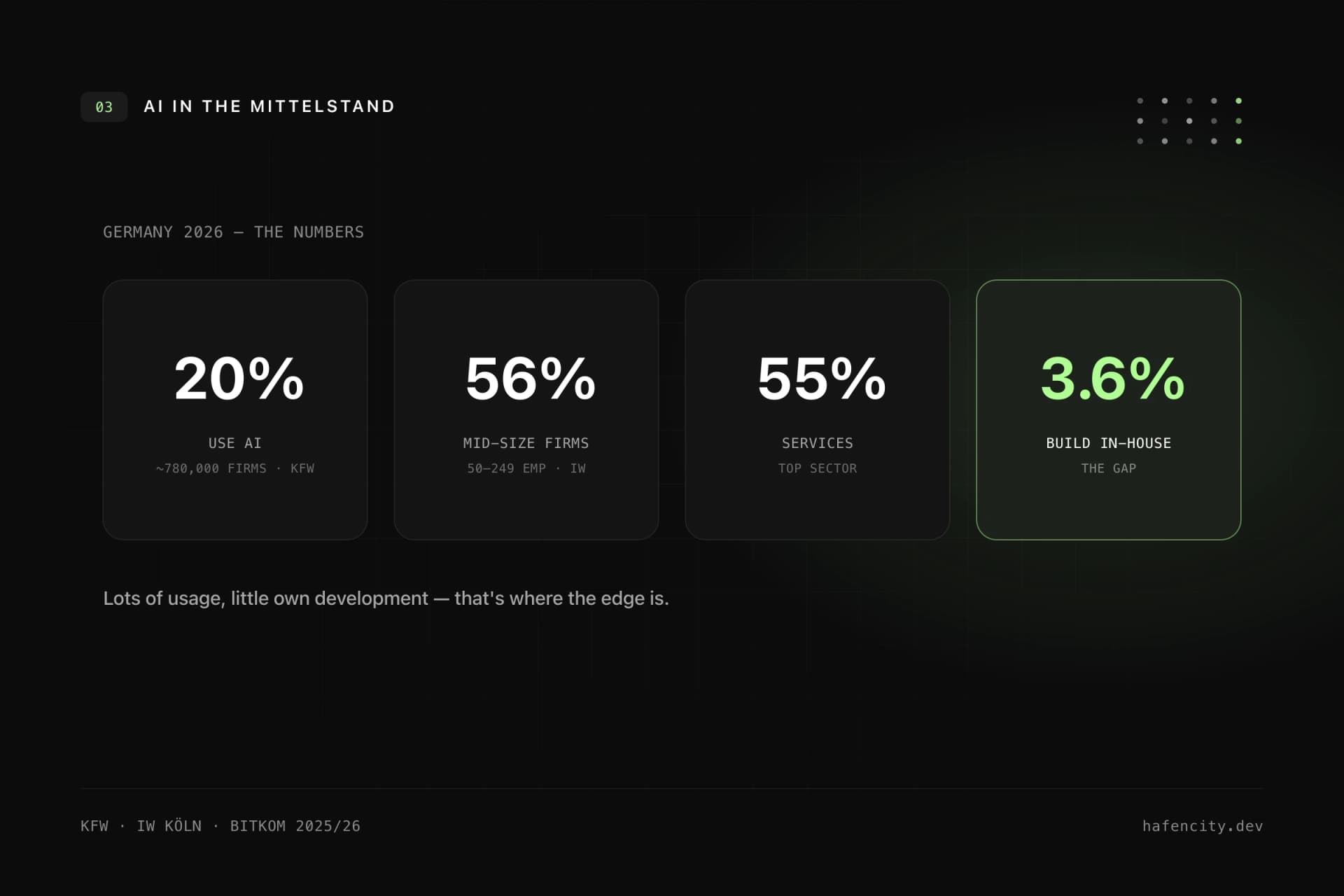

AI adoption in the German Mittelstand is no longer a niche topic in 2026. According to KfW Research, around 20 percent of mid-sized companies use artificial intelligence, roughly 780,000 firms and about five times the level of 2016 to 2018. The pace is high, but the average hides a very uneven distribution.
For a managing director or IT lead, the interesting question is not "do others use AI?" but: where does my company stand by comparison, what do the leaders actually do, and how can the situation be turned into a real advantage? This article frames the reliable numbers and shows where the opportunities are.
How far along is the Mittelstand really?
AI adoption is clearly accelerating, but its spread depends heavily on company size. KfW Research puts the share of AI-using Mittelstand firms at around 20 percent, or roughly 780,000 companies – a jump to about five times the 2016–2018 level. Other surveys with a different scope confirm the direction: Bitkom reports 41 percent active AI use for companies with 20 or more employees (February 2026), more than a doubling versus the prior year (17 percent), plus another 48 percent planning or discussing it.
Size is decisive for context. The IW Köln shows a clear gradient for 2025: large companies with 250+ employees use AI at 66.3 percent, medium-sized firms with 50 to 249 employees at 56.1 percent, and small firms under 50 employees at only 35.6 percent. So a company with 100 or 150 staff sits in a field where the majority is already active – the relevant competition has begun.
Which sectors lead
The sector gap is wider than the size gap: knowledge-intensive services use AI more than twice as often as construction. The IW Köln reports clear differences between sectors for 2025. In front are knowledge-intensive business services – consulting, IT, engineering – whose business itself rests on information and analysis. The industrial core follows at a distance, while trade and construction still use AI less often.
| Sector | AI usage | Context |
|---|---|---|
| Knowledge-intensive business services | 55.4% | clear leader, data-driven core business |
| Mechanical, electrical, automotive engineering | 39.9% | industrial core, predictive quality/maintenance |
| Wholesale and logistics | 24.1% | potential in planning, routing, forecasting |
| Construction | 21.9% | laggard, large catch-up need |
For benchmarking your own company, the movement behind the number matters more than the absolute value. AI is no experiment in mechanical engineering either: a BMWK-funded program bundled 37 joint projects with 363 sub-projects and around 690 million euros in volume for predictive quality, predictive maintenance and digital twins (BMWK). If you sit in the industrial Mittelstand, you are not competing with tech giants but with rivals in your own segment.
What they actually do with AI
In the Mittelstand, AI is mainly a tool for efficiency and quality, not a marketing topic. The IW Köln also asks about concrete goals. By far the most common is automating routine tasks – 84.5 percent of AI-using firms cite this goal. Support with complex tasks follows at 70.1 percent, and quality improvement is the third most common at 64.6 percent. As the business function with the strongest AI use, product and service creation leads at 45.5 percent – the core of value creation, not just the back office.
This fits the investment appetite. Despite the tight overall situation, Bitkom reports that 29 percent of companies planned to invest more in AI in 2025 than the year before, of which 8 percent significantly and 21 percent somewhat. What matters is less the absolute budget – the average Mittelstand firm invests around 204,000 euros per year across all projects according to the KfW Mittelstandspanel 2025 – than a clearly scoped use case with measurable value. Starting with a sharp use case delivers results faster than a broad, fuzzy program. Which use cases suit a start, we cover in AI use cases: start realistically.
The gap: lots of usage, little in-house development
The Mittelstand uses AI broadly, but mostly at the surface – and that gap is the real opportunity. The IW Köln separates depth of use cleanly: 29.3 percent of firms use free AI tools, only 13.0 percent buy AI as a service, and just 3.6 percent develop AI in-house. With every step toward real integration, the share drops sharply.
This is not a Mittelstand weakness but a consequence of real constraints. KfW Research names the main barriers as the skills shortage and missing competencies, scarce time and capacity, weak data foundations and concerns about security and maturity – and names, as the remedy, above all the qualification of employees and the systematic strengthening of in-house competencies and data infrastructure. Bitkom quantifies the barriers similarly: legal uncertainty and lack of technical know-how at 53 percent each, insufficient personnel at 51 percent. For a managing director, that means: the bottleneck is rarely the idea, but the capacity to execute. How software and AI can still be delivered despite the skills shortage, we cover separately in Software and AI despite the skills shortage.
Where the opportunities are
Value is created where AI moves into your own value chain – not where another tool is simply subscribed to. Three findings point the way. First: the fastest-growing digitalization project type in the Mittelstand is digitalizing the firm's own product or service offering – plus 20 percent more firms between 2020–23 and 2014–17, well ahead of customer contact (+9%) and internal workflows (+7%), per KfW Research. This is exactly where a hard-to-copy lead forms, because it sits inside your own offering.
Second: research and competence intensity is the strongest driver. According to KfW, firms with continuous research adopt AI at 38 percent, while firms with neither graduates nor innovation activity reach only 8 percent. Third: the gap between leaders and laggards is widening. The IW digitalization index 2025 shows small firms at 101.7 versus large firms at 203.4 points – a factor of about two, which the IW attributes to scarce funds and scarce personnel in smaller houses.
The practical consequence for the Mittelstand: the low-hanging fruit – free tools, individual assistants – will soon be picked by everyone. The advantage forms one step above, in integrating AI into your own processes and products. That is more demanding, but that is where the 3.6 percent sit, with barely any competition today. Why the step is worth it, we go deeper in Why skipping AI is a business risk, and which duties arise from using AI, in The EU AI Act for SMEs.
Next steps
Three questions place your own position faster than any tool demo:
- Position: Do we already use AI beyond free tools – or are we stuck among the 29.3 percent who only scratch the surface?
- Value creation: Where in our product or service would AI make a difference that competitors cannot simply subscribe to?
- Capacity: Do we have the internal time and competence for integration – or do we need a partner for that?
If the answers point toward integration, the next step does not start with a tool but with a clear use case and an honest data check. Depending on maturity, we begin with an AI strategy or directly with a scoped AI integration. Tell us your sector, your most important process and your data situation – then book an intro call.