
AI has broken through in the German economy: in 2025, for the first time 36 percent of companies with more than 20 employees used AI — almost double the share a year earlier (Bitkom). Globally, McKinsey now reports 88 percent of organizations using AI in at least one function. So the question is no longer "Is anyone actually doing this?" but "What does it cost us not to be part of it?"
Not every task needs AI, and not every team should put agents into production immediately. But building no experience at all is becoming measurably expensive. While one company waits, others build process knowledge, faster cycles and governance routine — and that lead is hard to close later.
Non-adoption is also a decision
Ignoring AI feels like caution — in reality it is a strategic bet with consequences. Doing nothing isn't a vote for the status quo; it's a vote against gathering experience in a market that is currently reorganizing itself.
Companies concretely risk: slower research and analysis, longer development cycles, weaker use of their own knowledge, higher cost for repetitive work, less attractive work environments for modern teams, and missing experience with governance. But the biggest damage does not happen because a competitor "uses an AI tool." It happens because competitors learn which processes can be automated and which cannot — and that knowledge compounds.
Adoption is broad, scaling is rare — both numbers matter
The numbers tell two stories at once: AI is almost everywhere, yet hardly anyone truly has it under control. That gap is the real opportunity — and the reason why learning early and in a controlled way is worth more than hastily buying a tool.
88 percent adoption sounds like "too late," yet only about 7 percent of organizations have fully scaled AI, and just around 39 percent report any measurable bottom-line impact (McKinsey). In other words: the competition is not about access to AI — everyone has that — but about the ability to put it cleanly into processes. That ability only comes from practice: teams have to learn how to frame good tasks, what data quality is required, which outputs are verifiable, and how reviews and approvals should work. Companies that start today build this experience. Those who wait have to learn everything at once later: tools, governance, data structure, culture and operations.
Where waiting gets expensive
Non-adoption doesn't cost in the abstract — it costs in concrete functions, namely wherever a lot of recurring knowledge work happens. Software development makes this especially visible: 90 percent of professionals already work with AI, and over 80 percent report higher productivity (DORA 2025). AI does not automatically write better code — but it frees good developers from analysis, testing, documentation and repetitive implementation.
| Area | Without AI | With controlled AI use |
|---|---|---|
| Software development | time lost in analysis, tests, docs | routine offloaded, faster cycles |
| Customer support | knowledge scattered, high search time | ticket summaries, reply suggestions |
| Sales & proposals | slow early sales phases | structured customer context, proposal blocks |
| Internal knowledge work | PDFs, contracts, tickets unfindable | searchable knowledge with clean permissions |
The point isn't to switch every column overnight. The point is that every row holds a real learning curve that competitors are going through right now. Which use cases realistically pay off first, we covered in AI use cases that actually pay off.
The right start: a controlled pilot
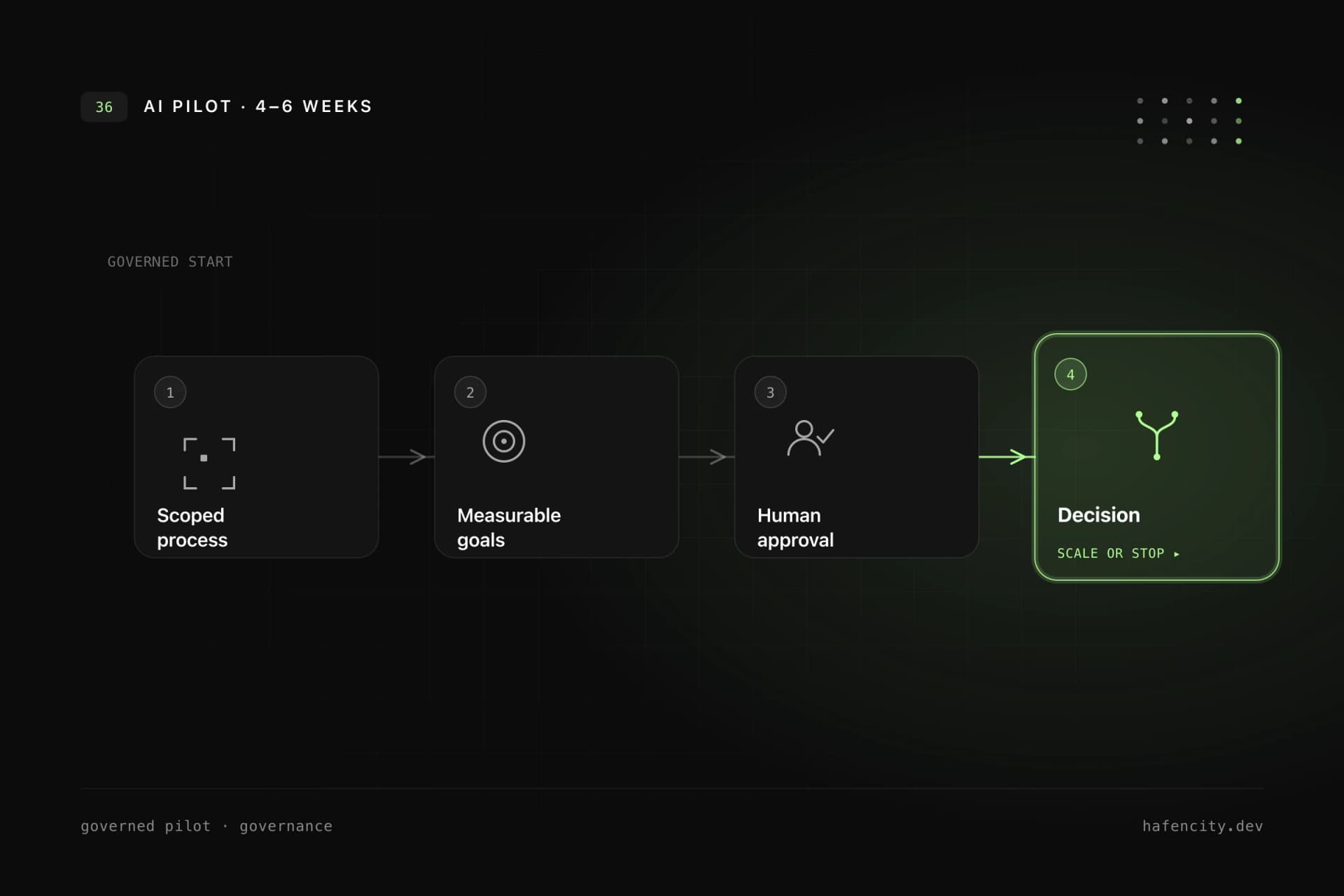
The professional path is neither hype nor blockade — it is a tightly scoped pilot with a clear decision point. That builds real experience without risking critical processes or sensitive data.
A good first pilot has a clearly bounded process, measurable goals, non-critical starting data, human approval, documented risks, clear tool rules, and a decision after four to six weeks. Suitable candidates are internal document search, support summaries, test-case generation, meeting and proposal preparation, or a knowledge base for product teams. The selection is decisive: high volume, low risk, measurable outcome. This is exactly where our AI strategy starts — we evaluate use cases and then build small, measurable pilots instead of a big-bang project.
Risks call for better control, not standstill
Yes, AI brings risks — but they do not disappear by ignoring AI; they are simply discovered later and under more pressure. Privacy, hallucinations, dependencies and quality variance are real. The difference: those who work in controlled pilots early learn these risks in a safe setting, instead of managing them in a crisis.
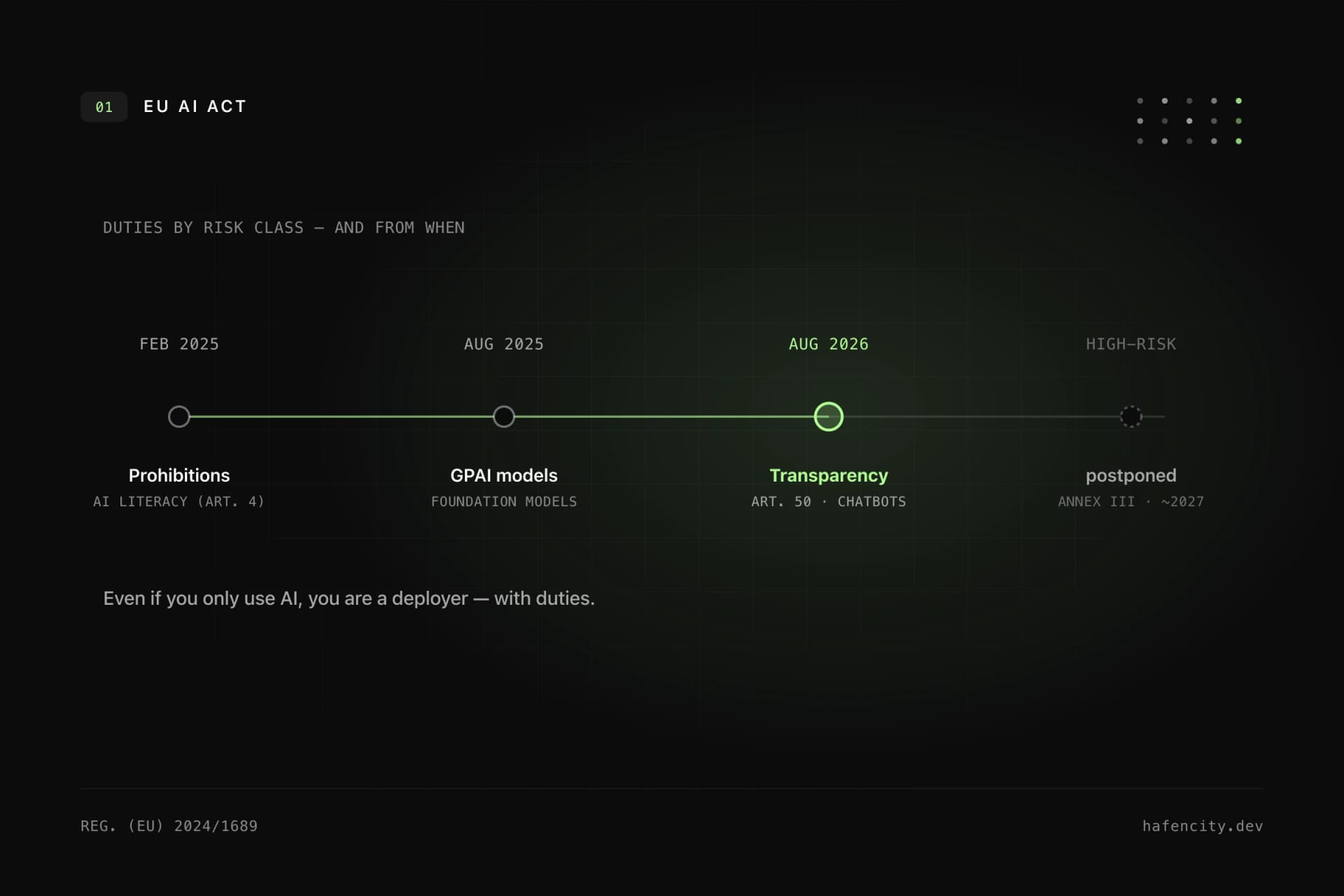
Regulation adds to this. Since 2 August 2025, the obligations of the EU AI Act apply to providers of general-purpose AI models; from 2 August 2026 the requirements for high-risk systems follow. Companies that define rules today — which tools are allowed, which data is excluded, which use cases need a privacy review, which outputs require human approval — build exactly the governance routine that will soon be expected anyway. We go deeper into what matters here in risks in AI software projects.
When AI should deliberately not be used
Non-use can be the right decision — but only as a conscious, reasoned choice, not as an omission. Holding back makes sense when value cannot be measured, data quality is poor, risk is high and uncontrolled, human responsibility is unclear, or the process itself is not yet understood.
The distinction matters: "We deliberately do not use AI here" is a good, documented decision. "We never looked into it" is not a strategy but a blind spot — and in a market where 88 percent of organizations already use AI, that blind spot gets increasingly expensive.
Next steps
Three questions settle the next step faster than any tool demo:
- Where does most of your recurring knowledge work happen — development, support, sales or internal research?
- Which process has high volume and low risk, making it suitable for a first pilot?
- Which privacy and approval rules would need to be in place from the start?
Unsure where a controlled start delivers the most? We make this call in projects regularly — pragmatically and with an eye on roadmap and budget. Take a look at our AI integration or book an intro call directly.