
Most digitalisation and AI projects in the German Mittelstand do not fail on the idea. They fail on the capacity to execute it. According to the KfW analysis of AI in the Mittelstand (February 2026), the lack of suitably qualified staff is one of the central barriers to AI adoption — and the KfW explicitly names external support as the remedy. The Bitkom AI study (February 2026) confirms the picture: 53 percent of companies cite a lack of technical know-how, 51 percent cite insufficient staff.
For a managing director that means: the question is rarely "should we?" but "with whom?". You cannot find the developers and AI specialists you need fast enough on the labour market. This article shows how to ship software and AI anyway — without building a team you cannot staff.
The bottleneck is not the idea — it is capacity
The biggest barrier to digitalisation and AI in the Mittelstand is the availability of skill — staff, time and technical know-how — not the question of whether it pays off. In its February analysis the KfW names the lack of skilled staff and competence, scarce time and capacity, and weak data foundations as the dominant barriers. The Bitkom survey quantifies them.
| Barrier (Bitkom, February 2026) | Share of companies |
|---|---|
| Legal/regulatory uncertainty | 53% |
| Lack of technical know-how | 53% |
| Insufficient staff | 51% |
What stands out is not only the size of the numbers but their nature: two of the top three barriers — know-how and staff — are capacity problems. They do not disappear once management is convinced. They disappear only when someone can do the work. That is also why competence is the strongest driver of adoption: per the KfW, firms with continuous research adopt AI at 38 percent, firms with neither graduates nor innovation activity at only 8 percent. Those with competence in-house build; those without wait.
Why hiring alone does not scale
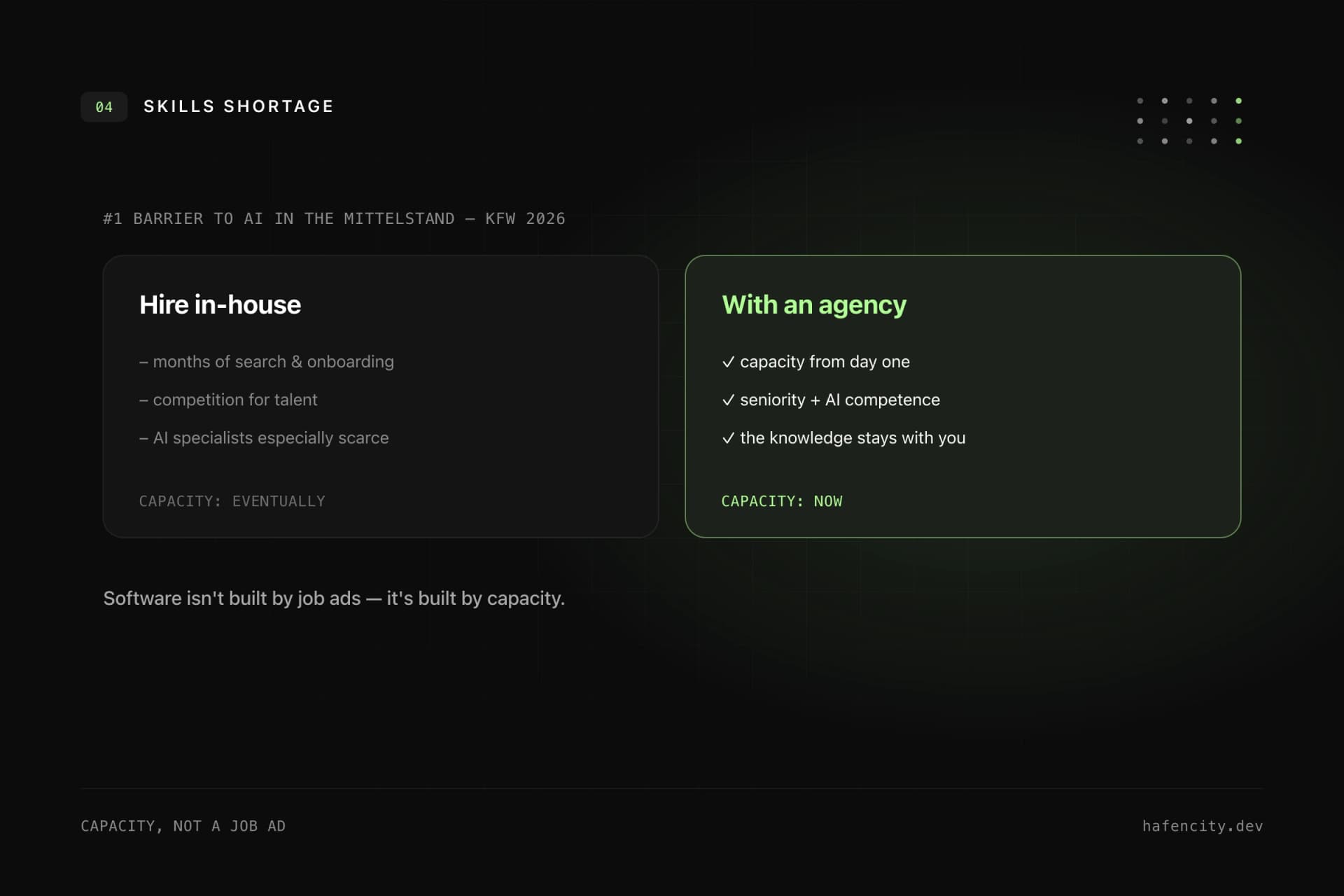
Hiring your own developers is right and important — but it solves an acute capacity problem too slowly, in a market where the right specialists are scarce. A hire is not the day someone starts. It is the sum of the job posting, selection, notice period and onboarding — often many months before measurable output appears. For an AI project meant to secure an edge now, that is a long wait.
On top comes the competition for talent. Experienced developers and especially AI specialists are rare and expensive; independent specialists bill on average around €8,022 per month according to the Freelancer-Kompass 2025. Smaller mid-sized firms compete directly with corporations and tech companies for them — and often lose. The data reflects it: the IW Digitalisation Index 2025 puts small firms at 101.7 points and large firms at 203.4 — a factor of roughly two that the IW explicitly attributes to scarce money and personnel in smaller firms.
The result shows in the depth of AI usage. According to IW Köln, 29.3 percent of companies use free AI tools, 13.0 percent buy AI-as-a-service, but only 3.6 percent develop AI themselves. Many experiment — few build something of their own. Exactly where usage turns into a differentiating product, the hands are missing. More figures on that in AI in the German Mittelstand 2026.
What an agency delivers that you cannot hire
A good software agency is not a substitute for staff but a different lever: it provides senior capacity, established processes and AI competence on demand — without you having to build a team you cannot staff on the market. You are not buying a person but a working team with architecture, development and AI experience that delivers from day one.
The practical difference comes down to four points:
| Dimension | Hiring (in-house) | Agency (partner) |
|---|---|---|
| Time to output | months (search, notice, onboarding) | days to a few weeks |
| Seniority | depends on the applicant market | established senior team from the start |
| AI competence | rarely available, expensive | a continuously used core competence |
| Utilisation risk | fixed cost even when idle | flexible by project phase |
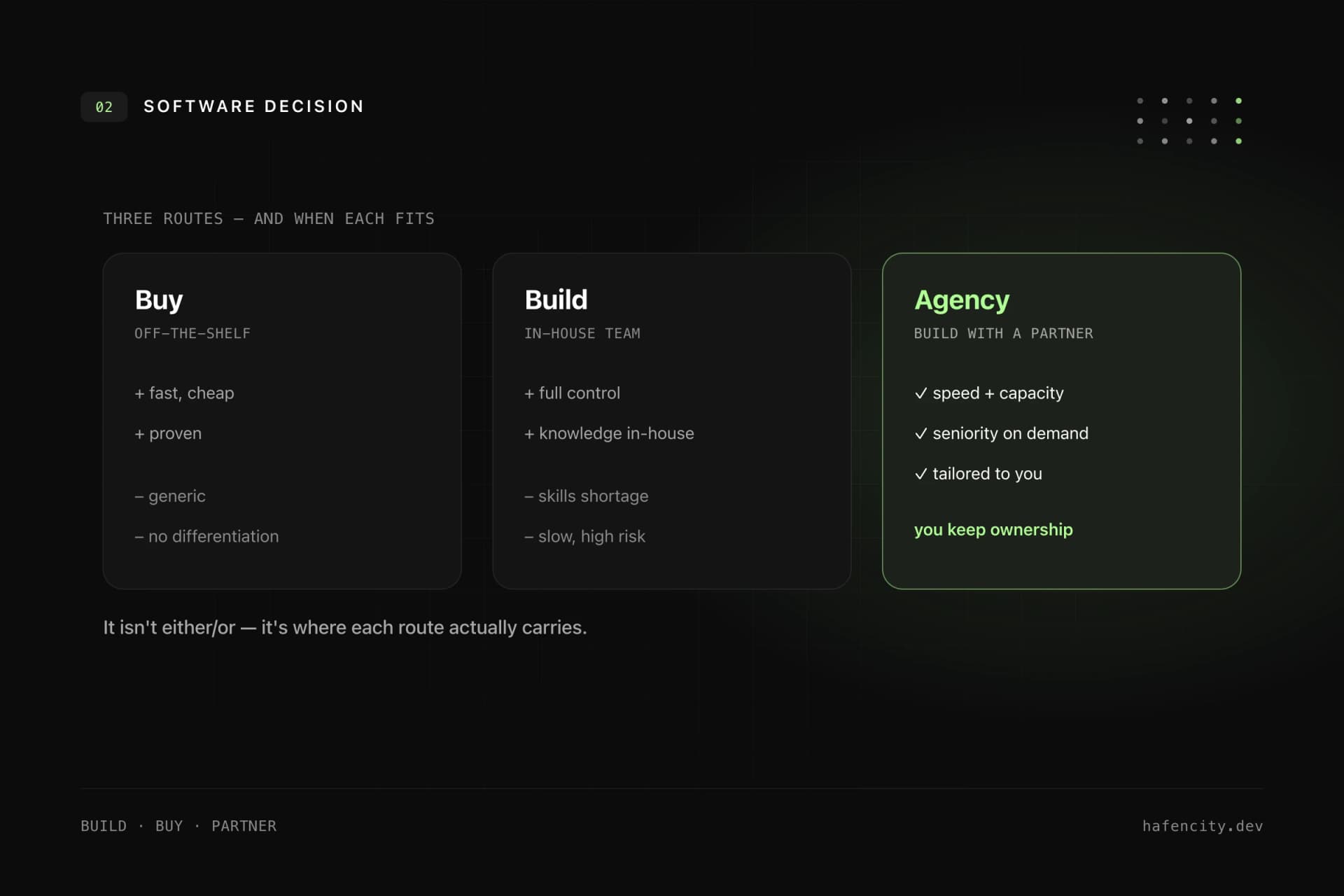
This is also why the fastest-growing digitalisation field calls for a partner: per the KfW (June 2025), digitalising the company's own offering is growing fastest — about 20 percent more firms are pursuing it than in the previous period. Digitalising your own product is demanding custom development, not an off-the-shelf purchase. How we approach it is shown in our software development; how to recognise a dependable agency is covered in How to spot a good software agency.
How the knowledge stays with you — without lock-in
The legitimate concern with external development is dependency. It is avoidable when ownership, handover and documentation are part of the contract from the start, not an afterthought. An agency that deliberately gives knowledge back makes itself replaceable — and that is exactly the quality signal you should look for.
In concrete terms: code, repositories, infrastructure and access belong to you. The code is readable, tested and documented, so another team could take over. There are regular knowledge handovers and, where useful, a gradual enablement of your own people. We deliberately rely on open standards instead of proprietary building blocks, so a switch stays technically possible. That standard keeps the work disciplined even where no one is watching.
This discipline has a second effect: it keeps costs predictable. Software rarely gets expensive through the hourly rate, but through unclear requirements and rework — according to Bitkom, 33 percent of AI-using companies report higher costs than expected (relative to the roughly 41 percent of all firms that use AI). Clean scoping, early prototypes and incremental delivery lower that risk rather than amplifying it. How AI accelerates development itself is described in AI in software development; the underlying make-or-buy decision is explored in Build, buy, or agency.
Next steps
Three questions clarify faster than any job posting whether a partner is the right path:
- Urgency: Does the project need to show impact in the coming months — or can you wait a year on search and onboarding?
- Competence: Do you need AI or architecture skills that are scarce and expensive on the market and that you would only use selectively?
- Ownership: Is it clearly agreed that code, data and documentation stay with you and that your team can take over?
If you see bottlenecks here, the first step is not a recruiting process but a sober conversation about goal, timeline and existing capacity. Tell us about your project and the missing hands — then book an intro call.