
In 2026 around 90% of developers use AI tools daily, and over 80% say it makes them more productive (DORA 2025 report). Yet a controlled trial by METR found that experienced open-source developers working on mature code were 19% slower with AI – while believing they were about 20% faster.
Both findings are true. The question is therefore no longer whether AI makes software development faster, but where: which parts of the process actually speed up, where the bottleneck moves – and how to make the gain measurable instead of trusting it.
What the 2026 numbers show
AI use is the norm in 2026 – the productivity gain is not automatic. The DORA 2025 report surveyed nearly 5,000 professionals: around 90% use AI in development, a median of two hours a day, over 80% report higher productivity, and 59% a positive effect on code quality. For the first time, AI adoption is linked to higher delivery throughput – a reversal from 2024.
At the same time, scepticism is growing. In the Stack Overflow Developer Survey 2025, 84% use or plan to use AI tools and 51% of professionals work with them daily – yet trust has fallen to 29%. And the METR study from July 2025 shows the flip side: in a randomized trial with 16 experienced developers and 246 tasks on familiar, mature repos, AI cost 19% more time on average. That is not a contradiction but context: when you hold a million-line project in your head, suggestions add little – and reviewing them takes all the longer.
Where AI accelerates – and where it slows you down
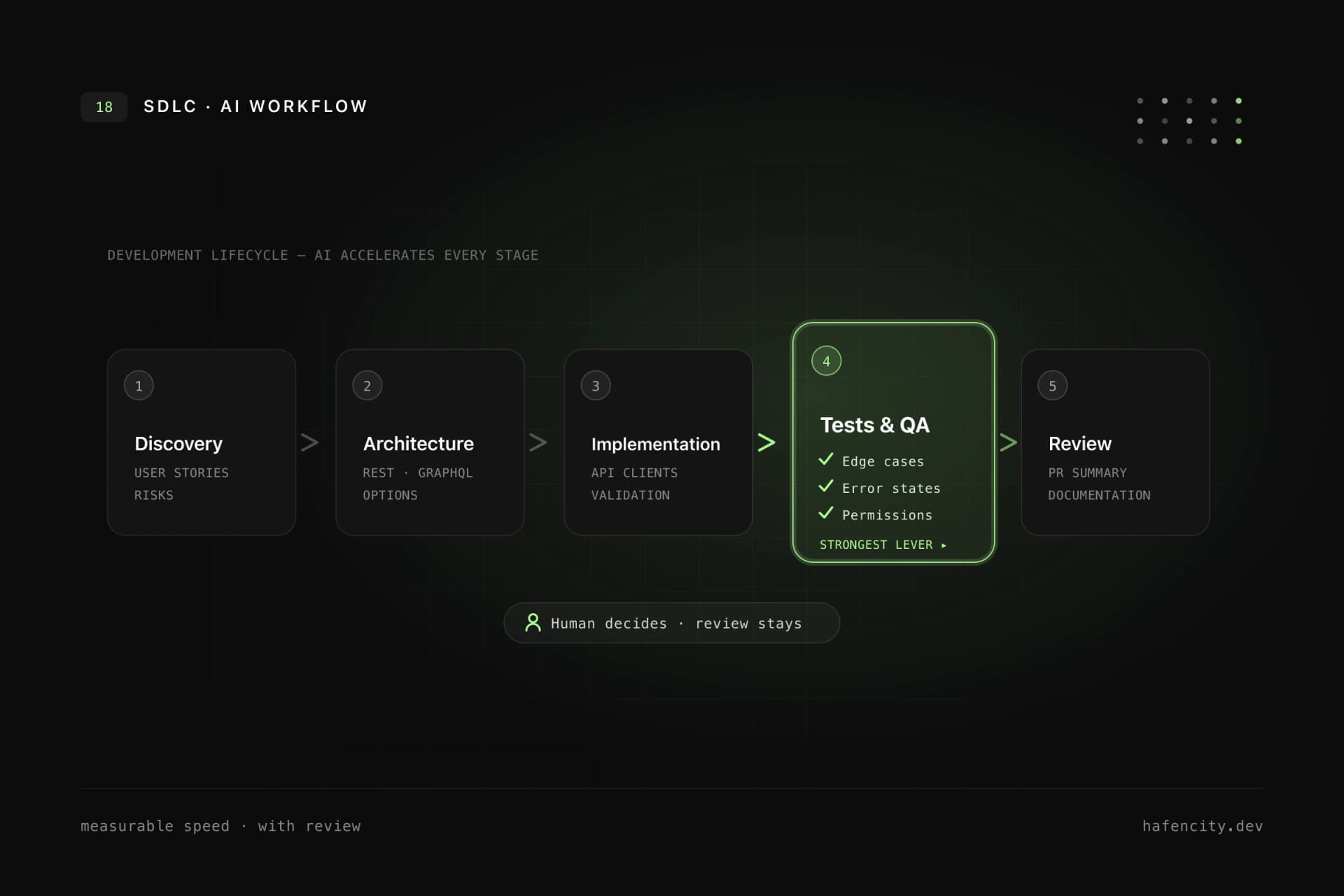
AI is strongest where work is structured, repeatable and immediately verifiable. That is where it saves preparation time and friction – not in typing, but in the handoffs before and after: vague tickets, missing acceptance criteria, undocumented architecture decisions, tests written too late, reviews that catch the same issues again and again.
| AI reliably accelerates this | Be careful here |
|---|---|
| Test cases and edge cases | Deep domain and business logic |
| Boilerplate, forms, validation | Security architecture |
| Data mapping and API clients | Payment and pricing logic |
| Migration scripts, build fixes | Permission and role models |
| Docs and pull-request summaries | Personal and medical data |
| Greenfield code without legacy | Large, mature codebases |
On the left, an agent produces suggestions a human can judge in seconds. On the right, AI may prepare, document and test – but the decision must remain traceable and owned by the team. We describe where we draw that line in Risks in AI software projects and AI coding with Codex and Claude.
The new bottleneck: review and stability
When code arrives faster, the bottleneck does not disappear – it moves downstream. The DORA 2025 report is clear here: AI lifts throughput, but without strong controls it has a negative relationship with delivery stability. More change volume without robust tests, clean version control and fast feedback loops leads to more change failures and more rework. The dominant new bottleneck is code review: it suddenly has to absorb more and larger changes.
In practice this means: anyone adopting AI must invest in review quality, test automation and platform at the same time. Otherwise you get what DORA calls "localized pockets of productivity", whose gains are absorbed further down the line. AI is therefore always process work too: better tickets, smaller pull requests, more focused reviews and documented decisions.
Speed needs measurement
Teams adopting AI should not measure "it feels faster" but prove the effect before and after. The METR study is the best reminder of why: participants were convinced they were faster – and were wrong. Useful metrics can be collected with standard tooling:
| Metric | What it shows |
|---|---|
| Cycle time | How fast work moves from start to merge |
| Review duration | Whether pull requests become clearer and smaller |
| Defect rate | Whether speed creates more bugs |
| Critical-path test coverage | Whether quality is secured earlier |
| Rework share | Whether requirements were understood better |
| Documentation quality | Whether knowledge is preserved |
These metrics are also why strong teams benefit more: AI amplifies existing habits. Where requirements are unclear and tests are missing, it produces inconsistency faster; where work is clean, it becomes a multiplier. More on this in Quality is measurable.
Tools and costs in 2026
The tools are mature in 2026 – and per developer they cost less than one hour of developer time per month. The market has consolidated around a few agents; in the Stack Overflow survey, ChatGPT (82%) and GitHub Copilot (68%) lead. Licence prices are rarely the decisive cost factor – adoption, review and training matter more.
| Tool | Entry | Pro / month | 2026 model |
|---|---|---|---|
| GitHub Copilot | Free (2,000 completions) | $10 (Pro), $39 (Pro+) | usage-based with AI credits (since June 2026) |
| Cursor | Free (Hobby) | $20 (Pro), up to $200 (Ultra) | credit pool per plan |
| Claude Code | included in Claude Pro | ~$20 (Pro), from $100 (Max) | subscription plus usage limits |
Prices come from the official plans of GitHub, Cursor and Anthropic (as of June 2026). Note: since 1 June 2026 several vendors bill usage-based with credits – so the monthly bill depends on actual consumption, not the list price alone. Which agent fits is less a price question than one of codebase, data protection and integration; we compare them in Codex, Claude and Cursor in an agency.
Next steps
A good start is not a large AI transformation programme but a focused four-to-six-week pilot. Three questions clarify the direction faster than any tool demo:
- Tasks: which three recurring, verifiable tasks (tests, docs, boilerplate) make a good pilot?
- Controls: are test automation, small pull requests and fast reviews already in place – or do they need to be built first?
- Measurement: which baseline values (cycle time, defect rate, rework) do we capture to prove the effect?
At hafencity.dev, we combine AI-supported development with clear architecture, review processes and measurable quality. Take a look at our AI integration and web app development – or book an intro call directly.