
Many agencies write on their website that performance, accessibility, best practices and SEO matter to them. That sounds good, but at first it is only a claim. It gets interesting when quality can be checked – and in 2026 it can be checked more than ever: Core Web Vitals are a ranking signal with clear thresholds, and since 28 June 2025 accessibility has been a legal requirement for many providers under Germany's Barrierefreiheitsstärkungsgesetz (BFSG).
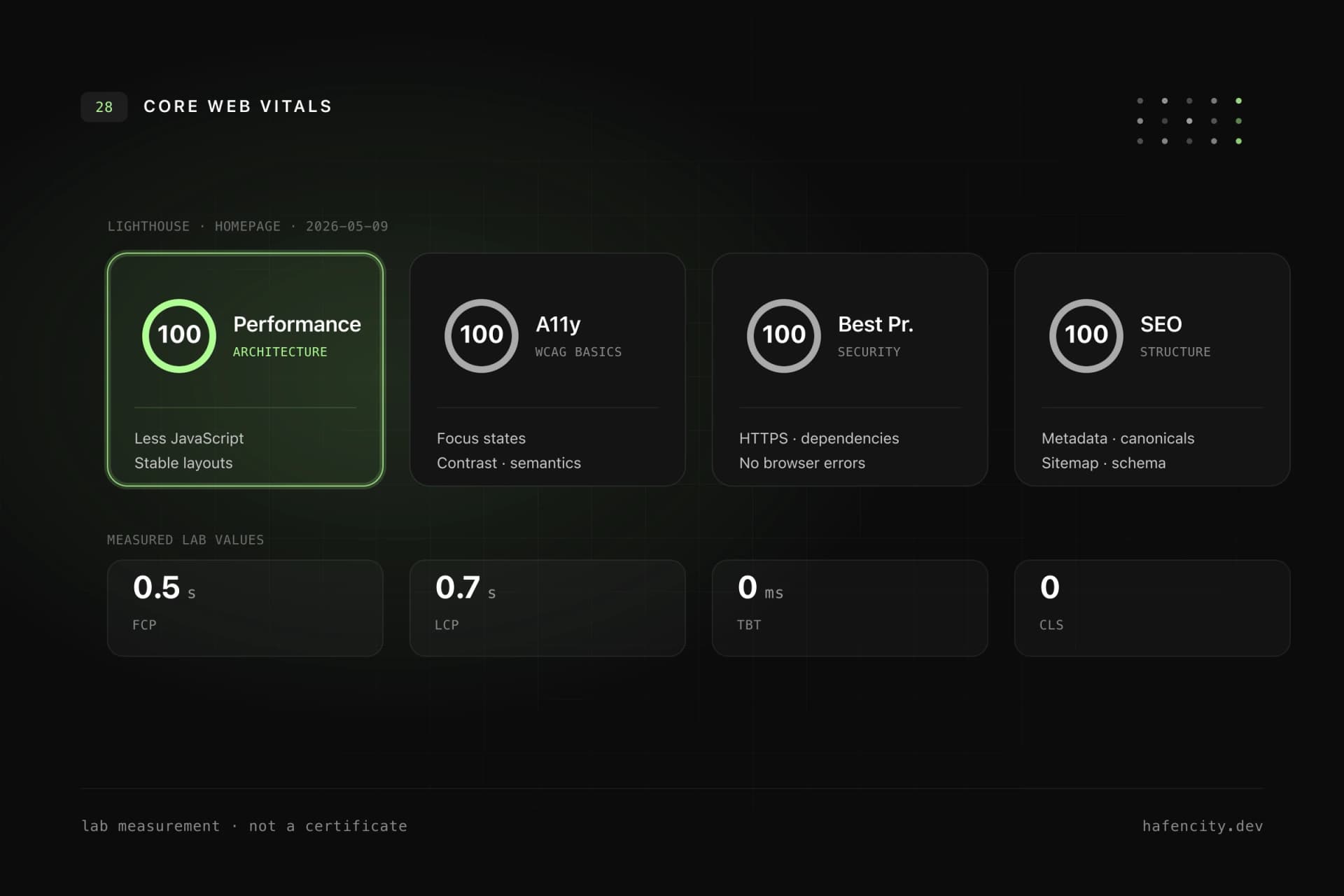
With our own website, we wanted to honor exactly that standard: a site that does not work against its own technical promise. So we did not "add SEO at the end". Performance, accessibility and technical structure were part of the build from the start. The result in the Lighthouse check of our homepage: 100 points in all four categories – not a certificate, but a solid signal that the fundamentals are in place.
What a score measures – and what it does not
A Lighthouse test is a lab measurement, not a seal of quality. It runs under defined conditions – a fixed device profile, a throttled connection, a defined page state. Values can change as soon as content, tracking, images or scripts change. So it would be unserious to say "the website is perfect". The honest statement is: the score shows that the technical foundation is clean and that the key quality areas were not patched in later.
How high the bar sits becomes clear from the market: according to the Web Almanac 2025 by HTTP Archive, only around 48% of websites passed the Core Web Vitals assessment on mobile in 2025, and about 56% on desktop. A clean score is not the default state – it is the result of deliberate decisions.
Performance: Core Web Vitals are the hard currency
Performance does not start by compressing a file at the end of a project – it starts with architecture. Google measures user-facing speed through three Core Web Vitals with clear thresholds. Since March 2024, Interaction to Next Paint (INP) has replaced the older responsiveness metric First Input Delay – an important shift, because INP measures responsiveness across the whole session, not just the first interaction.
The table below shows the official thresholds and our measured lab values. Note: INP is a field metric from real interactions – in the lab, Lighthouse approximates interactivity via Total Blocking Time, which was 0 milliseconds in our run.
| Metric | Good | Needs improvement | Poor | Our lab run |
|---|---|---|---|---|
| LCP (load speed) | ≤ 2.5 s | 2.5–4.0 s | > 4.0 s | 0.7 s |
| INP (responsiveness) | ≤ 200 ms | 200–500 ms | > 500 ms | field metric* |
| CLS (visual stability) | ≤ 0.1 | 0.1–0.25 | > 0.25 | 0 |
*INP is measured in the field; in the lab, Total Blocking Time (0 ms) serves as a proxy. Such values come from less unnecessary JavaScript, stable layouts with fixed aspect ratios, modern image formats (AVIF/WebP with clean sizes) and a sparing use of fonts. More on this in our article on Core Web Vitals optimization.
Accessibility: mandatory since June 2025, not optional
Accessibility is no longer a voluntary extra – for many providers it is a legal requirement. With the Barrierefreiheitsstärkungsgesetz (BFSG), in force since 28 June 2025, Germany transposes EU Directive 2019/882 (the European Accessibility Act). It applies to online shops, banking, booking and ticketing systems and many other consumer-facing services. New websites and apps get no grace period – they have had to be accessible since the cut-off date.
The binding reference is the European standard EN 301 549, which points web content to the WCAG conformance levels A and AA. The current standard is WCAG 2.2, a W3C Recommendation since October 2023; WCAG 3.0 is still a working draft. An exemption applies to microenterprises (fewer than 10 employees and up to 2 million euros annual turnover) offering services – products are not exempt. Violations can be fined up to 100,000 €.
A Lighthouse accessibility score does not replace a full WCAG audit. It catches many baseline issues – weak contrast, missing labels, incorrect heading structure – but only covers part of the success criteria. So we treat accessibility as part of normal UI quality: semantic HTML, visible focus states, full keyboard support, robust form labels and text that also works in a screen reader. A practical guide is in our BFSG and WCAG checklist.
Best practices: the invisible quality layer
Best practices are rarely the part of a website that users consciously notice – which is exactly why they get neglected. Yet they decide security, maintainability and trust. Lighthouse checks delivery over HTTPS, the absence of known vulnerabilities in dependencies, a clean console without browser errors and correct image rendering, among others.
For us, this layer includes current framework and dependency versions, a sensible Content Security Policy, valid links and redirects, stable forms with understandable validation, and a clear separation of content, layout and behavior. These points do not automatically make a website beautiful. But they prevent good design from sitting on a fragile foundation.
SEO: information architecture, not keyword decoration
SEO is often reduced to copy and keywords – but technical SEO starts much earlier. A website must clearly tell search engines which URL is canonical, which pages should be indexed, which language versions belong together via hreflang, and which content is an article, an organization, a service or a contact page. These signals come from metadata, Open Graph, structured data, sitemaps and clean redirects – fundamentals that the Google SEO Starter Guide also emphasizes.
On our website, these elements are part of the normal implementation, not an "SEO plugin at the end". Good SEO is not about tricking search engines, but about structuring content so clearly that people and machines understand what it is about. For a systematic view, see our article on technical SEO for software companies.
Quality as a system, not a score
The four Lighthouse dimensions are not trophies but checkpoints of the same way of working. Performance, accessibility, best practices and SEO interlock: a fast page is usually also a lean one, an accessible structure is also a machine-readable one, and clean technical foundations prevent good design from crumbling later.
It would be unserious to conclude from a single report that a website is permanently perfect. Good values can degrade after later changes, mobile field data can differ from desktop lab data, and external tools can add load. So the most important point is not the score but the process behind it: measure, understand, improve – and not wait until problems become visibly expensive.
Next steps
Three questions quickly clarify where your website stands on measurable quality:
- Performance: Do your most important pages pass the Core Web Vitals in the field – with real users, not just in the lab?
- Accessibility: Does your offering fall under the BFSG, and does it meet WCAG 2.2 at level AA?
- Technical & SEO: Are metadata, structured data, redirects and indexing set up cleanly?
If you are unsure about any of these, we are happy to review your site – pragmatically and with an eye on effort versus value. Take a look at our web development and accessibility services, or book an intro call directly.