
The average company now runs around 106 SaaS applications, according to BetterCloud's State of SaaS report. Each tool solves a problem, but together they create data silos, manual handovers and broken workflows. The real cost driver is rarely the license — it is the friction between systems.
Standard software is still often the right starting point: available quickly, maintained by the vendor, mature. The problem begins when software no longer supports the process, but the process has to be organized around the software. For SMEs and B2B companies in Hamburg, that is exactly the point where custom software becomes economical. This article shows when — and how to plan the move without unnecessary risk.
When standard software is exactly right
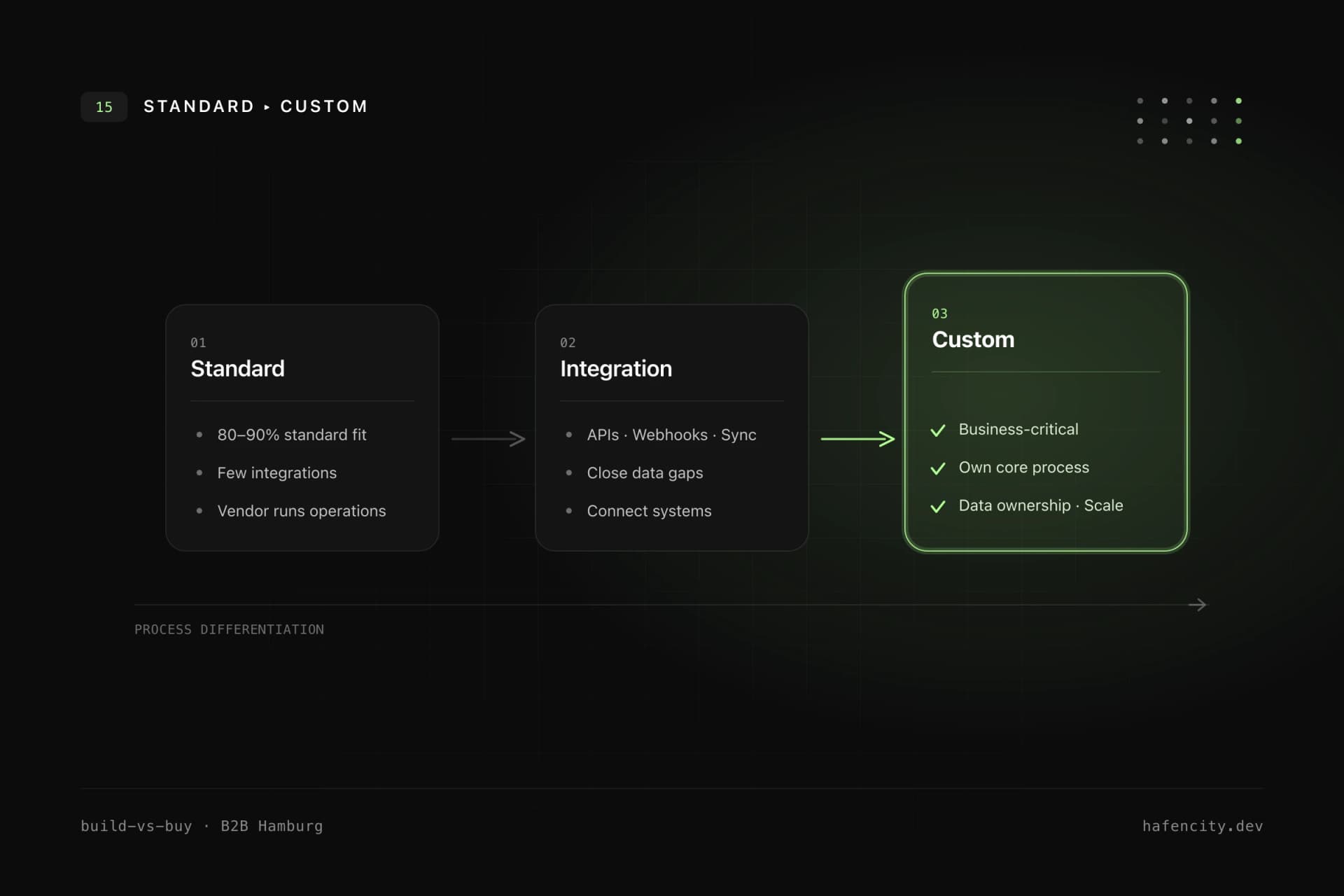
Standard software is the more economical choice as long as your requirements are close to the market standard. Accounting, simple CRM processes, project management, scheduling and support tickets are covered by mature tools. If an existing product cleanly meets 80 to 90 percent of your requirements, custom development is rarely worthwhile — operations, updates, support and security stay with the vendor.
Standard tools are usually enough when the process is not a business differentiator, few integrations are required, the data and permission model fit the product, workflows can be configured instead of custom-built, and subscription cost is reasonable relative to the value. The boundary is reached where configuration, workarounds and manual rework become more expensive than a focused custom solution — and that friction grows with every additional tool in the stack.
Warning signs: when the process routes around the software
A clear warning sign is when important work happens outside the actual system. If decisions live in email, prices in Excel, customer data in the CRM, order details in the ERP and status in chat threads, there is no reliable single source of truth. Other common signs:
- Teams maintain the same data in multiple systems.
- Exports and imports are part of daily operations.
- Standard software forces steps that make no business sense.
- Reporting takes days because data has to be cleaned first.
- Growth creates more coordination instead of more throughput.
- Permissions, roles, audit logs or privacy requirements cannot be represented cleanly.
In these situations custom software is not automatically the answer. But it should be evaluated, because the cost driver is usually not the license — it is friction in the process. How to turn that into measurable value is covered in our article on automating business processes and ROI.
What custom software costs — and what standard software hides
The comparison is often framed incorrectly: standard software looks cheaper because the license is visible monthly — but the expensive items are not. What matters economically is total cost over several years, not the entry price.
The orders of magnitude for custom software in Germany in 2026: small internal tools and automations start around €5,000, a focused business app or customer portal often lands at €20,000–60,000, and complex platforms or industry solutions at €50,000–150,000 and more (codeguides.de). Agency hourly rates in the DACH region in 2026 are typically €120–180 (agenturmatching.de). These are indicative figures — a serious estimate only follows once scope, integrations and quality requirements are clear.
What matters is an honest comparison of total cost:
| Cost item | Standard software | Custom software |
|---|---|---|
| Visible | license / per-user fee (monthly) | development (one-off, upfront) |
| Implementation | setup, customization | discovery, architecture, build |
| Integration | often extra cost per connector | part of the solution |
| Hidden | duplicate entry, workarounds, errors | operations, maintenance, evolution |
| Vendor lock-in | high (model, export) | low (your code, your data) |
| Opportunity cost | slow processes scale with you | falls with automation |
Custom software is not automatically cheaper. For generic requirements it is often more expensive. It becomes interesting when process cost, integration effort, growth constraints or data risks stay high over time. More on that in Why cheap software becomes expensive.
Integration instead of full replacement
Often a company does not need a new core system, but an integration layer. APIs, data pipelines, synchronizations, webhooks and reliable background processes connect existing standard software instead of replacing it — the fastest way to dissolve data silos. Typical patterns: CRM data is synchronized with ERP orders, customers get status from multiple systems in one portal, quotes are generated from product, price and customer data.
This is exactly where strong backend development is decisive: interfaces must handle errors, retries, permissions, logging and data consistency. An integration that only works in the ideal case merely moves problems elsewhere.
Customer-facing portals are a special case: pure B2B applications are usually exempt, but as soon as consumers are reached, the German European Accessibility Act (BFSG) applies, in force since 28 June 2025. With a custom build, accessibility can be planned in from the start instead of being retrofitted expensively later.
Migration without a big bang
The best migration is rarely the big cut. Especially in SMEs, it is wiser to relieve existing systems step by step and introduce new functionality in a controlled way — with early value and limited risk.
| Phase | Goal | Result |
|---|---|---|
| Analysis | make processes, data sources, risks and cost visible | clear decision basis |
| Target architecture | define the core process and system boundaries | what stays, what gets built |
| MVP | improve one critical workflow in production | early value, limited risk |
| Integration | connect existing systems | less duplicate data entry |
| Operations | establish monitoring, support and evolution | long-term stability |
Data migration is especially important. Legacy data is rarely as clean as it appears in presentations: duplicates, missing required fields and historical exceptions must be checked early. A detailed risk view is in Modernizing legacy software: cost, risk, migration. Which approach fits your situation can be roughly placed:
| Situation | Sensible approach |
|---|---|
| standard process, little differentiation | standard software |
| suitable tool, small gaps | configuration or customization |
| several systems, many manual handovers | integration solution |
| proprietary core process, high manual effort | custom software |
| new digital business model | custom web app or platform |
Next steps
Three questions narrow the decision faster than any feature list:
- Process fit: does the process differentiate your company — or is it market standard?
- Friction: how much time do duplicate entry, exports and manual handovers really cost per week?
- Total cost: what does the five-year calculation look like, including the hidden items?
Unsure whether standard software is enough for your next step or whether a custom solution is more economical? We narrow the right scope together in a sober clarification. Take a look at our software development or book an intro call directly.