
"Local expertise" sounds like soft location marketing — but in 2026 it is backed by hard numbers. According to the Hamburg Startup Monitor 2026, the Hanseatic city counts around 1,540 active startups, making it Germany's third-largest founding ecosystem after Berlin and Munich. In 2025, 203 new startups were added — up 26% and a clear signal that momentum is back after several weaker years.
For founders planning an app, that's more than a pleasant environment: it means access to capital, talent and experienced delivery partners, all close at hand. Let's look at the factors that actually decide the start in 2026.
Hamburg is Germany's third-largest startup ecosystem
The numbers from the Hamburg Startup Monitor 2026 paint a picture of substance over hype. Beyond the 1,540 active startups and the 26% rise in foundations, the thematic focus stands out: around 22% of Hamburg startups — about 170 companies — work in the GreenTech sector, well above the national average. And the ecosystem is international: 21% of founders were born abroad (13% nationally).
At the same time, the picture isn't all rosy: on venture capital Hamburg lags behind — around €3B has been invested in Hamburg startups since 2015, versus roughly €38B in Berlin over the same period. For app founders, the lesson is clear: early validation and lean spending aren't just virtues in Hamburg, they're necessities. Whoever shows a testable product early reaches the next funding round more easily.
Capital and funding: Hamburg funds with focus
Before you raise a round, it pays to look at non-dilutive funding. IFB Innovationsstarter GmbH, a subsidiary of IFB Hamburg, supports young, innovative startups based in Hamburg. According to the federal funding database, the InnoRampUp programme grants up to 90% of eligible expenses — a maximum of €150,000 per project, paid out in up to three stages.
Eligible companies are less than two years old, employ fewer than 50 people and have their main activities in Hamburg. For very early stages, programmes such as InnoFounder add to this. In practice this matters: these grants combine well with a tightly scoped MVP — the funding envelope often covers exactly the development cost of the first market-ready product.
From MVP to product: agile and cross-platform
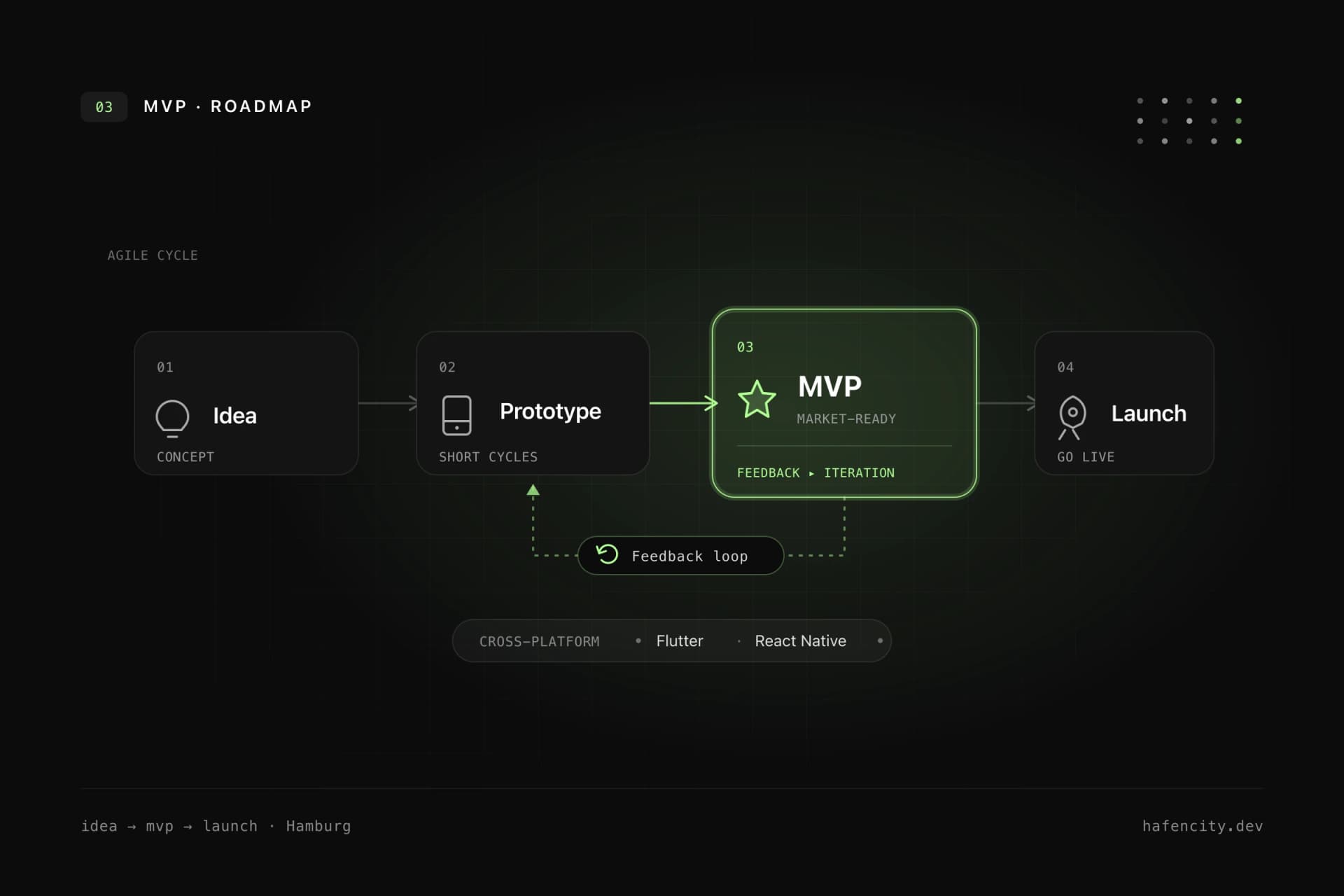
The fastest route to market in 2026 runs through a cross-platform stack and short iterations. Instead of building two native apps in parallel, startups share one codebase for iOS and Android — in many projects that halves the UI effort. The two leading frameworks are mature: Flutter is at version 3.44 (May 2026, with Dart 3.11), and with React Native 0.83 and Expo SDK 55 the New Architecture is on by default — the old bridge architecture has been removed.
| Flutter | React Native | |
|---|---|---|
| Current version | 3.44 (May 2026) | 0.83 / Expo SDK 55 |
| Language | Dart | TypeScript / JavaScript |
| Architecture | Impeller renderer | New Architecture (default) |
| Strength | consistent UI, one codebase for many platforms | large React ecosystem, web proximity |
Which framework fits depends on your team and UI complexity — we compare the options in detail in Flutter vs. React Native vs. Native. What matters is less the logo than the cut of the MVP: a focused product takes around 8 to 16 weeks under an agile approach, because each iteration folds in real user feedback instead of building blind for months.
What app development in Hamburg costs
The biggest cost driver is scope, not the postcode. A serious DACH agency charges hourly rates of about €120–180 in 2026 (app cost overview); freelancers sit below that but don't bring a full team. From this, three rough project classes emerge:
| Project type | Scope | Realistic range |
|---|---|---|
| MVP (cross-platform) | core function, one build for iOS + Android | €15,000–40,000 |
| Business app | several modules, backend, integrations | €40,000–100,000 |
| Enterprise / platform | complex logic, scaling, high load | from €100,000 |
These bands are guide values, not fixed prices: a photo upload with a map costs differently than a real-time logistics app. This is exactly where Hamburg's funding landscape pays off — an IFB grant of up to €150,000 can substantially lower the own share of an MVP. How we think about budget, roadmap and funding together is shown in our guide to building an MVP.
Why local expertise makes the difference
Proximity is not a gut feeling but a time advantage. In the Hamburg Startup Monitor 2026, 66% of startups want more in-person exchange — a clear signal that personal collaboration matters even in a remote world. Short distances mean shared workshops, faster decisions and less friction between idea and release.
Equally important is the shared understanding of German rules. Since 28 June 2025 the Accessibility Strengthening Act (BFSG) applies: B2C apps and online shops must be accessible — with no transition period for new offerings. Add GDPR and EU requirements on top. A local team plans for these points from the start instead of retrofitting them expensively after launch. What to look for when choosing a partner is summarised in how to spot a good software agency.
Next steps
Three questions move your app project forward faster than any location debate:
- Core function: what is the one thing your MVP must do so users will test it?
- Funding: do you meet the IFB criteria (Hamburg office, < 2 years, < 50 employees) for a grant?
- Stack: is cross-platform enough, or are there native requirements (hardware, performance) that argue against it?
Planning an app and want to use Hamburg's levers — funding, proximity, a fast MVP — properly? Take a look at our app development and cross-platform development, or book an intro call directly.