
For years the decision fit into one rule of thumb: "native is fast, cross-platform is a compromise." That rule is outdated in 2026. React Native replaced the old asynchronous bridge with its New Architecture — and as of version 0.85 (April 2026) it has been removed from the codebase entirely. Flutter 3.44 renders with Impeller instead of Skia, hitting steady 60/120 FPS. Native's performance lead has shrunk to a footnote for most apps.
That shifts the real question — away from "who is fastest?" toward cost, maturity and team. Let's look at the differences that actually matter in 2026.
Three paths, one question: codebase or platform depth
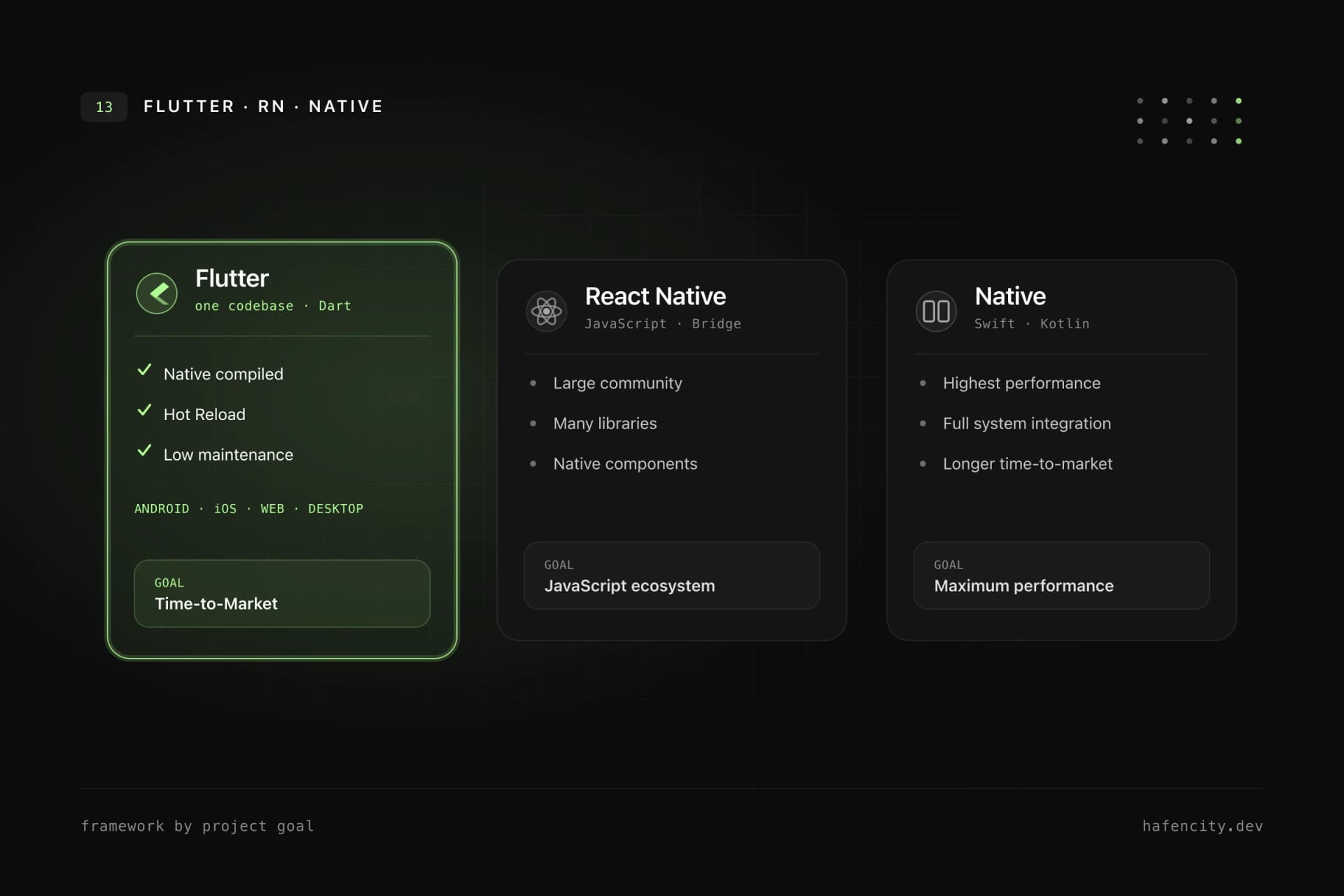
At their core, the three approaches don't differ in quality but in how much code you write twice. Flutter and React Native share one codebase across iOS and Android (and often web); native development maintains a separate stack per platform.
Flutter is Google's open-source framework. You write in Dart, and Flutter renders the UI itself — since the switch to the Impeller engine with precompiled shaders, which eliminates the earlier first-frame stutter. The result is a pixel-identical UI across all platforms.
React Native comes from Meta and uses JavaScript or TypeScript. Unlike Flutter, it drives real native UI components from JavaScript. For teams already working in the React and web ecosystem, the ramp-up is short.
Native development means separate projects: Swift with SwiftUI for iOS, Kotlin with Jetpack Compose for Android. Maximum platform depth, but double the effort in development and maintenance. When that effort pays off, we cover in more depth in the business case for Flutter and What is Flutter?.
Performance in 2026: the old myth no longer holds
The claim "cross-platform is slow" was once justified — for standard apps, it isn't anymore. React Native's frequently cited bottleneck was the bridge: an asynchronous JSON layer between JavaScript and native code. With the New Architecture (JSI, Fabric, TurboModules) it's gone; since React Native 0.85 every app runs exclusively on the new, direct model.
Flutter takes the other route and renders everything itself. With Impeller — the default renderer on iOS and Android since 2024/2025 — shaders are precompiled, the typical stutter disappears, and steady 120 FPS are realistic on modern hardware. For compute-heavy 3D graphics, AR/VR or tasks at the edge of the hardware limit, native stays ahead. For lists, forms, real-time updates and API calls — the vast majority of business apps — the difference is barely noticeable in practice.
Cost: a single codebase saves 30–40%
The biggest economic lever isn't the hourly rate — it's the number of codebases. Building iOS and Android natively means developing and maintaining two apps in parallel. Cross-platform shares up to roughly 90% of the code — which, by market experience in DACH practice, lowers development cost by about 30–40% and shortens time-to-market.
| Criterion | Flutter | React Native | Native |
|---|---|---|---|
| Language | Dart | JavaScript / TypeScript | Swift · Kotlin |
| Codebase | one | one | two (iOS + Android) |
| UI approach | own renderer (Impeller) | native components | native |
| Performance class | high | high | maximum |
| Time-to-market | short | short | long |
| Relative cost | low–medium | low–medium | high |
The numbers reflect typical ranges for Germany (day rates €800–1,500, MVP budgets from around €20,000). The point: the entry price says little about total cost. A second native codebase costs more not just once, but again every sprint, every update, every bugfix. How that adds up specifically for Flutter, we show in What does a Flutter app cost?.
Maturity and team: what the language brings
You choose the technology not only by features, but by the people who maintain it. Both cross-platform frameworks are mature in 2026 — "young ecosystem with few libraries," as people once said about Flutter, no longer applies to either.
React Native benefits from the huge JavaScript ecosystem: if you already have a web team using React, you can reuse knowledge, tooling and partly code. Flutter brings a smaller but very coherent world with Dart — strongly typed, good for large teams and long-lived codebases. Per the Stack Overflow Developer Survey 2025, both sit close together in adoption, with Flutter slightly ahead. In practice that means: both have enough developers, packages and long-term outlook. The more honest question is which ecosystem fits your existing team.
Decision guide: when each one is right
There is no universally "best" technology — there's the right one for your project:
- Flutter, when a consistent, on-brand UI across all platforms matters, the team is being built from scratch, and you value a coherent, type-safe codebase.
- React Native, when you already have React/web know-how in-house, want to integrate native modules, and JavaScript/TypeScript is your main language anyway.
- Native, when AR/VR, compute-heavy graphics, deep hardware integration or strict real-time requirements form the product core — or when you only serve one platform.
In most business projects the choice is between the two cross-platform paths, not between cross-platform and native.
Next steps
Three questions settle the decision faster than any framework duel:
- Platforms: do you need iOS and Android (and web) — or is one platform enough?
- Team: do you already have web/React know-how, or are you building the team from scratch?
- Product core: are standard features central, or hardware, AR/VR and real-time requirements?
Unsure which technology fits your product, team and budget? We make this call in projects regularly — pragmatically and with an eye on roadmap and total cost of ownership. Take a look at our app development and cross-platform development or book an intro call directly.