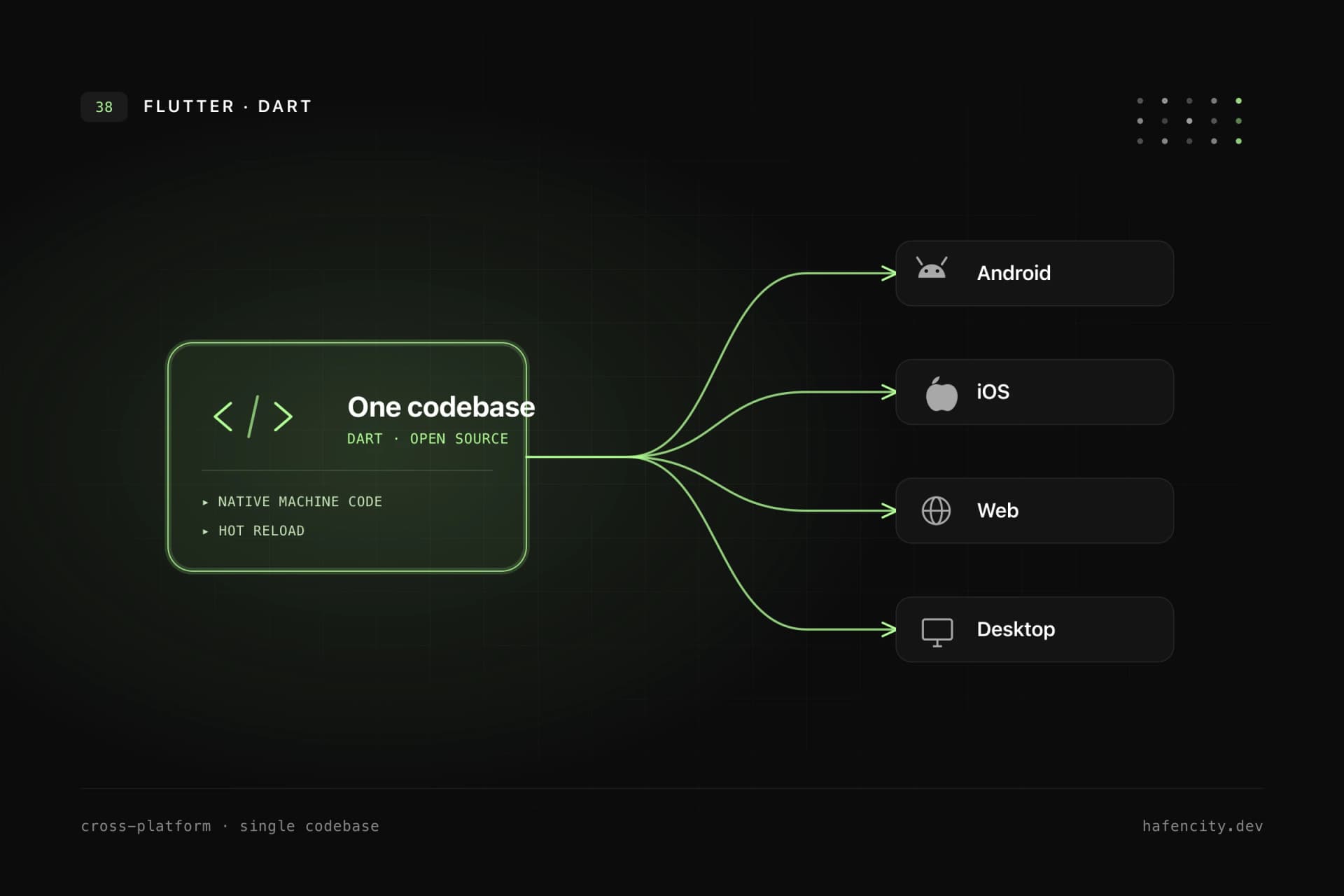

Flutter is Google's open-source framework that lets a team build high-quality apps for iOS, Android, Web and desktop from a single Dart codebase. That is exactly what makes it interesting for businesses: instead of funding two or three separate apps, you ship one product that runs everywhere.
In 2026 Flutter is no longer a young experiment. The current stable version is Flutter 3.44 (May 2026), and large products like Google Pay, the BMW app and Nubank run on it at a scale of millions of users. Let's look at what actually matters in 2026 — soberly, with current numbers.
What Flutter is — and what changed by 2026
Flutter is a UI framework, not just an app builder — it ships its own rendering engine. Google released Flutter in 2017; you write in Dart, which compiles ahead-of-time to native machine code. The result is apps with smooth 60–120 fps that feel native.
The most important technical leap of recent releases is Impeller: the new graphics engine that replaces the older Skia and has been the default on iOS and Android since Flutter 3.27. Impeller compiles shaders at build time instead of at runtime — eliminating the stutter ("jank") Flutter was occasionally accused of. Add Hot Reload: code changes appear in the running app in under a second, which noticeably lowers iteration time and therefore cost.
One codebase for six platforms
Flutter's core promise is reach from a single source: one code, six officially supported targets. The same project produces iOS, Android, Web, Windows, macOS and Linux builds. Mobile is the most mature; desktop and web are production-ready — with nuances we'll get to shortly.
The honest reading matters: "one codebase" does not mean "zero platform-specific work". UI and business logic are shared; app-store setup, push configuration, permissions and individual native integrations remain work per platform. The gain is still large, because by far the biggest part — the interface and the data flow — is built only once. How this stacks up against native development and React Native is detailed in Flutter vs. React Native vs. Native.
What a Flutter app costs
Flutter's biggest economic lever isn't the hourly rate — it's that features are built and maintained only once. The initial cost is similar to other professional app development; the difference shows over the lifetime, when every change would otherwise be doubled.
| Project type | Typical budget (DACH) | What's included |
|---|---|---|
| MVP | €15,000–30,000 | Core flow, one platform pair (iOS + Android), first validation |
| Business app | €30,000–80,000 | Backend, auth, integrations, several modules |
| Enterprise | €80,000+ | Scaling, compliance, complex processes, ongoing operation |
The ranges are guide prices from DACH projects — the exact price depends on scope, integrations and design depth. What is solid is the saving from a shared codebase: Google reports for Google Pay that after the move to Flutter the app held 35% less code (1.1M instead of 1.7M lines) and a new feature cost only about 1.2x rather than double the effort. A detailed breakdown is in How much does a Flutter app cost?.
Where Flutter shines — and where the limits are
Flutter is strong when a consistent, branded UI across all platforms matters — and weaker where the web ecosystem or very specific native APIs dominate. That honesty belongs in every technology decision.
Clear strengths: an own rendering engine delivers pixel-precise, identical interfaces on iOS and Android; the extensive widget set speeds up demanding UI; and the mobile ecosystem is now mature, including solid test and CI tooling.
Real limits to plan for:
- App size: Flutter bundles its engine — the download is slightly larger than purely native apps. Irrelevant for most products, a point for extremely lean utility apps.
- Native edge cases: brand-new or very specific OS APIs sometimes need their own plugins via platform channels.
- Web/SEO: Flutter Web renders to Canvas/WebAssembly and is ideal for interactive app-in-the-browser scenarios — for strongly SEO-driven content pages, classic web development is the better choice. More in our cross-platform development.
Who is betting on Flutter in 2026
Flutter left the startup niche long ago — it powers apps with tens of millions of users. That is the best proof of maturity: not promises, but production.
According to the overview by Very Good Ventures and the official Flutter showcase, companies including Google Pay, the international BMW app, the neobank Nubank, Alibaba, Toyota and eBay Motors rely on Flutter. In the Stack Overflow Developer Survey 2025 Flutter remains among the most-used cross-platform frameworks. For a framework that was still considered young a few years ago, that is a clear sign of maturity — and a good argument for long-term maintainability.
Next steps
Three questions quickly settle whether Flutter fits your project:
- Reach: do you need iOS and Android (and maybe web/desktop) with a consistent interface?
- Pace & budget: do you want to build features once instead of several times, and maintain them long-term?
- Edge cases: are there very specific native requirements or strongly SEO-driven web content that must be handled separately?
If the first two are a clear yes, Flutter is rarely the wrong choice. We use it in projects regularly — from MVP apps to scaled platforms. Take a look at our app development or book an intro call directly.