
In 2026 the question is no longer "Is Flutter mature enough?" but "Can we afford not to use it?". According to the latest Statista survey, Flutter is the most-used cross-platform approach at around 46% — ahead of React Native. The current stable version is Flutter 3.44, maintained by Google with roughly four releases a year.
For companies, this is a budget and roadmap question, not a technology one. One codebase instead of two, one team instead of two, one maintenance track instead of two — that visibly changes the economics of an app. Here is the business case, with current numbers and without the marketing gloss.
What Flutter is in 2026 — and why it's a business topic
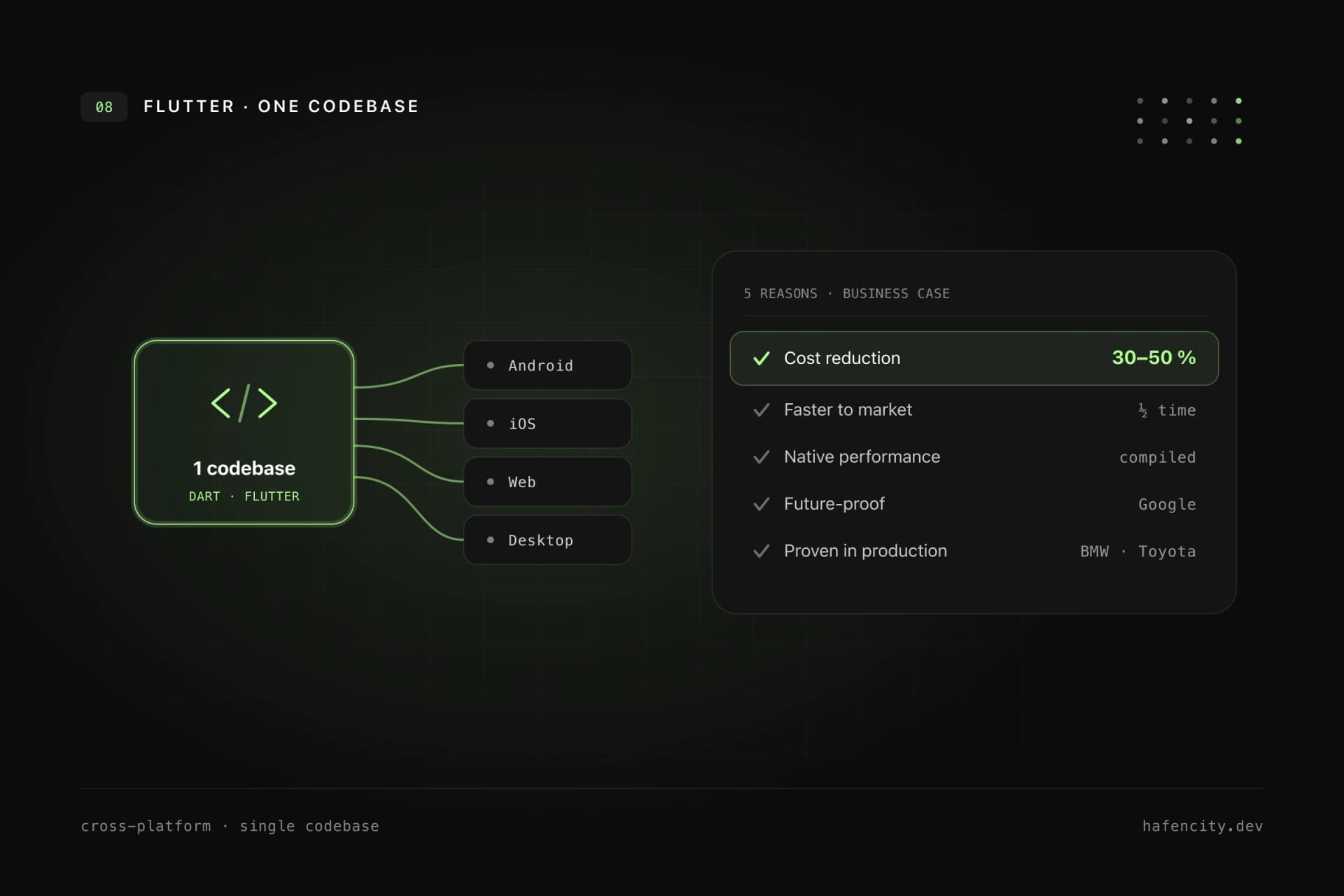
Flutter is Google's open-source framework that lets one team build apps for Android, iOS, Web and Desktop from a single codebase. The difference from earlier cross-platform approaches is technical, but it has direct budget consequences: Flutter renders its own UI and compiles release builds to native machine code instead of wrapping a web view. The result is an app that feels native to users — at a fraction of the double effort.
That is exactly why the choice isn't purely a developer decision. It determines how many teams you need, how fast you ship releases, and how expensive every change stays over the years. The five reasons below are ordered along that business logic.
1. One codebase lowers cost and maintenance
The biggest lever isn't a single saving but that every piece of work happens only once. Two native apps mean two codebases, often two teams (Swift/SwiftUI and Kotlin), and every feature built, tested and maintained twice. Flutter consolidates that. Industry data and our own project experience show 30–50% lower build cost versus native dual development of equivalent quality.
| Dimension | Flutter (1 codebase) | Native (2 apps) |
|---|---|---|
| Development cost | base | +30–50% |
| Teams | 1 (Dart/Flutter) | 2 (Swift + Kotlin) |
| Effort per feature | 1× | 2× |
| Platforms | iOS, Android, Web, Desktop | separate per platform |
| Performance | AOT machine code, Impeller | native |
The DACH ballpark: a Flutter MVP starts realistically at around €20,000–50,000, with senior teams at €100–150 per hour (market overview). What matters is the total picture: what you maintain once instead of twice in operation adds up over years. How we break this down in detail is shown in our piece on the cost and time savings of a Flutter app.
2. Faster to market — hot reload and one team
In competitive markets, speed is often worth more than the last ten percent of technical perfection. Flutter's hot reload shows code changes in the running app within seconds — which markedly speeds up the interplay of development, design and product management. Because one team serves both platforms, the coordination overhead between separate iOS and Android teams also disappears.
How large the effect can be is shown by Alibaba's Xianyu team: after moving to Flutter, the time for a new feature dropped from one month to two weeks, per the Flutter Showcase. For an MVP that means: live sooner, user feedback sooner, and the chance to correct course sooner.
3. Native performance without compromise
The old objection "cross-platform is slow" doesn't apply to Flutter. Flutter bypasses the web view entirely: Dart is compiled ahead-of-time to native ARM or x64 machine code in release builds, and the UI is drawn directly to the GPU via its own engine. Since the Impeller engine (default since Flutter 3.27), the once-dreaded shader jank on the first animation pass is gone too.
In practice this means smooth 60–120 fps interfaces and consistent visuals across devices. For the vast majority of business apps — portals, marketplaces, fintech frontends — perceived performance is indistinguishable from native. Where the limits lie and how Flutter compares to native and React Native, we cover in Flutter vs. React Native vs. Native.
4. Future-proof: Google, ecosystem and platform reach
A technology choice is only as good as its half-life. Flutter is actively maintained by Google — with roughly four stable releases a year and a public roadmap. The current version, Flutter 3.44 (mid-2026), signals a mature, no-longer-experimental framework. As an open-source project with a large package ecosystem (pub.dev), the risk of being tied to a single vendor is low.
On top of that comes platform reach: the same codebase can later be extended to Web and Desktop targets without rebuilding the product. That keeps strategic options open — an advantage single-platform native development doesn't offer.
5. Proven in practice: what major brands achieve with Flutter
The most convincing arguments aren't promises but production numbers. Flutter has long powered apps used daily by tens of millions of people — a clear signal that it holds up for demanding, regulated and large-scale applications.
- Google Pay migrated iOS and Android to a single Flutter codebase and shrank it from 1.7 to 1.1 million lines — about 35% less code (Flutter Showcase).
- BMW runs the My BMW app with Flutter across more than 30 markets and built one of the largest Flutter teams anywhere to do it.
- Alibaba (Xianyu) cut feature development from one month to two weeks.
- Toyota uses Flutter in infotainment systems — evidence of stability beyond the classic app store.
What these examples share is that they don't come from hobby projects but from fintech, automotive and e-commerce with hard requirements for security, scale and maintainability.
When Flutter isn't the first choice
Honesty means naming the limits too. If your app relies heavily on platform-specific hardware, highly specialised native SDKs, or maximum graphics performance (e.g. heavy games), native development can be the more solid base. The cross-platform advantage also disappears for pure single-platform projects. In those cases, a short architecture review beats any blanket recommendation — and that's exactly what we run before every project.
Next steps
Three questions clarify whether Flutter fits your project:
- Platforms: Do you need iOS and Android (and Web/Desktop down the line)? Then one codebase pays off immediately.
- Product type: Is your app UI- and data-driven (portal, marketplace, fintech) or extremely hardware-heavy?
- Speed: How quickly do you need to be in market and gather feedback?
If you need iOS and Android and your product is UI-driven, Flutter is the more economical choice in most cases in 2026. We make this call in projects regularly — pragmatically and with an eye on budget and roadmap. Take a look at our app development or book an intro call directly.