
Many companies in Hamburg are exploring AI, but few need a large transformation program on day one. In 2026, Bitkom reports that 41% of German companies already use AI actively — twice as many as a year earlier. At the same time, a widely cited MIT study finds that around 95% of generative-AI pilots have no measurable impact on business results.
That contradiction is the real story. The difference between a nice experiment and a production system is rarely the model — it's the approach: a concrete bottleneck, reviewable data, clarified privacy and honest measurement. A serious AI agency in Hamburg therefore does not start with the tool. It starts with the process.
The numbers: why most AI pilots stall
AI is no longer an adoption problem — it's an execution problem. The enthusiasm is there, often the budget too, but the path from demo effect to measurable value is steeper than most roadmaps assume. A third of AI users tell Bitkom that AI cost more than expected. Gartner names the main reasons for abandonment as poor data quality, inadequate risk controls, escalating costs and unclear business value.
What matters is what the successful 5% do differently. MIT attributes the gap to a "learning gap": successful teams integrate AI into existing workflows instead of running isolated tools, and they rely more on bought-in solutions and partners than on pure in-house builds. This is exactly where an AI strategy is worth more than another pilot in the sandbox.
Use case first: small, reviewable, relevant
The most common mistake is starting too broadly. "We build one AI chatbot for everything" sounds attractive, but it is rarely the best first step. A better start is a limited use case with a clear metric. Good starting points for Hamburg companies are support triage, internal knowledge search, proposal preparation, document analysis or reporting — tasks that occur frequently, build on existing information and can be reviewed by humans.
| Criterion | Good first use case | Risky start |
|---|---|---|
| Frequency | happens daily/weekly | rare special case |
| Data basis | existing, scoped sources | unclear, scattered data |
| Reviewability | a human can judge the output | output hard to verify |
| Error impact | correctable, not critical | legally/financially sensitive |
| Measurability | clear metric before the start | "feels better" |
We collected more concrete examples and how to assess them in Realistic AI use cases. The through-line stays the same: a use case small enough for an honest test and relevant enough for real value.
Data, privacy and the EU AI Act
AI is only as good as its context — and its legal frame. Many pilots convince in the demo and fail in daily use because of outdated documents, missing permissions or inconsistent terminology. Before starting, ask the sober question: which sources are actually needed, are they current, are there duplicates, and who may see which information? For most projects a single prompt is not enough — what is needed is clean AI integration that connects CRM, ERP, ticketing and document storage in a controlled way.
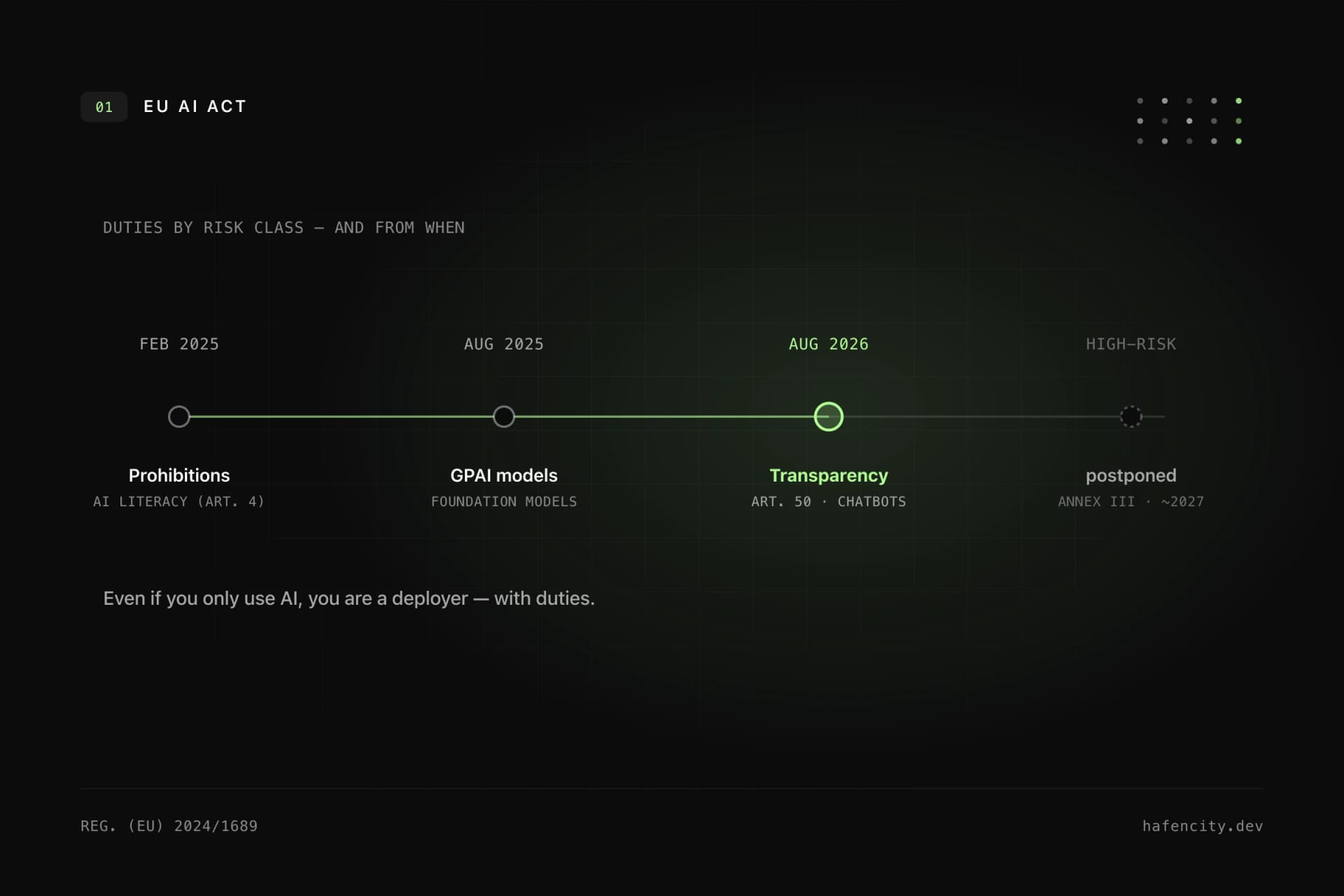
In parallel, privacy belongs at the start, not the end: are personal data processed, in which country, with which subprocessors, and are inputs used for training? A data processing agreement, EU regions and a deletion and logging concept are standard. On top of that comes the regulatory frame: obligations for general-purpose AI models have applied since 2 August 2025, while obligations for high-risk systems were deferred via the Digital Omnibus to 2 December 2027. For typical assistance and automation use cases, what matters most is transparency, documentation and a clear risk classification.
From bottleneck to rollout in five steps
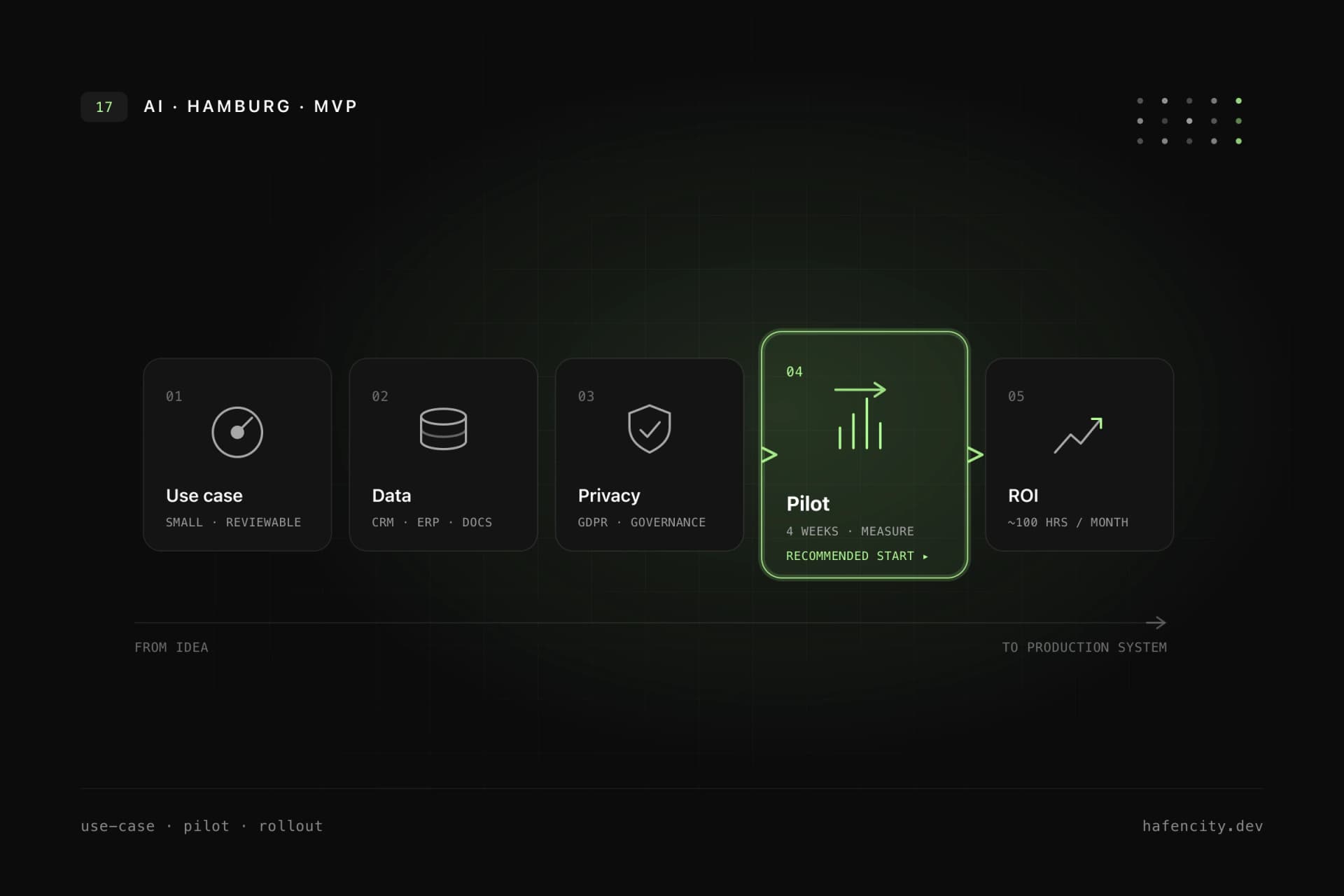
A good AI pilot is not a showroom — it's a test with a decision at the end. It answers one concrete question: does this solution create measurable value in the real workflow without reducing quality, privacy or control? The roadmap behind it is deliberately unspectacular.
A useful pilot has a clearly scoped process, real but controlled data, defined user groups, success criteria before the start, manual review steps, plus logging and error analysis. At the end stands a decision: stop, improve or roll out. Example: a support team tests AI-generated ticket summaries and answer drafts for four weeks and measures handling time, correction effort, answer quality and satisfaction. Only when these values are reliable does the step into automation make sense.
Calculate ROI honestly
AI projects should be evaluated economically — soberly, not euphorically. This is not only about minutes saved, but also about quality, consistency, faster response times and lower rework. A simple calculation is enough to begin.
| Metric | Example value | Effect |
|---|---|---|
| Cases per month | 2,000 | scales the value |
| Time saved per case | 3 min (verified) | ~100 hrs/month potential |
| Correction / rework rate | before vs. after | quality signal |
| User adoption | is the system used? | reality check |
| Operating & license cost | ongoing | caps the net ROI |
If a process occurs 2,000 times per month and AI saves three minutes on average in a reviewed pilot, the theoretical potential is around 100 hours per month. Whether this pays off depends on quality, risk, license cost, operations and integration effort — which is why measurement sits before rollout in the roadmap, not after it.
Governance, human review and AI agents
Control is not a brake — it's the precondition for productive AI. Lean governance answers a few clear questions: which tools may be used, which data may go in, who owns sources and prompts, and how are outputs reviewed? For mid-sized companies, a short policy, a use-case register and a clear approval process are often enough at the start. The key point is that responsibility should not sit with individual employees experimenting with a new tool.
That applies especially to AI agents, which can read context, use tools and prepare tasks in existing systems. Production agents need limited permissions, defined tools and APIs, logging of all actions, sources and reasoning, stop rules and human approval for critical steps. An agent should not be allowed to act freely just because it technically can. This creates a controlled path: first assistance, then partially automated workflows, and more autonomy later only where quality and risk allow it.
Next steps
Three questions decide whether an AI project is ready for a first pilot:
- Bottleneck: which frequent, reviewable process costs the most time today?
- Data & privacy: are the needed sources current, accessible and legally usable?
- Measurement: which metric decides success or stop before the start?
If you want to evaluate a concrete AI project in Hamburg, a short conversation is often more useful than a large preliminary study. Take a look at our AI integration or use contact to discuss which use case is realistic enough for a first pilot.