
Many digital projects do not fail at the user interface. They fail at the interfaces between systems. Customer data sits in the CRM, orders in the ERP, documents in a DMS, payments with a provider, reports in a data warehouse. When those systems do not communicate reliably, teams fall back to manual work, duplicate data entry and error-prone coordination. This is exactly where an API comes in – and in 2026 it is no longer a technical detail: per the Postman State of the API 2025, 65% of organizations generate revenue directly from their API programs and 82% follow an API-first approach.
That is why companies search for custom API development, REST API development or ERP integration. This article explains the main API types, when REST, GraphQL, webhooks or events make sense, why APIs are increasingly the interface to AI agents, what development costs, and what to watch for in professional backend development.
REST, GraphQL, webhooks or events?
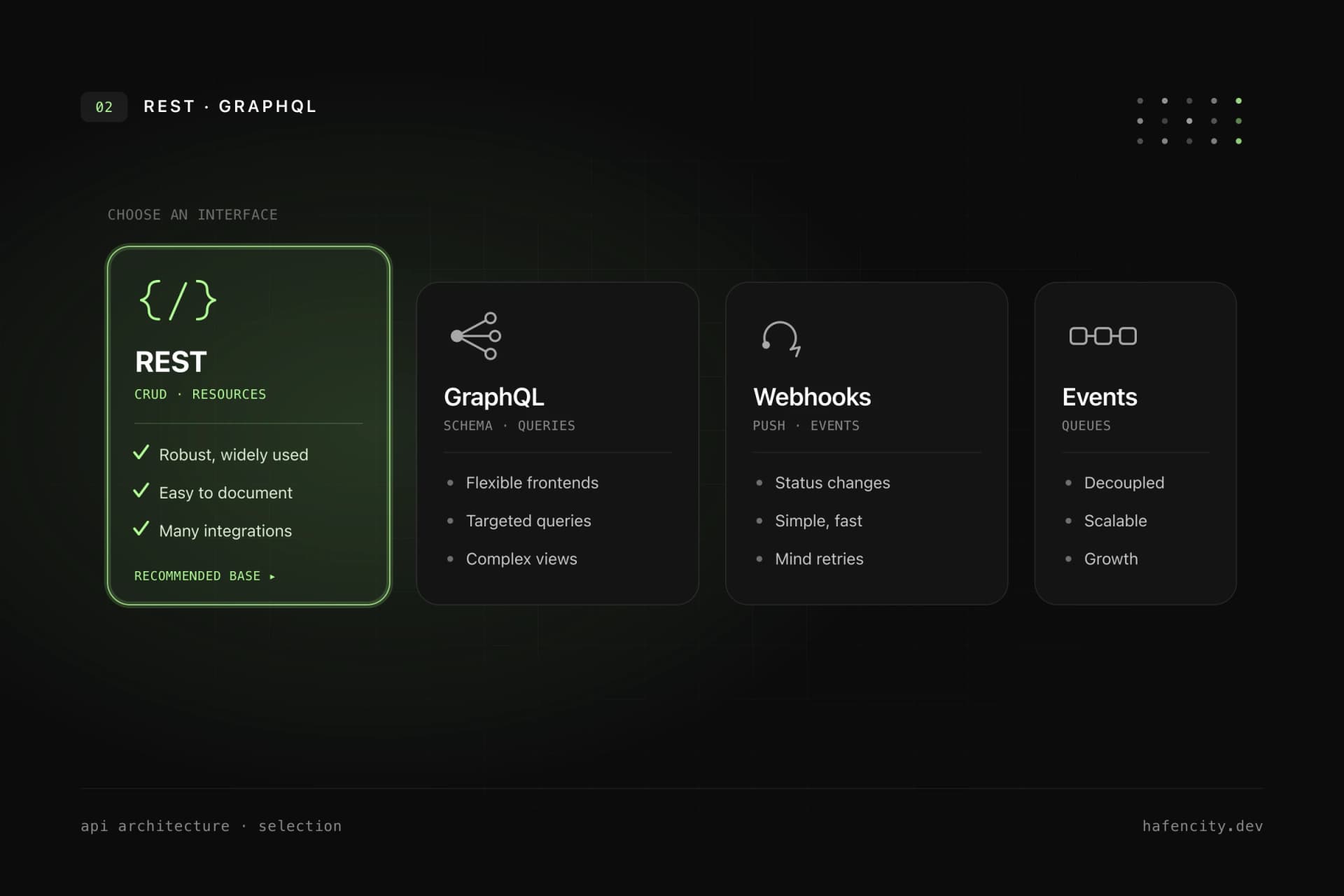
Architecture follows the use case, not the trend. Not every interface needs the same approach – the choice depends on how data is read, written and forwarded. REST is far from obsolete: in the Postman State of the API 2025, 93% of teams use it, while webhooks (50%), WebSockets (35%) and GraphQL (33%) complement it for specific jobs.
| Approach | Good for | Strengths | Limits |
|---|---|---|---|
| REST API | classic CRUD flows, clear resources, many integrations | widely understood, robust, easy to document | many endpoints for complex views |
| GraphQL | flexible frontends, variable data queries, complex screens | clients request exactly the data they need | needs schema design and clear limits |
| Webhooks | notifying other systems about events | simple, fast, ideal for status changes | delivery, retries and security to solve |
| Event architecture | decoupled systems, workflows with many follow-up steps | scalable, resilient, good for growth | harder to operate and debug |
For most business applications REST is still the most honest base. GraphQL pays off when several frontends need very different data views and you want to avoid over- and under-fetching. Webhooks complement APIs when one system needs to inform another automatically. A real event architecture only becomes worth it when processes grow fast or systems should be intentionally decoupled – it brings scalability, but also more operational and monitoring effort.
In 2026 the API is also the interface to AI agents
A clean API is now a contract not only between systems, but also between system and AI agent. With the Model Context Protocol (MCP) there is an open standard through which assistants and agents can discover, understand and invoke APIs. That changes what an API is built for: no longer just frontends and partners, but also machines acting on behalf of users.
The numbers show how fast this is moving. Per Postman, 51% of organizations already run AI agents, and one in four developers now designs APIs with AI agents in mind. MCP is familiar to 70% of developers, but only 10% use it regularly – the field is early, but clearly in motion.
In practice this means good API hygiene pays off twice. Clear schemas, unambiguous permissions and clean logging make an interface maintainable for humans and safely usable by agents. If you want to automate processes, plan your API and agent strategy together – more on that in AI agents in the enterprise and in our work on AI agents.
What does API development cost?
The biggest cost driver is rarely the API code, but everything around it. Data models, legacy systems, permission concepts, missing documentation and unclear process rules decide the effort. The ranges below are orientation values from our projects in the DACH market – not a fixed price, but an order of magnitude for planning.
| Project | Typical scope | Realistic range |
|---|---|---|
| Small internal API | few endpoints, simple authentication, one system | 8,000–25,000 € |
| Product API | roles, versioning, documentation, tests, monitoring | 25,000–70,000 € |
| ERP/CRM integration | data mapping, error handling, synchronization | 30,000–100,000 € |
| Integration platform | several systems, events, queues, audit logs, operations | from 100,000 € |
More important than the entry price is an honest assessment of the unknowns. Is there a sandbox for the target system? How good is the data quality? Who is allowed to see which data? For critical integrations a technical spike is worth it: it checks early whether the target system is reachable, what data formats look like and which limits the external API has. That avoids expensive surprises later.
Security: no open gaps
APIs often connect directly to critical data – so security belongs in the design, not in the review afterwards. The OWASP API Security Top 10 (2023) are the benchmark here: the number one risk is Broken Object Level Authorization (BOLA) – the API hands out objects without checking whether the user is actually allowed to access them. Three of the top five risks revolve around authorization.
Key building blocks of a resilient API:
- authentication, e.g. OAuth 2.0, API keys or sessions
- authorization on role and record level (against BOLA)
- consistent input validation
- rate limits and abuse protection
- safe error responses without internal details
- encrypted transport, logging and monitoring
For portals, apps and partner integrations, checking only the login is not enough. The API must ensure on every access that users can only see and change data that actually belongs to them. How we implement this in data-sensitive projects is shown in our article on customer portals.
Documentation, versioning and developer experience
An API without documentation becomes expensive fast – every integration then costs more time and more support. For REST APIs an OpenAPI specification is the standard, currently version 3.2 (September 2025, backward-compatible with 3.1). It describes endpoints, data models, error codes and authentication in a machine-readable way and doubles as documentation, a test basis and a source for generated clients. OpenAPI 3.2 adds structured tags and better streaming support – relevant for SSE and exactly the kind of agent channels from the MCP space.
Good documentation covers purpose, authentication, schema, data models, example requests and responses, error codes, versioning, limits and idempotency. And it needs a versioning strategy: APIs change, and without clear compatibility rules existing integrations break the moment new requirements arrive. An interface is a contract – change it uncontrolled and the edges break.
Next steps
Three questions clarify the direction faster than any architecture debate:
- Process: Which systems need to be connected, and who owns the data?
- Usage: Who calls the API – internal frontend, partner, mobile app, external customers or AI agents?
- Risk: Is there a sandbox for the target system, and how good is the data quality really?
Unsure which architecture fits your project? We plan interfaces regularly – pragmatically, securely and with an eye on operations and roadmap. Take a look at our backend development or book an intro call.