
Few SaaS platforms start as platforms. They begin as an internal tool, a customer portal or an MVP for the first pilot customers — and only grow from there. That this path pays off in 2026 is clear from the market: according to Bitkom, revenue from cloud software in Germany is growing 16.4% to €38.3 billion in 2026 — faster than the software market overall (+10.2%).
For Hamburg companies this means: demand for web apps and SaaS products is real, but the entry point stays small. The actual craft lies in building version one fast enough to prove value and clean enough to scale. Good web app development connects both.
The 2026 market: cloud software grows, the entry stays small
Cloud software is the fastest-growing part of Germany's digital economy — and that is exactly where web apps and SaaS platforms play. While the overall ICT market grows 4.4% to €245.1B in 2026, the software business grows 10.2% and cloud software alone 16.4%, per Bitkom. Behind those numbers are many products that once started as a small internal tool.
Hamburg is shaped by mid-sized companies, trade, logistics, media, real estate, industry and an active startup scene. Many web app projects therefore meet existing processes, legacy systems and high expectations for reliability. The local advantage is not that software works differently in Hamburg, but proximity to domain teams, shorter feedback cycles and a stronger understanding of regional business models: customer and partner portals, internal dashboards, workflow systems, booking flows and SaaS products for specialized B2B niches.
Discovery: from process problem to product goal
At the start there is no technology stack, only a process question. What matters is not which framework you use, but which problem the product should solve — and whether an internal tool can become a product at all. Good discovery clarifies that before the first budget is spent.
- Which process is currently slow, error-prone or hard to measure?
- Which user groups will work with the application, and which permissions do they need?
- Which data is created, reviewed, approved or exported?
- Which existing systems (CRM, ERP, accounting) need to be connected?
- Which metric proves that the product works?
The result is not a rigid specification, but a clear product goal, prioritized core flows, a first data model, the technical risks and a roadmap from MVP to platform. How we turn an idea into a workable roadmap is described in building an MVP.
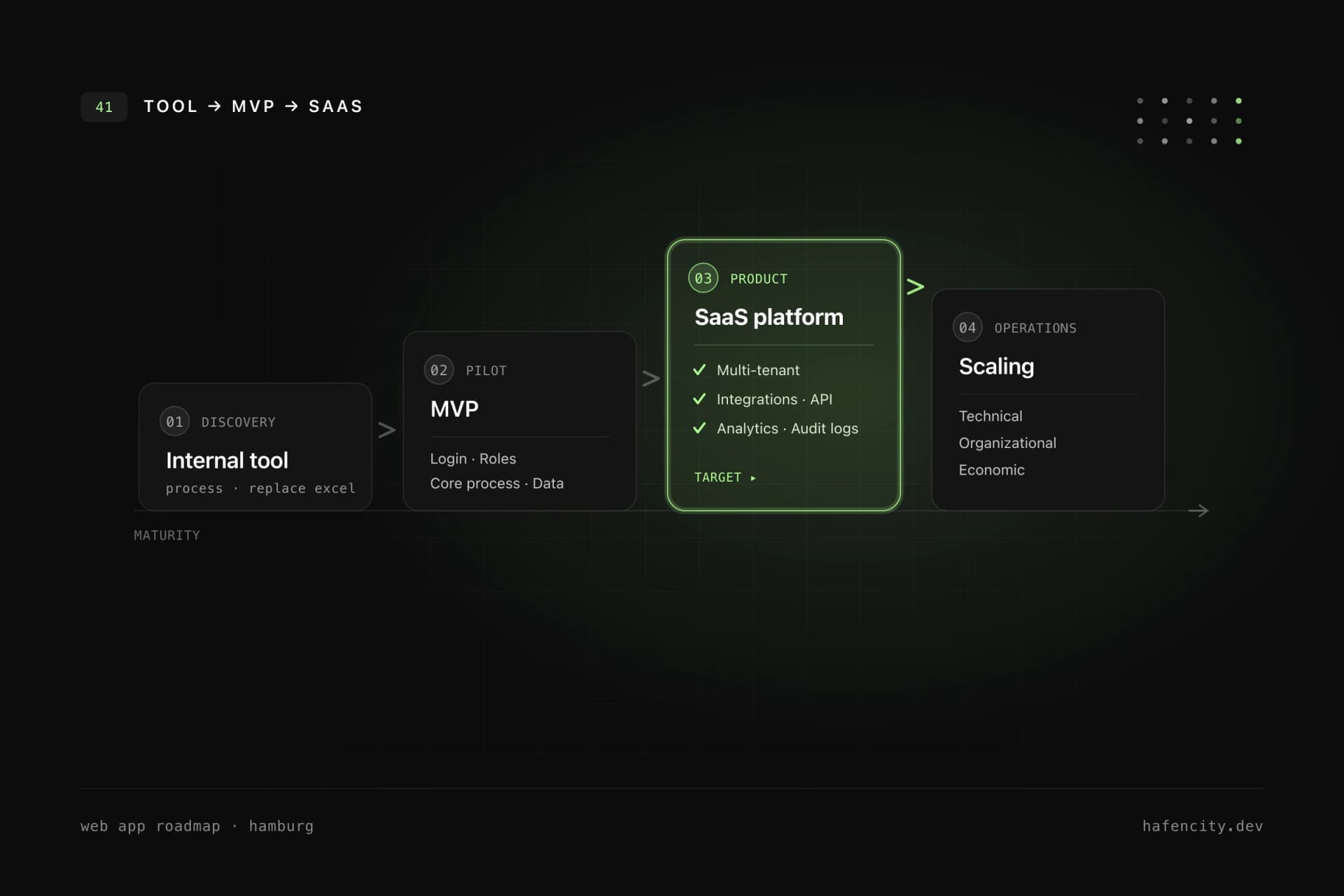
The path from MVP to platform
A resilient SaaS platform emerges in stages, not in one big bang. Each stage delivers real value and sets up the next — the only rule is that the technical base must not be thrown away once you move beyond the MVP.
| Stage | Scope | Budget (DACH) | Duration |
|---|---|---|---|
| Prototype / discovery | clickable, target, risks | €5,000–15,000 | 2–4 weeks |
| MVP | 1 core flow, login, roles, analytics | €25,000–60,000 | 2–4 months |
| B2B SaaS v1 | tenants, billing, integrations | €60,000–150,000 | 4–8 months |
| Operations & development | monitoring, maintenance, roadmap | from €1,500/month | ongoing |
A strong MVP includes login and basic roles, one clearly scoped core process, a reliable data model, admin functions, clean error and empty states, a production-like deployment, plus simple analytics and error tracking. Not every function needs to be automated immediately: billing, advanced reports or rare edge cases can be supported manually at the start.
What a web app costs in Hamburg
Budgets follow the build stages — not a flat rate. The ranges above are realistic for the DACH market in 2026 and match the wider data: a first B2B SaaS version typically lands in the €50,000 to €120,000 range over 3–6 months per industry breakdowns, and our experience extends more complex platforms to €150,000.
The biggest cost driver is rarely the interface, but integrations, the data model and edge cases. Hourly rates for qualified agencies in the DACH region in 2026 mostly sit between €120 and €180; a pure rate comparison falls short, though, when maintainability and operations matter over years. A detailed breakdown is in our post on web app costs and architecture.
Architecture, roles and integrations
Multi-tenancy, permissions and interfaces decide whether the platform can grow. The backend holds business logic, the data model, permissions, integrations and background jobs together. A lean backend is often enough for an internal tool; a SaaS platform needs early thinking around multi-tenancy, roles, billing, audit logs and data exports — retrofitting these later is the most expensive mistake.
As a frontend foundation, a React-based stack has proven itself: Next.js has been a mature base since version 16 (October 2025), with React 19, a stable React Compiler and Turbopack as the default bundler. Where the framework fits and when it pays off, we discuss in Next.js agency: when does Next.js pay off?. Integrations into CRM, ERP or accounting are, in practice, the most underestimated part: they need error handling, retry behavior, monitoring and clear responsibility when data does not match.
Law and operations: BFSG, data protection and scaling
Since 28 June 2025, accessibility is a duty, not a nice-to-have, for many B2C web apps. The German Accessibility Strengthening Act (BFSG) requires digital services aimed at end consumers to meet WCAG 2.1 level AA; violations can incur fines of up to €100,000. Pure B2B offerings and micro-enterprises with fewer than 10 employees and at most €2M turnover are exempt. What this means in practice we summarize in our BFSG and WCAG checklist.
After launch, the real product responsibility begins. A web app needs monitoring for errors, performance and availability, structured logs, tested backups, security updates, deployment workflows with staging and rollback, and support channels. Scaling means more than server capacity: technical (caching, queues, multi-tenancy), organizational (support, release processes) and commercial (pricing, billing, retention). The best time to plan for it is early — the worst is the moment first customers already depend on the platform.
Next steps
Three questions bring clarity before the first line of code:
- Stage: is a prototype enough to validate, or should a real-user MVP come first?
- Architecture: will it stay an internal tool, or are multi-tenancy and billing foreseeable?
- Law: does the app target end consumers — and therefore fall under the BFSG?
Unsure which stage fits your plan? We make this call in projects regularly — pragmatically and with an eye on roadmap and budget. Take a look at our web app development or book an intro call directly.