
For years the choice fit into one sentence: "Firebase is NoSQL, Supabase is Postgres." That rule of thumb is outdated in 2026. With Firebase SQL Connect — generally available since April 2025, originally launched as "Data Connect" — a full PostgreSQL database on Google Cloud SQL can now run behind Firebase. That shifts the real question from "NoSQL or SQL?" toward cost model, data sovereignty and long-term portability.
Both platforms solve the same core problem — ready-made backend building blocks so teams ship faster. Let's look at the differences that actually matter in 2026.
Quick overview: two paths to a backend
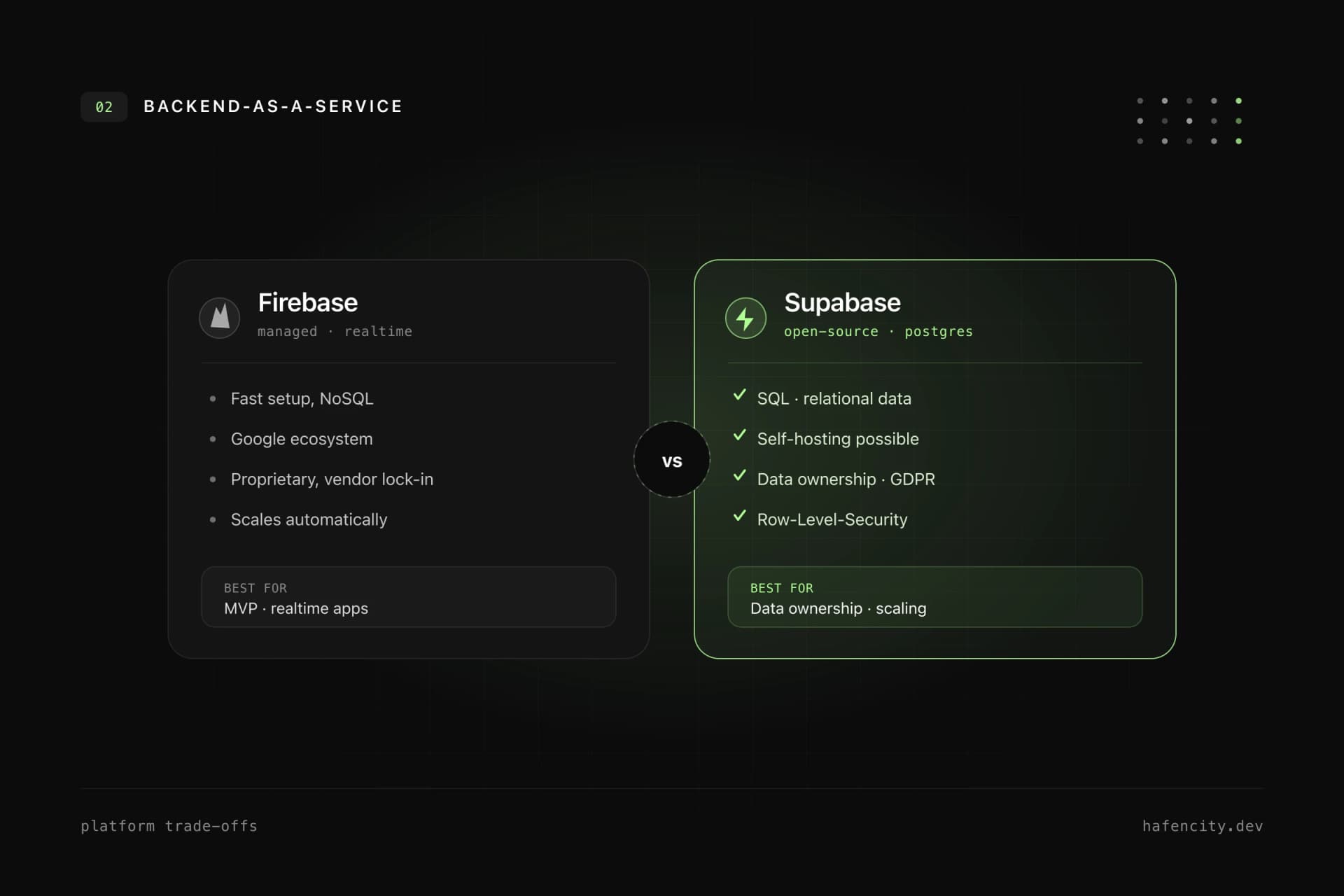
Firebase is Google's established Backend-as-a-Service platform and combines authentication, realtime databases, hosting, storage, analytics and Cloud Functions in a tightly integrated ecosystem. Its strength was always speed: a small team gets a working backend in hours, with no servers to run.
Supabase positions itself as the open-source alternative with PostgreSQL at its core — extended with authentication, storage, Edge Functions and realtime. The developer experience is built around SQL and open standards. That this bet is paying off shows in the momentum: in October 2025 Supabase raised $100M in a Series E at a $5B valuation — per TechCrunch just four months after its $2B round — and counts over 4 million developers.
The data model: NoSQL, Postgres — or both
This used to be the clear dividing line, and it's where the most has changed. Firebase still offers Firestore and the Realtime Database as two NoSQL databases — now extended with PostgreSQL via SQL Connect. Supabase is relational from the ground up.
In practice: for hierarchical, fast-syncing data (chats, presence, feeds) Firestore remains extremely convenient. But as soon as relational structures, joins, complex queries and reporting come in, a real SQL database is the more honest foundation — and you get that natively with Supabase, or via SQL Connect with Firebase. We summarised each platform in What is Supabase? and What is Firebase?.
Cost model: usage-based vs. base plus usage
The biggest practical difference isn't the price — it's the pricing model. Firebase's Blaze plan bills purely by usage; costs scale with every read, write and GB. Supabase combines a predictable monthly base with usage-based components.
| Item | Firebase | Supabase |
|---|---|---|
| Model | usage-based (Blaze) | base + usage |
| Entry | Spark plan free (quotas) | Free: 500 MB DB, 50K MAU, 2 projects |
| Pro / month | – (purely usage-based) | $25/project, incl. $10 compute |
| Database reads | Firestore $0.18 / 100K | included in compute/plan |
| Realtime DB storage | $5 / GB | – (Postgres storage in plan) |
| PostgreSQL | SQL Connect from $0.90 / 1M ops | natively included |
The numbers come from the official pricing pages (Firestore, Firebase, Supabase, as of June 2026). The lesson: an app with many small realtime updates has a completely different cost profile than a SaaS platform with complex reports. Model your expected usage before committing — the entry price says little about the bill at 50,000 users.
Privacy, GDPR and data sovereignty
Both platforms can run in EU regions — the difference is the depth of control. Firebase is part of Google Cloud: you need a data processing agreement, should choose EU regions and, depending on the data, review standard contractual clauses. That's workable, but stays tied to Google's infrastructure.
Supabase is open source and can be fully self-hosted — on your own infrastructure or with an EU provider of your choice. For projects with strict requirements (healthcare, public sector, sensitive B2B data) that's often the more direct path to real data sovereignty. How we think about backend and privacy together in projects is shown in our backend development.
Vendor lock-in: how easily can you get out again?
Portability is the most underestimated decision. Firestore stores data in a proprietary NoSQL model; a later migration to another database means rethinking the data model. Standard PostgreSQL — whether on Supabase or via Firebase SQL Connect — can instead move to any other Postgres host or your own servers. If long-term independence matters, a relational database is the more open choice.
Recommendation: choose by architecture, not by hype
There is no universally "better" platform — there's the better choice for your project:
- Firebase, when an MVP needs to launch fast, mobile SDKs and realtime sync are central, and your team already works in the Google ecosystem.
- Supabase, when you prioritise a relational data model, SQL, open source, a self-hosting option and long-term portability.
- Both combined is a legitimate pattern: Firebase for auth/push/analytics, Postgres for the relational core data.
Next steps
Three questions settle the decision faster than any feature duel:
- Data structure: are your core data relational (joins, reports) or document-like (feeds, presence)?
- Privacy: is an EU region with a DPA enough, or do you need self-hosting?
- Cost: what does your usage profile look like at 10,000–100,000 users — many small reads or few large queries?
Unsure which base fits your product? We make this call in projects regularly — pragmatically and with an eye on roadmap and budget. Take a look at our web app development or book an intro call directly.