
Supabase is long past being an insider tip in 2026. In June 2026 the company raised $500M in a Series F at a $10.5B valuation — led by GIC, with Accel, Y Combinator, Stripe and Salesforce Ventures on board. According to TechCrunch, that doubled the valuation in eight months. The driver is the boom around AI coding and agents that spin up databases at scale.
Behind the hype sits a sober idea: a full PostgreSQL database, extended with ready-made backend building blocks — open source and portable. Let's look at what Supabase actually is, what it costs and when it's the right choice for your project.
What Supabase is at its core
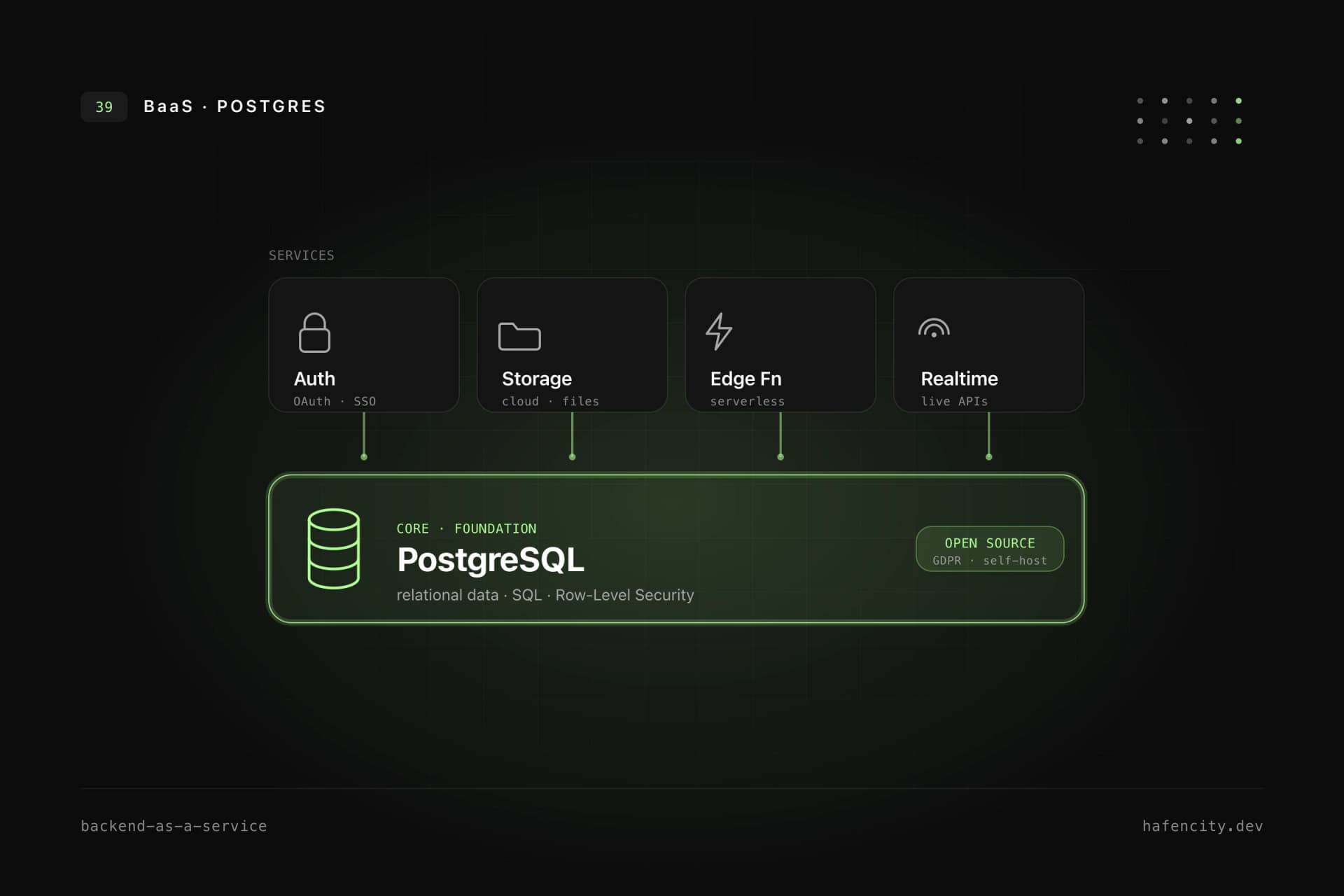
At its core, Supabase is a full PostgreSQL database with ready-made backend services built around it. That's the decisive difference from many BaaS platforms: you don't work with a proprietary data model but with the decades-proven relational open-source database. Every row, every relation, every index is standard SQL — with everything that entails: joins, transactions, row level security, extensions.
Around it, Supabase layers the things a product would otherwise have to wire up itself: authentication, auto-generated APIs, realtime channels, file storage and server-side functions. The goal is the same as Firebase's — let teams ship faster — only on an open, relational foundation. We compared both platforms head-to-head in Firebase vs. Supabase.
The building blocks at a glance
Instead of integrating separate services, Supabase gives you database, auth, APIs, realtime, storage and functions from one source — all on the same Postgres instance. That saves integration effort and keeps data sovereignty in one place.
Concretely, per the Supabase features, the platform includes:
- PostgreSQL database: the relational core with SQL, row level security and hundreds of extensions.
- Auth: user management with email, magic links and OAuth providers (Google, GitHub, Apple and more).
- Auto APIs: REST and GraphQL endpoints generated directly from the database schema.
- Realtime: database changes pushed live to connected clients — ideal for dashboards and collaboration.
- Storage: S3-compatible file storage with the same access rules as the database.
- Edge Functions: server-side TypeScript functions on Deno, executed globally at the edge.
- Vector search: with pgvector you store and query embeddings directly in Postgres — the basis for semantic search and RAG.
What Supabase costs
The biggest advantage in the pricing model is predictability: a fixed monthly base plus clearly defined usage-based components. The free tier is enough for prototypes and small projects, the Pro plan covers most production apps, and only at enterprise scale does it get bespoke.
| Plan | Price / month | Included |
|---|---|---|
| Free | $0 | 500 MB DB, 50,000 MAU, 2 active projects |
| Pro | $25 / project | 8 GB DB, 100,000 MAU, $10 compute credits, daily backups |
| Team | $599 | SOC 2 & ISO 27001, 28-day log retention, 14-day backups |
The numbers come from the official Supabase pricing page (as of June 2026). Beyond the included quotas, billing is usage-based — roughly $0.00325 per additional active user and $0.125 per additional GB of database. As always: model your expected usage before committing, because the entry price says little about the bill at 100,000 users.
Privacy, GDPR and data sovereignty
On privacy, Supabase offers two paths — hosted in the EU or fully self-operated. In the hosted variant you pick the Frankfurt region (eu-central-1), sign a data processing agreement and rely on SOC 2 Type 2 and — with a BAA and add-on — on HIPAA compliance. For many B2B and SaaS projects that's enough.
The honest caveat: Supabase is a US company and therefore falls under the CLOUD Act despite EU hosting. If you need maximum data sovereignty — in healthcare or the public sector, say — the self-hosting option is often the better route. Because the platform is open source, you can run it on your own infrastructure or with an EU provider and keep full control over data residency and operations. How we think about backend and privacy together in projects is shown in our backend development.
Why Supabase has momentum in 2026
Supabase benefits precisely from the shift AI coding triggered: anyone building software with agents needs a database that can be spun up programmatically and instantly. That's exactly why, according to the company, the number of databases created has grown by more than 600% year over year — a large share of it kicked off by AI tools and coding agents.
Technically, the pgvector integration plays straight into this trend: embeddings sit next to the relational core data instead of in a separate vector database. And alongside the Series F, Supabase also announced Multigres — an open-source horizontal scaling layer that brings sharding, zero-downtime migrations and high availability to the Postgres ecosystem. That addresses the classic limit of relational databases: scaling beyond a single instance. For AI-driven projects, our piece on RAG chatbots, GDPR and cost is also worth a look.
When Supabase fits — and when it doesn't
There is no universally "better" platform — there's the better choice for your project. Supabase plays to its strengths when structure and portability matter:
- A good fit when your core data is relational (joins, reports, complex queries), you value SQL and open source, want to keep a self-hosting option open or plan AI features like vector search.
- Less ideal when your team is deep in the Google ecosystem, you primarily need mobile SDKs and offline sync, or a very simple, document-like data structure (feeds, presence) is central.
If you're still weighing the platforms, The best Firebase alternatives gives a broader view of the field.
Next steps
Three questions settle the decision faster than any feature list:
- Data structure: are your core data relational (joins, reports) or document-like (feeds, presence)?
- Privacy: is the EU region with a DPA enough, or do you need self-hosting for full data sovereignty?
- Scaling: what does your usage profile look like at 10,000–100,000 users — and how much do predictable costs matter to you?
Unsure whether Supabase fits your product? We make this call in projects regularly — pragmatically and with an eye on roadmap and budget. Take a look at our web app development or book an intro call directly.