
"Firebase or nothing" — that's how the start of many app projects feels. Google Firebase is quick to set up, well documented and often the obvious pick for an MVP. But once user numbers, the bill and privacy requirements grow, it pays to look at alternatives. In 2026 this field is stronger than ever: in June 2026, TechCrunch reported a $10.5B valuation for Supabase, which now claims around 10 million developers — an open-source backend is no longer a niche topic.
We've put together the five strongest Firebase alternatives for your next project — with current pricing, honest strengths and weaknesses, and a clear recommendation on when each one fits.
Why look for Firebase alternatives?
Firebase is a strong platform — its weaknesses only show up at scale. Three reasons come up again and again in our projects. First, cost: the Blaze plan bills purely by usage, with Firestore at $0.18 per 100,000 reads. That's cheap at small scale but hard to predict for high-traffic apps. Second, data sovereignty: Firebase runs on Google Cloud, which requires a data processing agreement and, depending on the data, EU standard contractual clauses. Third, vendor lock-in: Firestore stores data in a proprietary NoSQL model that is involved to migrate later.
None of these is a deal-breaker on its own — but together they explain why more teams are evaluating alternatives. We broke down how Firebase and Supabase differ in detail in Firebase vs. Supabase.
The five alternatives at a glance
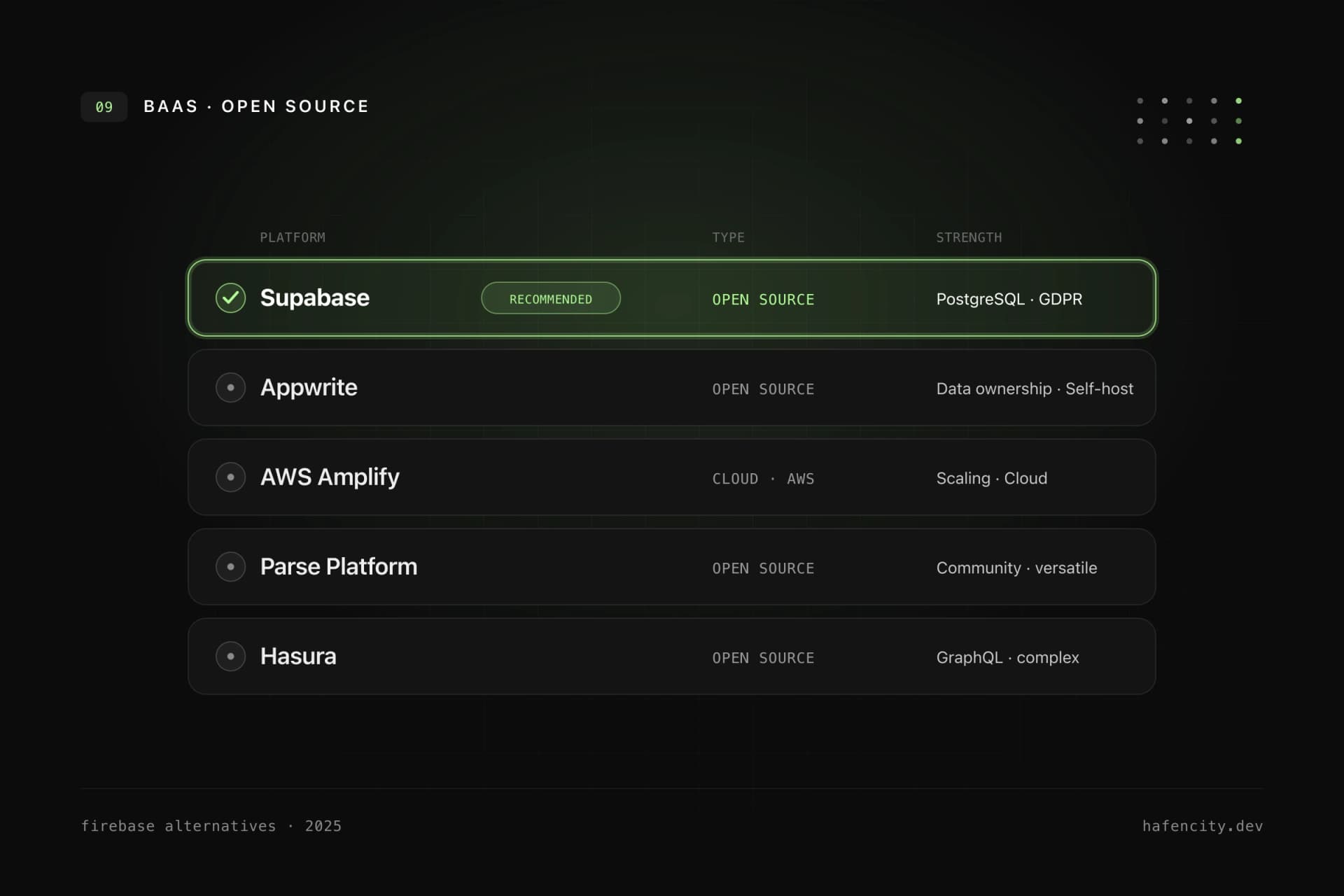
The field of Firebase alternatives has shifted noticeably since 2025. The once-standard candidates Parse and Hasura are no longer typical Backend-as-a-Service options: Parse is a self-hosted legacy project since its hosted service shut down, and Hasura has evolved into a universal data layer with PromptQL for AI applications. Two modern specialists take their place: Convex and PocketBase.
| Platform | Type | Database | Entry price | Self-hosting |
|---|---|---|---|---|
| Supabase | Open-source BaaS | PostgreSQL | Free · Pro $25/project/mo | yes |
| Appwrite | Open-source BaaS | MariaDB | Free · Pro $25/mo | yes |
| AWS Amplify | Cloud (AWS) | DynamoDB · Aurora | usage-based (AWS services) | no |
| Convex | Reactive backend | reactive DB | Free · Pro $25/developer/mo | yes (OSS) |
| PocketBase | Open source (1 file) | SQLite | free (server only) | yes |
Supabase, Appwrite and Convex: the open-source league
If you prioritise open source and data sovereignty, these three are the strongest options. Supabase is the clear leader: a complete backend built around a real PostgreSQL database, extended with auth, storage, Edge Functions and realtime. The Pro plan costs $25 per project per month (incl. $10 compute credits) per the pricing page, with a free tier offering 500 MB database and 50,000 monthly active users below that. That the bet is paying off shows in the momentum: a Series F at $10.5B closed in June 2026.
Appwrite takes a similar approach but builds its own abstraction API over MariaDB and puts special emphasis on easy self-hosting. The Cloud Pro plan has cost $25 per month since September 2025. Convex is the youngest challenger: a reactive backend where UI components subscribe to queries and update automatically when data changes — ideal for realtime and AI apps. The Pro plan is $25 per developer per month, and the free tier includes 1M function calls a month.
AWS Amplify and PocketBase: enterprise versus lightweight
These two represent the extremes — maximum cloud integration on one side, radical simplicity on the other. AWS Amplify has been TypeScript-first since the Gen 2 generation: you define auth, data, storage and functions declaratively in code, with managed AWS services like Cognito, DynamoDB or Aurora running behind the scenes. Billing is purely usage-based across those services — strong when your team already works in the AWS ecosystem, but with the least data-sovereignty headroom of the five.
PocketBase is the opposite: a complete backend in a single Go file with an embedded SQLite database, realtime, auth and an admin UI. It's free, runs on any small server, and is excellent for MVPs, internal tools and small-to-medium apps. Worth knowing: the project is still pre-1.0 at version 0.36, so full backward compatibility isn't guaranteed until then.
Cost models: predictable, usage-based or self-hosted
The most important difference between the alternatives isn't the price — it's the pricing model. Three logics stand opposed, and they fit very different projects.
The usage-based approach (Firebase, AWS Amplify) starts cheap and scales with every read, write and GB — predictable only if you know your usage profile well. The predictable base (Supabase, Appwrite, Convex) combines a fixed monthly base from $25 with usage-based components — easy to budget, but due even when idle. Self-hosting (PocketBase, or the open-source variants of Supabase and Appwrite) incurs only your server costs and gives full data sovereignty — but operations are on you. Model your expected behaviour at 10,000 to 100,000 users before committing; the entry price says little about the later bill.
Which alternative fits your project?
There's no universally "best" platform — only the better choice for your project. As a guide:
- Supabase, when you want a relational data model, SQL, open source and a mature ecosystem — the safest default in 2026.
- Appwrite or PocketBase, when data sovereignty and self-hosting lead; PocketBase especially for lean, low-cost projects.
- AWS Amplify, when your team already lives in AWS and needs enterprise scaling.
- Convex, when realtime sync and AI features are the heart of your app.
How we think about backend, architecture and privacy together in projects is shown in our backend development.
Next steps
Three questions settle the decision faster than any feature comparison:
- Data model: are your core data relational (joins, reports) or document-like (feeds, presence)?
- Privacy: is an EU region with a data processing agreement enough, or do you need self-hosting?
- Cost: what does your usage profile look like at 10,000 to 100,000 users — many small reads or few large queries?
Unsure which base fits your product? We make this call in projects regularly — pragmatically and with an eye on roadmap and budget. Take a look at our web app development or book an intro call directly.