
Firebase is by far the most convenient way to get an app live without running your own server — which is exactly why, according to AppBrain (as of June 2026), it ships in around 72% of all Android apps on the Play Store. But "What is Firebase?" can no longer be answered in one sentence in 2026: a PostgreSQL database can now run behind Firebase, Gemini is integrated as an AI layer — and the heavily marketed AI builder Firebase Studio is currently being shut down.
This overview separates the tool from the marketing cloud: what Firebase technically is, which building blocks it provides, what it costs and when it is the right foundation for your product.
Firebase in one sentence
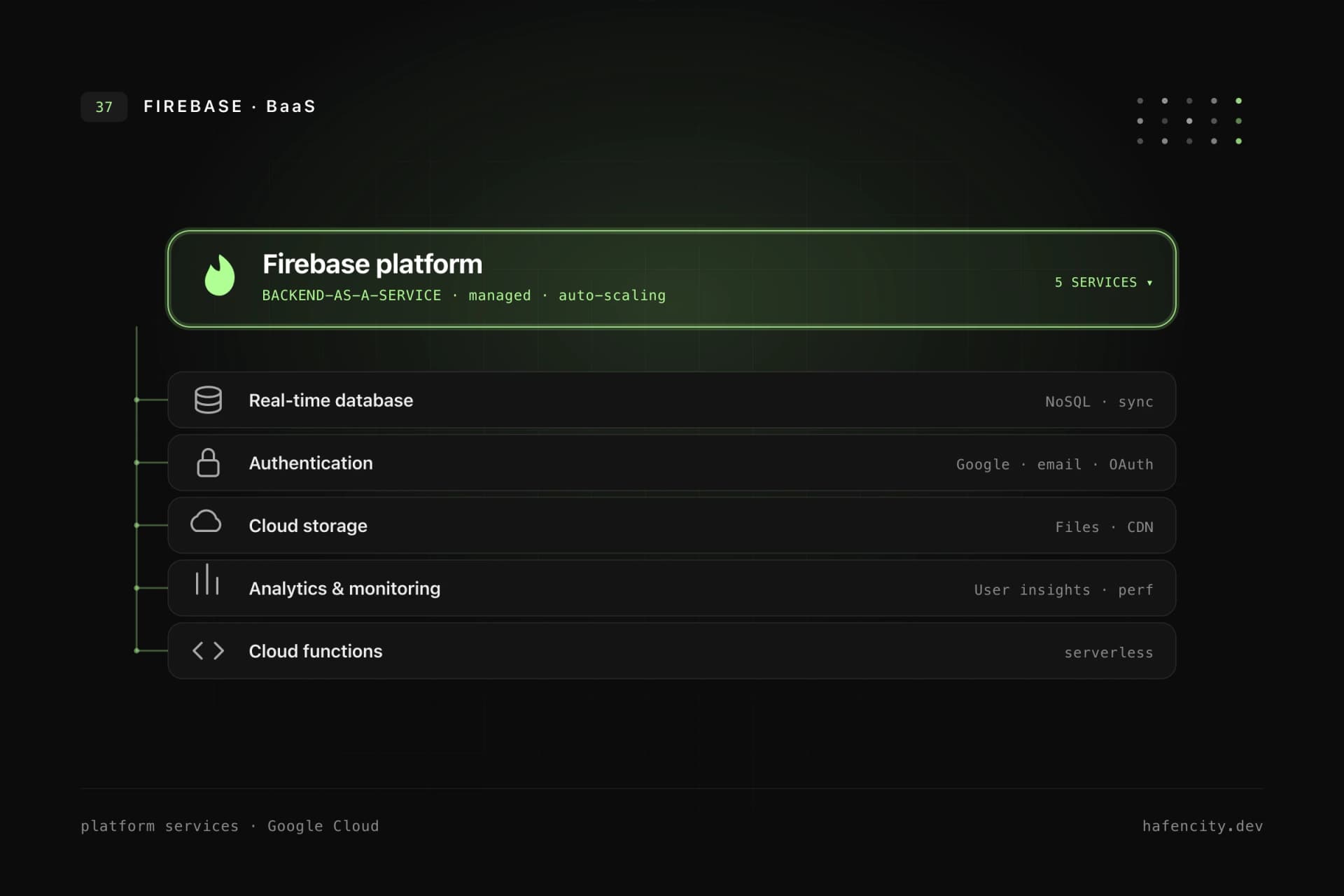
Firebase is a Backend-as-a-Service platform from Google: a collection of ready-made, tightly integrated cloud services that you wire into your app via SDK instead of building and operating them yourself. Authentication, database, file storage, serverless functions, push notifications, crash reporting, analytics — all of it comes as a hosted building block running on Google's infrastructure.
The appeal is speed. A small team builds a working backend in hours, with no servers, scaling or patch management to worry about. Firebase is part of Google Cloud; under the hood it uses the same infrastructure, but it is far quicker to set up than raw cloud services.
The building blocks: what Firebase offers in 2026
Firebase isn't a single database but a suite of around two dozen services — Google groups them into "Build", "Run" and the new "AI". The building blocks you actually use in practice:
- Authentication — login via email, Google, Apple, phone and more, free for 50,000 monthly active users.
- Firestore & Realtime Database — two NoSQL databases for document-like and realtime-synced data respectively.
- Cloud Storage — file and media storage for uploads, images and documents.
- Cloud Functions — serverless backend logic that reacts to events without a server of your own.
- Hosting & App Hosting — delivery of web apps and server-side frameworks such as Next.js.
- Crashlytics, Performance Monitoring, Remote Config, Cloud Messaging — operations, stability and push for production apps.
- AI Logic — the new AI layer that integrates the Gemini API directly into client apps (Kotlin, Swift, JavaScript, Dart); Google I/O 2026 added Gemini 3.x models and Google Maps grounding.
Which of these services play together in real projects is shown with concrete examples in What is Firebase used for?.
Data model: NoSQL — and now PostgreSQL too
For years the rule was: Firebase is NoSQL. In 2026 that is only half true. Firestore stores data as documents in collections, the Realtime Database as one big JSON tree — both ideal for hierarchical, fast-syncing data like chats, presence or feeds, but awkward for joins and complex queries.
That gap is exactly what Firebase SQL Connect closes (originally "Data Connect", generally available since April 2025): a full PostgreSQL database on Google Cloud SQL, addressed via a GraphQL schema with typesafe SDKs. That shifts the old fundamental question "NoSQL or SQL?" toward cost model and data sovereignty. We run the head-to-head in Firebase vs. Supabase.
What does Firebase cost?
Firebase has two plans: Spark is free with fixed quotas, Blaze bills purely by usage — costs scale with every read, write and GB. That is both a blessing and a trap: prototypes stay free for a long time, but a successful app without a well-thought-out data model can make the Blaze plan surprisingly expensive.
| Service | Spark (free) | Blaze (usage-based) |
|---|---|---|
| Firestore reads | 50,000 / day | $0.06 / 100K |
| Firestore writes | 20,000 / day | $0.18 / 100K |
| Realtime Database | 1 GB storage, 10 GB/month | $5 / GB storage, $1 / GB download |
| Cloud Storage | 5 GB | $0.026 / GB storage |
| Cloud Functions | – | 2M invocations free, then $0.40 / M |
| Authentication | 50,000 MAU | 50,000 MAU free |
| SQL Connect (PostgreSQL) | 90-day trial | from $0.90 / 1M operations |
The numbers come from the official pricing pages (Firebase, Firestore, as of June 2026). Important: Firestore charges reads at $0.06 per 100,000 and writes at $0.18 per 100,000 — so a read-heavy app has a different cost profile than a write-heavy one. Model your expected usage before committing.
Firebase Studio is being sunset — Firebase is not
This is where the biggest confusion arises in 2026: Google is sunsetting the AI builder Firebase Studio, not the Firebase platform. Firebase Studio (which grew out of Project IDX) was the agentic browser environment for generating whole apps from a prompt. According to the official documentation, new sign-ups have been disabled since 22 June 2026, and the service shuts down on 22 March 2027; existing projects can be migrated to Google AI Studio or Antigravity.
For your backend, nothing changes. The core products — Firestore, Authentication, Cloud Functions, Cloud Storage, App Hosting, SQL Connect — carry on unchanged and were even expanded at Google I/O 2026. Anyone reading "Firebase is being discontinued" is confusing the build tool with the platform.
When Firebase fits — and when it doesn't
There is no universally right platform — there is the right choice for your project. Firebase is strong when an MVP needs to launch fast, mobile SDKs and realtime sync are central, and your team already works in the Google ecosystem.
You should be cautious when three things come together: complex relational data models with many joins and reports, strict data-sovereignty requirements (self-hosting, sensitive sectors) and very large volume where usage-based pricing becomes hard to predict. Then it pays to look at alternatives — which we walk through in The best Firebase alternatives — or at your own backend, as we set up in backend development.
Next steps
Three questions settle whether Firebase is the right base faster than any feature list:
- Data structure: are your core data document-like (feeds, chats, presence) or relational (joins, reports)?
- Data sovereignty: is an EU region with a data processing agreement enough, or do you need self-hosting?
- Scaling: what does your usage profile look like at 10,000–100,000 users — many small reads or few large queries?
Unsure whether Firebase fits your product? We make this call in projects regularly — pragmatically and with an eye on roadmap and budget. Take a look at our backend development or book an intro call directly.