
Firebase ships in the overwhelming majority of Android apps today — per AppBrain it's one of the most widely distributed SDKs anywhere. But "widely used" doesn't answer the real question: what is Firebase actually worth using for — and where does it hit its limits?
The short answer: Firebase isn't a single product but a bundle of more than 15 managed services from Google that covers the typical backend jobs of an app — from login through real-time database to push. In 2026 the platform has also become a foundation for AI apps. Let's look at the use cases Firebase genuinely solves well.
Firebase isn't a product — it's a toolkit
When people say "Firebase" they rarely mean one thing — the platform is a collection of loosely coupled building blocks you use individually or in combination. That's the appeal: you pick the services your product needs without building a backend from scratch. A small team gets a working backend in hours, with no servers to run. For an introduction to the individual components, see What is Firebase?.
| Service | What it's for | Entry cost |
|---|---|---|
| Firestore / Realtime DB | Real-time data, sync, offline | Spark free, then usage-based |
| Authentication | Login, social, anonymous | up to 50,000 MAU free |
| Cloud Messaging (FCM) | Push for iOS, Android, web | unlimited, free |
| Hosting / App Hosting | Web frontends, SSR | Spark free |
| Analytics | Events, funnels, A/B tests | free |
| SQL Connect | PostgreSQL on Cloud SQL | trial, then usage-based |
Use case 1: real-time apps, chat and collaboration
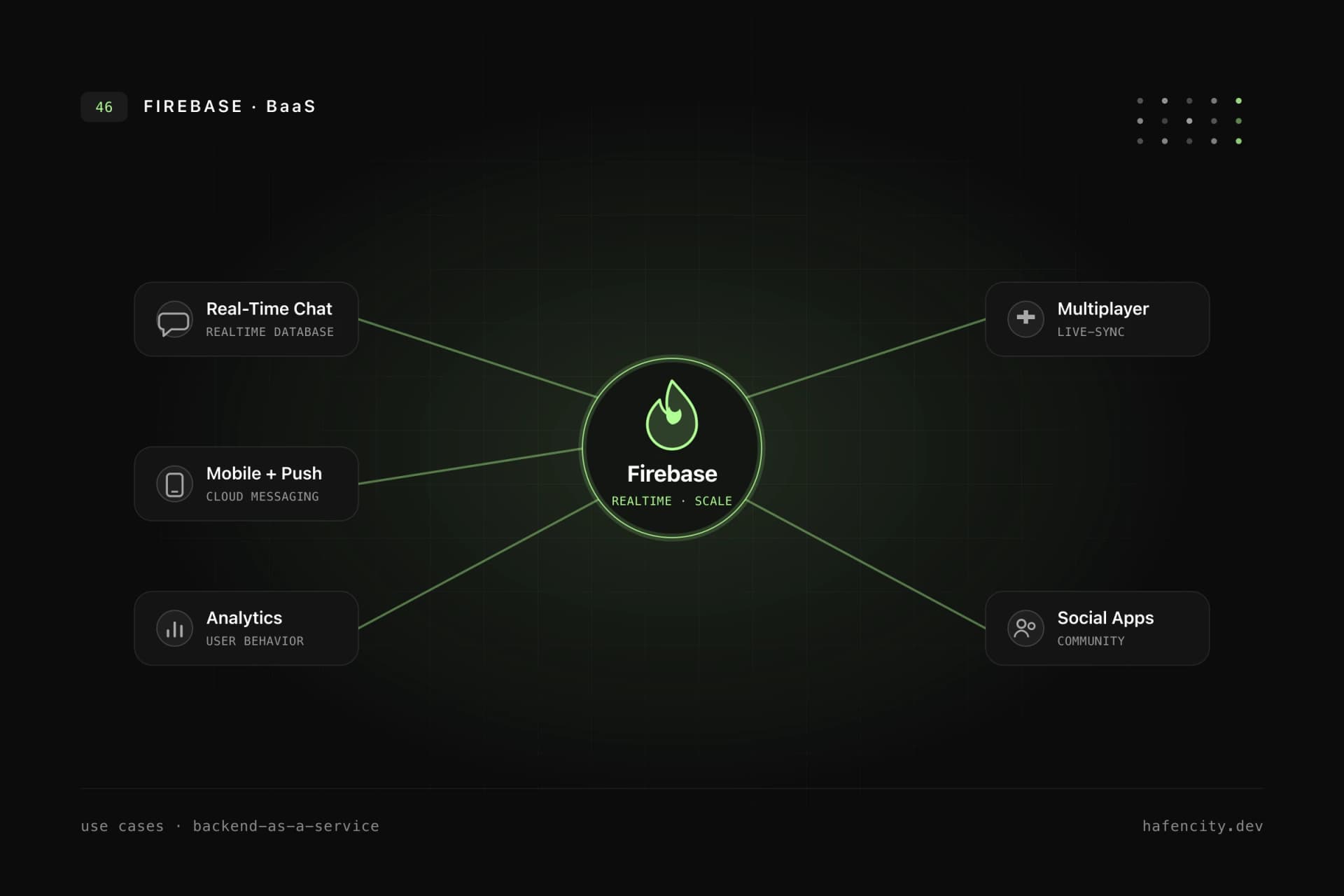
Real-time synchronisation is the reason many teams reach for Firebase in the first place. Firestore and the Realtime Database push changes to all connected clients via listeners — no polling, no WebSocket infrastructure of your own. That makes exactly the features that are otherwise hard feel easy: chat and messaging apps, collaborative editors, live locations, presence indicators ("online just now") and multiplayer state. The built-in offline cache additionally keeps the app responsive on flaky networks and syncs changes once connectivity returns.
For hierarchical, fast-updating data — feeds, game scores, live dashboards — this model is extremely convenient. It's the area where Firebase has been strongest for years and where it saves weeks of development versus a hand-built, self-operated backend.
Use case 2: mobile apps, login and push
For mobile MVPs Firebase is often the fastest shortcut to a finished product — mainly because of Authentication and Cloud Messaging. Firebase Authentication covers email/password, social logins (Google, Apple, Microsoft), anonymous sessions and, since 2026, phone number verification — up to 50,000 monthly active users free. Cloud Messaging (FCM) sends push notifications across iOS, Android and web — completely free, with no volume cap.
This combination is the core of many consumer apps: users sign up in seconds, stay engaged through push, and the team avoids the trickiest infrastructure of all — identity and deliverability. If you want to test an idea on the market quickly, that's a strong foundation; more on that in our app development.
Use case 3: analytics, A/B tests and engagement
Firebase isn't only a backend — it's also a measurement and steering tool for the product itself. Firebase Analytics (Google Analytics for Firebase) captures events, funnels and user flows for free and at practically unlimited scale. Combined with Remote Config and A/B Testing, behaviour isn't just measured but deliberately changed: you unlock features for user segments, test variants against each other and roll out winners — without shipping an app update.
For teams that work data-driven, this closes a gap many backends leave open: the link between a technical event and a product decision. Engagement metrics, conversion funnels and crash reporting (via Crashlytics) live in the same console as the database.
Firebase in 2026: from BaaS to AI app platform
The biggest change of recent months: Firebase is no longer a pure NoSQL backend but a platform for relational and AI-powered apps. Firebase Data Connect has become Firebase SQL Connect — a fully managed PostgreSQL database on Google Cloud SQL, extended with real-time sync and offline cache. At Cloud Next 2026 Firestore Enterprise capabilities such as full-text search, geospatial queries and relational joins via subqueries arrived, alongside Firebase AI Logic, which brings Gemini models directly into the app — including hybrid inference across a local and a cloud model.
One detail worth knowing: Firebase Studio, the AI-powered app builder, has stopped accepting new workspaces as of 22 June 2026. Existing projects can migrate to Google AI Studio or Antigravity. For platform choice that means: the Firebase backend stays stable, while the AI tooling around it is still in motion.
When Firebase isn't the first choice
Firebase is strong but not a universal tool — three situations argue against the default. First, when your core data is heavily relational from the start, with many joins and complex reports: SQL Connect softens this, but a natively relational platform starts cleaner here. Second, when strict EU data sovereignty or self-hosting is required — Firebase runs on Google Cloud, you need a data processing agreement and should choose EU regions. Third, when your profile is extremely read-heavy and the usage-based Blaze plan becomes hard to predict; Firestore pricing (around $0.18 per 100,000 reads) adds up with many small queries.
In those cases a sober comparison pays off. We've set out the options in Firebase vs. Supabase and in The best Firebase alternatives — Supabase, Appwrite and a custom backend are the more honest choice depending on requirements.
Next steps
Three questions settle faster than any feature list whether Firebase fits your project:
- Data structure: are your core data document-like and real-time (chat, feeds, presence) or heavily relational (joins, reports)?
- Privacy: is an EU region with a data processing agreement enough, or do you need self-hosting?
- Cost profile: how many reads and writes do you expect at 10,000–100,000 users — many small updates or few large queries?
Unsure whether Firebase is the right base? We make this call in projects regularly — pragmatically and with an eye on roadmap and budget. Take a look at our app development or book an intro call directly.