
"It still works" is the most expensive assumption in product management in 2026. From the outside, an outdated digital product looks like a solved problem — inside, it's a tax that grows with every sprint. According to McKinsey, technical debt makes up 20–40% of a company's technology value, and around 30% of CIOs lose more than a fifth of their IT budget to resolving it.
This is not a question of aesthetics. It's a question of speed, security and — since 2025 — law. In this article we look at why products get stuck in the past, what standing still really costs, and how modernization works in 2026 without halting the running business.
Why products get stuck in the past
Standing still is rarely a decision — it's the sum of many reasonable individual ones. Every "later" was right on its own: the budget went to the next feature, the team had no spare capacity, the system kept running. Over years, those deferrals add up to a product nobody wants to touch, because every change feels unpredictable.
Three recurring patterns sit behind it: tight budgets that pit modernization against visible features; a lack of in-house know-how for outdated frameworks whose specialists have long moved on; and an understandable respect for changing a business-critical system. None of these reasons is irrational. Together, though, they produce exactly the paralysis that gets expensive — much as we describe in Why cheap software becomes expensive.
The hidden bill: what standing still really costs
Outdated software doesn't save money — it shifts it into a line item that isn't in the budget. Technical debt behaves like a loan with compound interest: every new feature takes longer, every bug drags more behind it, and at some point the team spends more on upkeep than on progress. That's what makes the magnitude tangible.
The costs spread across several budget lines and therefore stay invisible: maintenance, hosting on oversized infrastructure, slower release cycles, security incidents and lost revenue from poor user experience. With worldwide IT spending of $6.31 trillion for 2026 (Gartner), a substantial share flows into merely maintaining existing systems rather than creating value.
| Symptom | Business risk | Modernization lever |
|---|---|---|
| Releases take weeks, not days | Slow response to market and customers | CI/CD, automated tests |
| Outdated dependencies, no patches | Security gaps, compliance breach | Dependency upgrade, audit |
| No mobile/responsive support | Lost users, weak SEO | Frontend relaunch |
| Knowledge tied to single people | Outage risk, high onboarding cost | Documentation, refactoring |
| Manual processes around the system | High running cost, error-prone | Automation, API integration |
An honest inventory of these items is the first step — the kind we run in a software audit that delivers risks, costs and a concrete roadmap.
Compliance is no longer optional in 2026
What used to be "nice to have" is now a legal deadline with fines attached. Two frameworks affect virtually every customer-facing digital product in the DACH region. Germany's Accessibility Strengthening Act (BFSG) has applied since 28 June 2025 and requires B2C web shops, apps and many digital services to be accessible per WCAG. Violations can be fined up to €100,000; in the services area only micro-enterprises are exempt (fewer than ten employees and at most €2 million annual turnover).
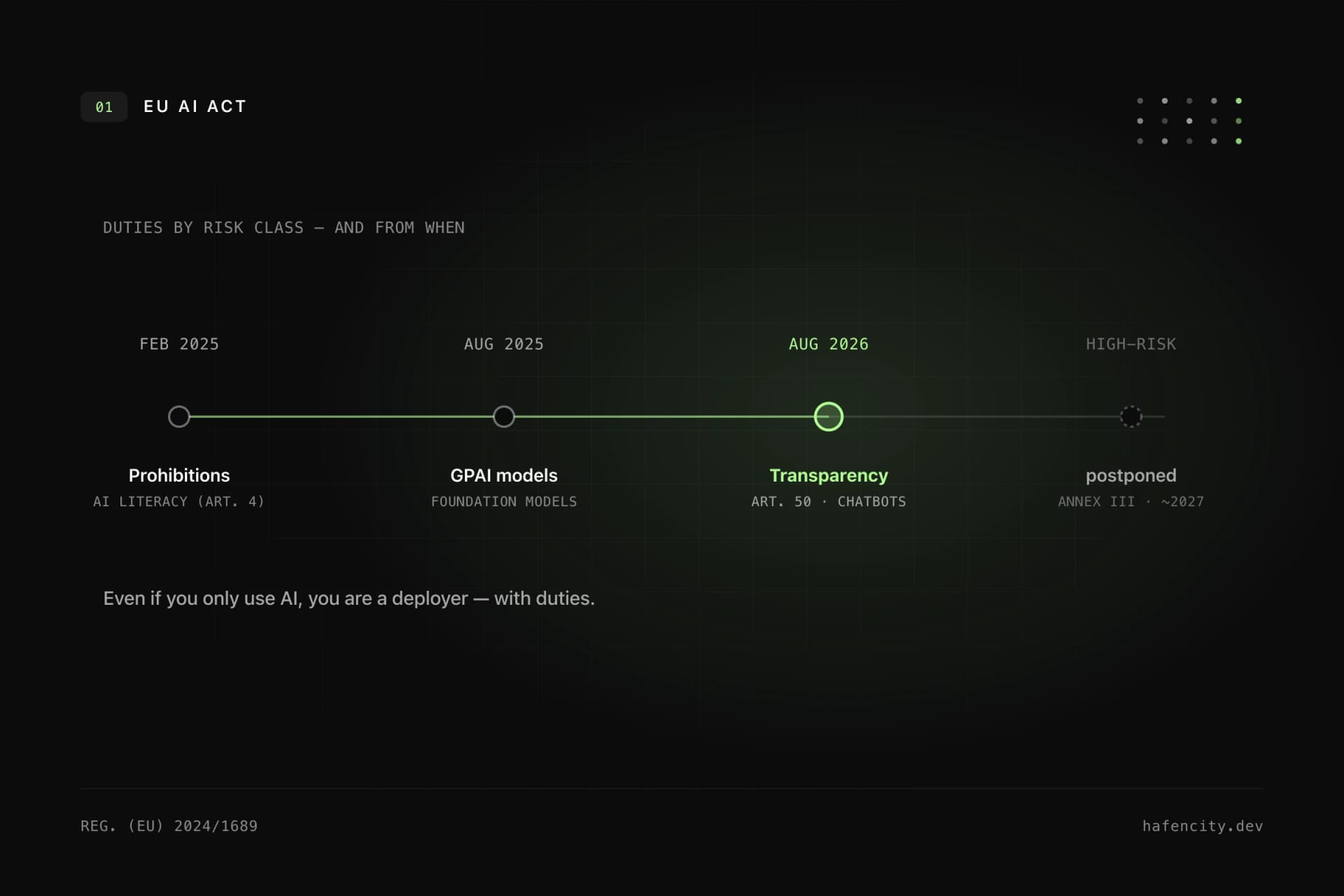
In parallel, the EU AI Act applies: for high-risk AI systems the core obligations take effect from 2 August 2026. If you bolt AI features onto a legacy system that knows neither logging nor clean data flows, it's better to modernize now than under time pressure. What accessibility means in practice is laid out in our BFSG and WCAG checklist. An outdated product almost never meets these requirements on the side — so compliance turns from a cost factor into a modernization driver.
Modernization without a big bang: the incremental path
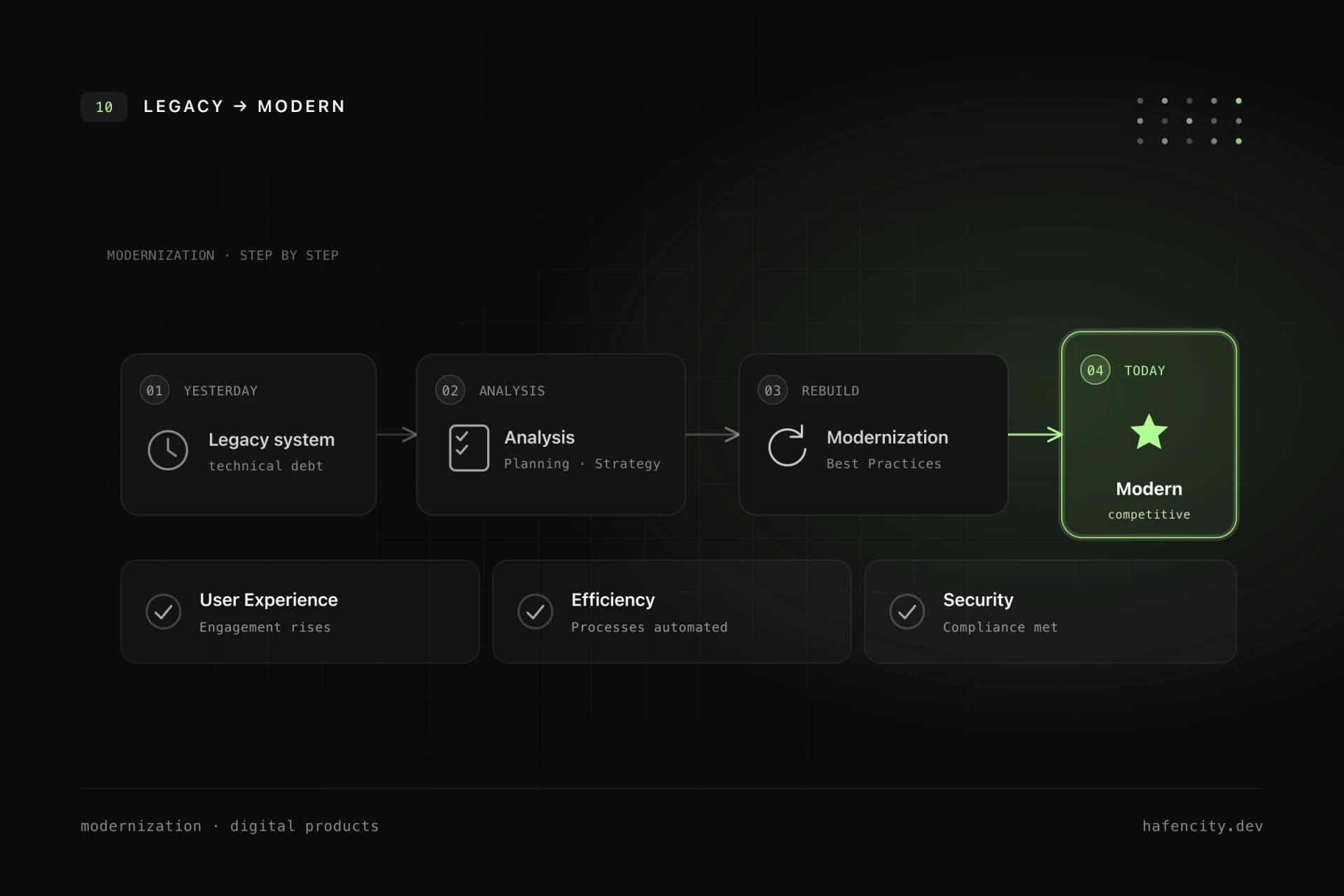
The most common expensive mistake isn't the delay — it's the full rebuild. A big-bang rewrite halts the running business, ties up your best team for months and only delivers value at the very end, if it's ever finished. The opposite has proven itself: the strangler pattern, where you replace the legacy system module by module in production.
The path follows four phases. First, an audit makes risks, dependencies and debt visible. Then you prioritise by risk times business value — the costliest and riskiest part first, not the most convenient. Next you replace incrementally, so old and new systems run in parallel and can be rolled back at any time. Finally you operate and measure: performance, security and cost belong on a permanent dashboard, not in a one-off project closeout. This order is also why generative AI changes so much: it accelerates code comprehension, testing and migration in exactly the steps that used to dominate the cost. For how such a program runs in practice, see Modernizing legacy software: costs, risks, migration.
How to tell it's time
You don't need an audit to spot the first warning signs — just honesty. If several of the following apply, your product is working against you rather than for you:
- New features take noticeably long, and nobody dares touch certain parts of the codebase.
- Dependencies haven't been updated for years; security patches go un-applied.
- The product is unusable or poor on mobile and fails BFSG/WCAG.
- Knowledge of the system rests on one or two people.
- Manual processes surround the software that could really be automated.
None of these is an emergency on its own. Together, they're a reliable indicator that the running costs already exceed the effort of modernization.
Next steps
Three questions quickly reveal how urgent your case is:
- Speed: do new features take days or weeks — and why?
- Risk: are all dependencies patched, and do you meet the BFSG and foreseeable EU AI Act obligations?
- Cost: do you know what the status quo costs per year in maintenance, hosting and lost speed?
If you hesitate on any question, a closer look pays off. In these projects we start with an audit that delivers risks, effort and a prioritised roadmap — pragmatic, with no full rebuild as a reflex. Take a look at our development or book an intro call directly.