
"Flutter is the future of app development" — you've read that line for years. In 2026 the more interesting question is no longer whether Flutter has a future, but where the framework actually stands today. The answer is more sober and more convincing than any hype: Flutter is a mature platform whose current stable version is 3.44 (June 2026, Dart 3.12), and it has grown well beyond mobile.
At the same time, Flutter is no silver bullet. In the Stack Overflow Developer Survey 2025, Flutter and React Native are neck and neck — both used by roughly 13 to 15 percent of respondents. So anyone deciding on Flutter in 2026 should know its real maturity, its real costs and its clear limits.
Where Flutter really stands in 2026
Flutter has grown up in 2026 — yesterday's promises are today's production reality. The biggest change is under the hood: with the Impeller engine, Google replaced the old Skia rendering. Impeller compiles shaders at build time rather than at runtime, which eliminates the notorious "jank" on a first animation. Since release 3.27, Impeller is the default on iOS and newer Android devices (API 29+).
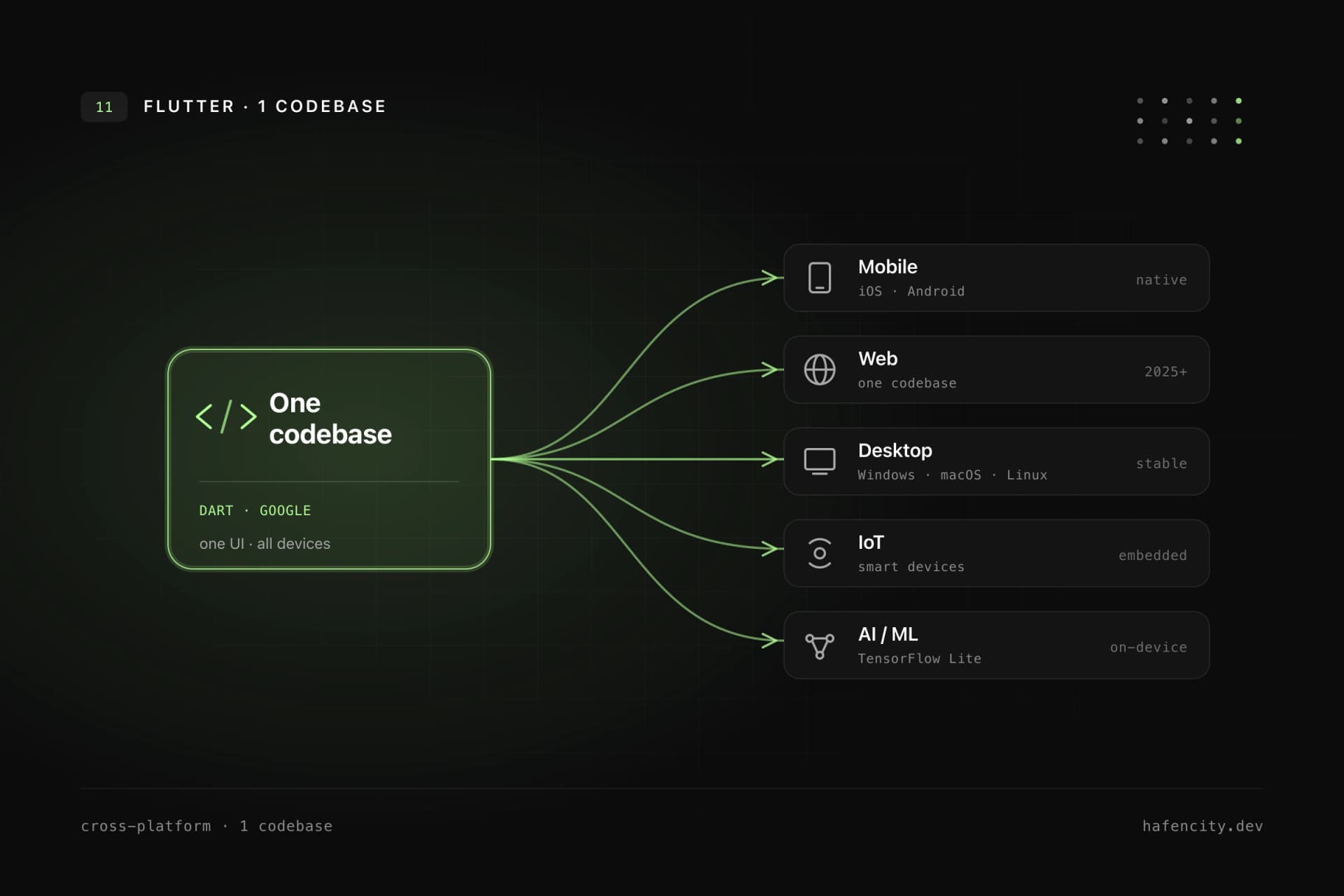
In practice, Flutter now credibly covers four platform families from one codebase. Mobile has been stable for years, desktop for Windows, macOS and Linux is on the stable channel, web has become production-ready, and in embedded Flutter ships in series — for example in infotainment systems by Toyota and in the My BMW app. According to Google, over one million apps on the Play Store were built with Flutter.
Flutter Web has grown up
The biggest leap since the last generation of this article is Flutter Web — thanks to WebAssembly. For a long time Flutter Web was a niche option with performance and SEO weaknesses. With WASM compilation and the new skwasm renderer, that has fundamentally changed: complex, interactive web apps now run 2 to 3 times faster than on the pure JavaScript path.
The prerequisite is WasmGC in the browser — supported by over 90 percent of users in 2026, including Safari from version 18. If a browser falls outside that, Flutter automatically falls back to the canvaskit renderer. For data-heavy dashboards, internal tools or app-like portals, Flutter Web is therefore a serious option that allows a single codebase for web and mobile. Where it's about classic, content-driven sites with a hard SEO focus, native HTML/JS — for example with Next.js — remains the better fit.
Desktop, embedded and on-device AI
Beyond mobile and web, Flutter has matured two areas that used to be pure roadmap items: desktop and on-device AI. Desktop builds for Windows, macOS and Linux have reached the stable channel — handy for internal tools that should share the same design as the mobile app.
More interesting for many products is AI integration. Instead of sending every request to the cloud, machine learning can run directly on the device — via LiteRT, the 2024 rename of TensorFlow Lite. LiteRT runs models from TensorFlow, PyTorch, JAX and Keras locally. The upside: sensitive data stays on the device, the app works offline and responds without latency. For cloud AI — say a RAG chatbot — you connect regular APIs as with any app. How we integrate AI into products realistically is shown in our AI integration.
What Flutter costs — and what it saves
The most common reason to pick Flutter is economic: one codebase instead of two. In the DACH market, agency hourly rates typically sit at €100 to €150. A shared codebase for iOS and Android often saves 30 to 40 percent of effort versus two separate native apps — provided the product needs little platform-specific logic.
| Project | Benchmark (DACH) | What it includes |
|---|---|---|
| MVP / first version | €20,000–35,000 | core feature, one platform pair, launch |
| Business app | €40,000–80,000 | several modules, backend, auth, roles |
| Platform / scaling | €90,000+ | complex domain, integrations, operations |
| Maintenance & ops | 15–25 % p.a. | OS updates, fixes, further development |
The ranges are benchmarks and depend heavily on scope. The recurring line matters: budget 15 to 25 percent of the initial cost per year for maintenance and operations — apps that aren't maintained age fast. A detailed breakdown is in What does a Flutter app cost?.
When React Native or native is the better choice
Flutter is strong, but not universally superior — and an honest comparison is part of the picture. React Native is practically level in 2026 and the more natural path for many teams: it renders with native components and uses the huge JavaScript/TypeScript ecosystem. If you already have a React web team, you share knowledge and some code.
Flutter plays to its strengths when a pixel-perfect, cross-platform-identical UI matters and the team can learn Dart or already knows it. Fully native (Swift/Kotlin) remains the right call for deep hardware integration, platform-specific UX nuance or maximum performance in special cases. The honest answer is rarely "X is better" but: which solution fits your team, existing codebase and product ambition? That's exactly the trade-off we make in our app development regularly.
Next steps
Three questions settle the technology choice faster than any framework debate:
- Platforms: do you need iOS and Android — and later web or desktop from the same codebase?
- Team: do you have Dart/Flutter expertise, a React team, or native specialists?
- Product: how much platform-specific hardware and UX depth is really in your app?
Unsure whether Flutter fits your project? We make this call in projects pragmatically — with an eye on roadmap, team and budget. Take a look at our cross-platform development or book an intro call directly.