
A web app rarely starts with a specification. It starts with a sentence like "this process could work much better digitally." But the path from there to a production platform is not a straight line. The Standish Group's CHAOS research has shown a stubborn pattern for years: only around 31% of software projects count as successful, roughly half are "challenged" and about 19% fail outright — and small, tightly scoped projects perform far better than large ones.
That is exactly where this article focuses. It is not about budget and architecture in detail — we cover that in web app cost, timeline and architecture. This one is about the process: how an idea becomes an MVP, how an MVP becomes a stable product and how a product becomes a platform that can be operated and improved over time.
A web app is not just a bigger website
A website explains, sells or informs — a web app gets work done. Users log in, edit data, upload files, start workflows, manage roles or collaborate around information. That difference creates different requirements: clear user roles, a reliable data model, understandable business logic, authentication, error handling, privacy and iteration based on real usage data.
These are not later add-ons. Good web app development treats them as part of product planning, design and architecture from the start. If you plan a web app like a slightly more complex website, you build the most expensive complexity — data, permissions, operations — only once real users already depend on it.
Scope discipline beats feature volume
The most common mistake in early web app projects is starting too large. If version one is supposed to be a customer portal, CRM, document management, reporting suite, billing tool and admin system at once, risk rises quickly — and the data backs that up. Analysis by Pendo shows roughly 80% of features in software are rarely or never used, while only about 12% drive most daily usage. Every feature nobody needs still costs design, testing, data model complexity, support and operations.
Good scope answers three questions: what is the central workflow? Which user role must succeed first? And which feature proves the most important value? Everything that does not directly support those answers belongs on the later roadmap. That does not make the idea less important — it is product discipline.
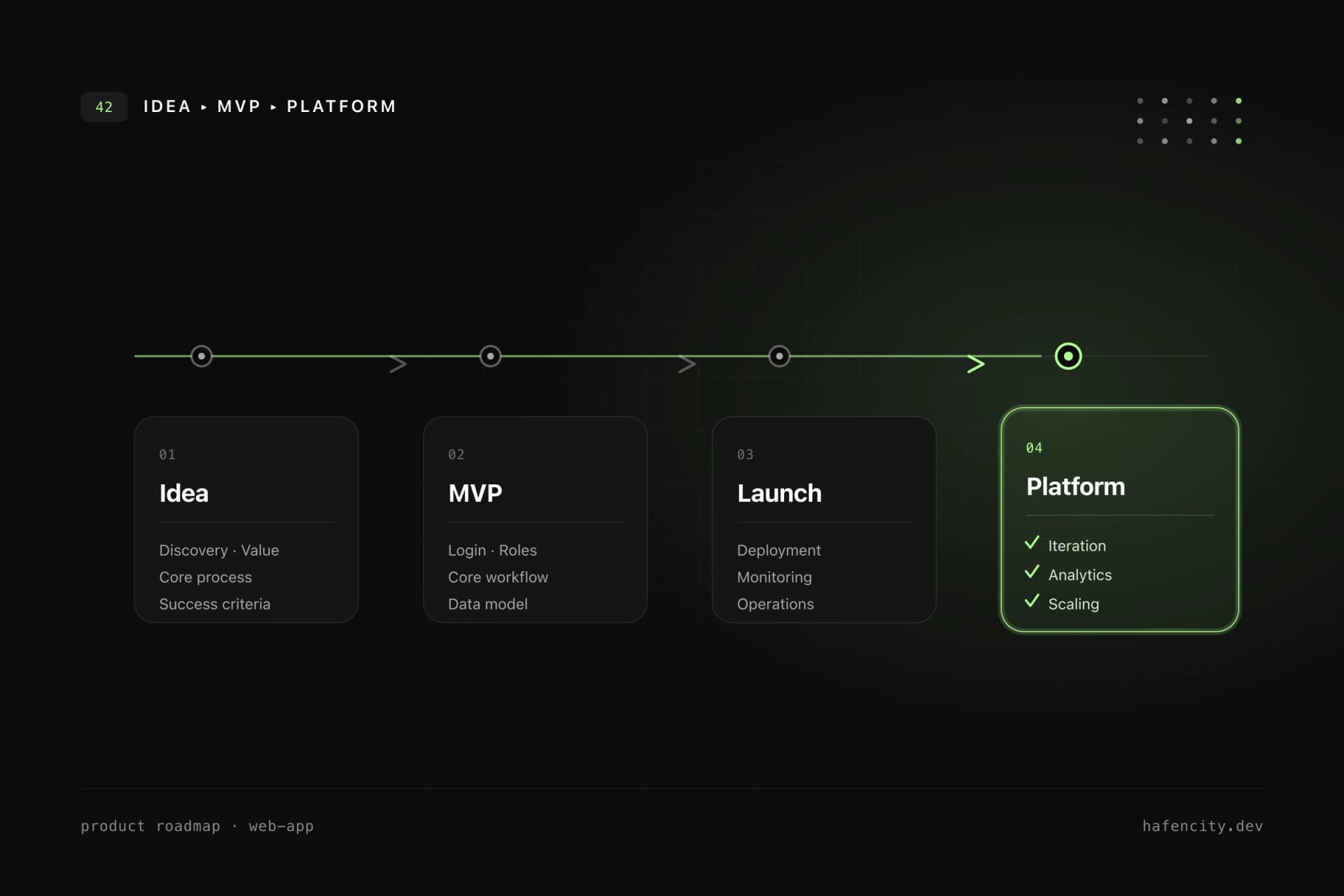
From idea to platform: four phases, not one big build
An idea does not become a platform in one step, but in a clear sequence. Each phase has its own goal, focus and success signal. Blurring them — for example baking multi-tenancy and billing into the MVP — costs both speed and clarity.
| Phase | Goal | Focus | Success signal |
|---|---|---|---|
| Idea | understand value and risk | discovery | clear product goal, prioritized core process |
| MVP | prove the key value | one core workflow | first real usage with real data |
| Product | operate reliably | stability, security | recurring usage, support scales |
| Platform | grow in control | expansion from data | new roles, integrations, automation |
In small teams the same people often hold several roles. The job title matters less than making sure product, design and technical decisions do not stay unresolved. For how much time and budget each phase realistically needs, see building an MVP: cost, timeline, roadmap.
What really belongs in a first MVP
An MVP is the smallest version that proves the most important value — small, but not disposable. A disposable prototype can be useful when you only need to visualize a flow or prepare a pitch. An MVP that handles real users, real data and real processes needs a clean technical foundation.
On the frontend, a React-based stack makes sense for many web apps today: Next.js 16 has been the stable major since October 2025, bringing Turbopack as the default bundler, and React 19.2 provides the current rendering base. More important than the version number, though, is the backend: it connects business logic, data access, permissions and integrations and determines whether the app stays maintainable. Not everything has to be automated on day one — billing, advanced reporting or email automation can be partly supported manually at first if it helps the team learn faster.
Security, privacy and accessibility belong in the foundation
Login sounds simple but quickly becomes critical — and compliance is not an appendix. Even a small product needs answers for password reset, invitations, roles, sessions and blocked accounts; B2B web apps often add SSO, two-factor authentication, multi-tenancy and audit logs. Permissions, validation, rate limits, secure defaults, backups and privacy must run through architecture and implementation, not be checked only in a pre-launch review.
There is also a clear legal line since 2025. The European Accessibility Act, implemented in Germany via the Barrierefreiheitsstärkungsgesetz (BFSG), took effect on 28 June 2025 and requires many consumer-facing web apps and online shops to be accessible. Microenterprises with fewer than 10 employees and at most EUR 2 million annual turnover are exempt for services, but violations can be fined up to EUR 100,000. Designing for accessibility early makes it cheaper to build — we summarized the concrete requirements in our BFSG and WCAG checklist.
Operations and iteration: launch is the beginning
Many projects treat launch as the destination — for users it is the starting point. From that moment, stability, support, security updates, performance, bug fixing and a roadmap based on real feedback matter. A platform without an operations concept becomes riskier with every feature; a platform with solid operations can grow step by step.
That requires the right metrics. Analytics in web apps should not only count page views but answer product questions: do new users activate? Is the core workflow completed? Where do users drop off? Which features are never used? This creates a healthy iteration cycle of measure, learn, prioritize and build — and an MVP becomes a platform because new roles, integrations or automation are added when they are justified from both a product and technical perspective.
Next steps
Three questions sharpen the start of a web app faster than any feature list:
- Core workflow: which single process must work reliably in version one?
- Users and roles: who must succeed first — and which permissions does that role need?
- Operations: who owns stability, security and further development after launch?
If several answers are still open, that is fine — then the project is best started with discovery rather than full development. Take a look at our web app development or bring your idea straight to us via the contact page.