
How much does a professional website cost in 2026? The honest answer is: it depends on scope — but the ranges are tighter and better documented than many quotes suggest. A simple company site with five templates is not the same project as a multilingual presence with a CMS, custom design, SEO planning, performance work, accessibility and integrations.
Two things have shifted in recent years: AI tools push down the cost of first drafts, and since 28 June 2025 accessibility has become mandatory for many websites under Germany's Accessibility Strengthening Act (BFSG), which implements the EU Accessibility Act. This article compares four options — agency, freelancer, builder and internal team — with realistic ranges for the German-speaking (DACH) market.
What really drives website cost in 2026
The number of pages does not set the price — the number of distinct templates, features and review cycles does. A site with 20 similar content pages can be cheaper than a small presence with several special layouts, filters, calculators and integrations. Typical cost drivers are a custom homepage, multilingual content, a clean CMS structure, complex forms and connections to CRM, newsletter or analytics tools.
The second big block is everything before the first pixel: audiences, positioning, information architecture, copy and conversion goals. The less clear these are, the more effort appears mid-project. Then there is technical quality, which you do not see in a layout but feel in the bill: fast load times and stable Core Web Vitals, semantic HTML, keyboard and screen-reader support, maintainable components and clean deployments. Professional web development keeps the site fast, extensible and maintainable — not merely online.
The four options compared
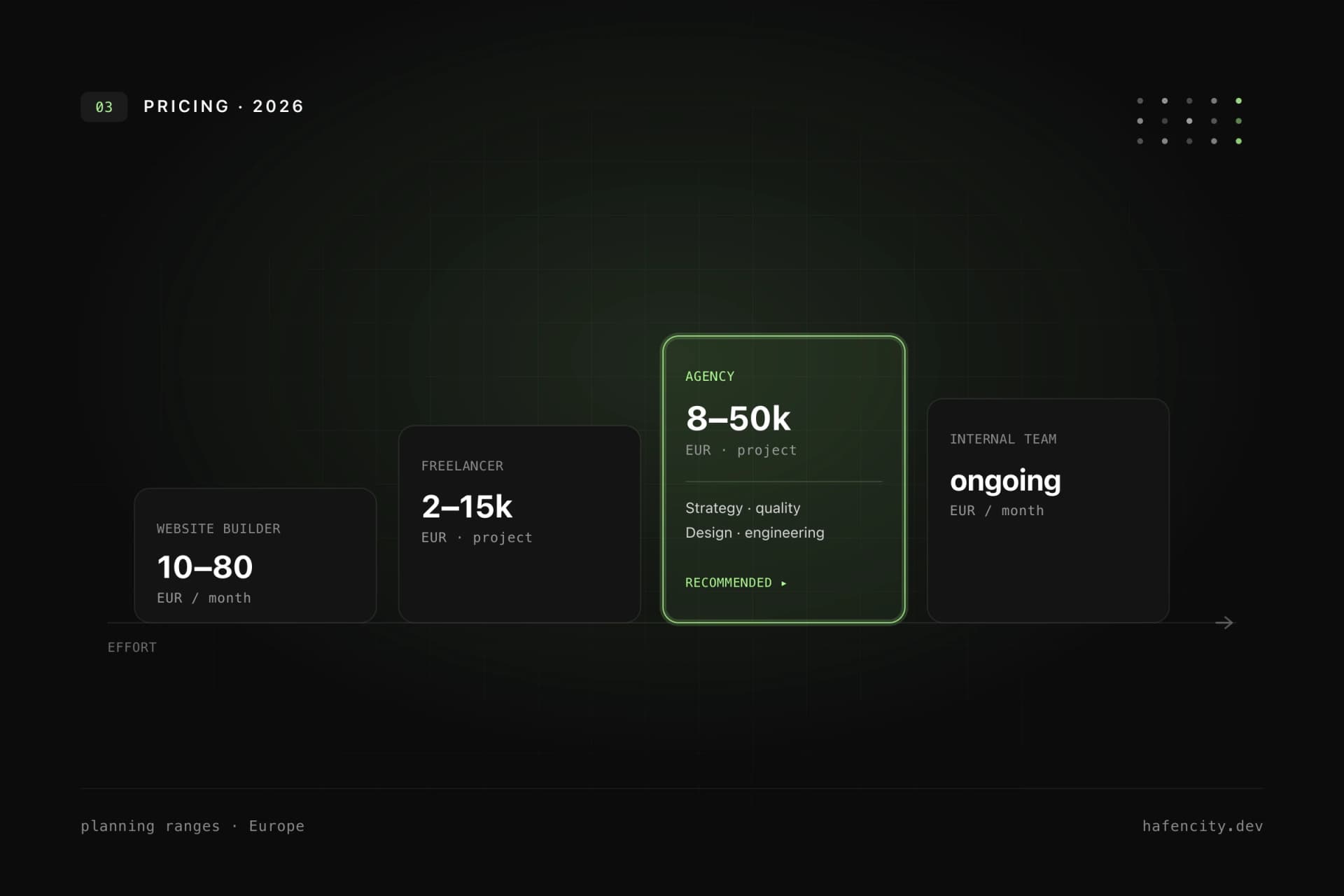
Each of the four options has a sensible use case — "expensive" and "cheap" say little on their own. The table below shows the ranges we consider realistic for professional 2026 projects in the DACH market; they line up with current market overviews.
| Delivery model | Typical cost range | Best fit |
|---|---|---|
| Website builder | approx. 10–80 EUR/month plus internal time, templates and possible external help | simple sites, fast validation, small budgets |
| Freelancer | approx. 2,000–15,000 EUR, complex projects more | small to medium websites with a clear scope |
| Agency / studio | approx. 8,000–50,000 EUR, large projects 50,000–150,000 EUR | strategic sites, redesigns, technical quality |
| Internal team | ongoing payroll and opportunity cost, often several thousand EUR/month | continuous demand, clear product ownership |
A builder fits when speed and budget matter more than individuality and technical control. A freelancer is often the most economical option for a clear scope. An agency pays off when strategy, design, development, SEO and QA must work together or several stakeholders are involved. An internal team makes sense only when there is enough continuous digital work — otherwise fixed cost and utilization risk dominate.
Hourly rates in 2026: what delivery really costs
Behind every fixed price are hourly rates — and they are surprisingly well documented in 2026. According to the Freelancer-Kompass survey by freelancermap, the average freelancer hourly rate in 2026 is 103 EUR — declining slightly for the first time since the survey began in 2016. In IT and software specifically it averages around 95 EUR. For web design and frontend, market data puts freelancers at roughly 60–120 EUR and agencies at 100–200 EUR, which prices in the overhead of multiple roles.
The day rate follows directly: at 103 EUR per hour and eight hours, that is roughly 824 EUR per day. A well-considered business site with concept, design, build and testing quickly spans 15–40 person-days — which is why serious quotes rarely start below 8,000 EUR once real concept work and QA are included. When you compare offers, compare the included days, roles and assumptions, not the headline price.
The forgotten costs: operation, maintenance and compliance
Most budgets are not too low because the build is expensive, but because operation is missing. After launch, costs run continuously for hosting, domain and email, licenses, copy and translations, privacy and cookie management, tracking, content migration, plus maintenance, security updates and ongoing improvement. Ignore that and you pay twice — exactly what we describe in Why cheap software gets expensive.
A new mandatory item is accessibility. Since 28 June 2025 the BFSG applies; many consumer-facing websites and online shops must meet recognized standards, typically WCAG 2.2 via the EN 301 549 norm. Micro-enterprises with fewer than ten employees and at most 2M EUR annual turnover are exempt for services, but not for products and shops. Violations can be fined up to 100,000 EUR per the BFSG guidance. How to implement it in practice is laid out in our BFSG and WCAG checklist.
AI builders and vibe coding: fast, but not free
AI shifts the cost of the first draft, not the cost of a good product. In 2026 the tools split into two camps: AI-assisted no-code editors like Framer and Webflow, and AI-native code generators like Lovable or v0 that emit real code. Both produce a presentable draft in hours — for landing pages and prototypes that is a genuine gain.
The limit is the same as with classic builders: strategy, information architecture, editorial quality, performance and accessibility do not appear automatically. What matters is who owns the code and how maintainable it is. A generated draft that cannot be handed over cleanly is not saved budget — it is deferred cost. AI is valuable where it accelerates an experienced team, not as a replacement for responsibility.
Which option fits which company?
The choice follows the business goal, not the lowest quote. As a guide:
- Builder, when the website is mainly a digital business card, standardized design and functions are acceptable, and internal time is available for maintenance.
- Freelancer, when the scope is clear, direct collaboration is preferred, and maintenance and availability are contractually defined.
- Agency, when strategy, design, development and SEO must work together, several stakeholders are involved, and the website is a relevant sales or recruiting channel.
- Internal team, when there is continuous digital work and budget for several roles — often as a hybrid model with an external foundation and internal maintenance.
Next steps
A solid budget does not start with "What does a website cost?" but with three sharper questions:
- Goal: Which business goals should the website support — leads, recruiting, brand, internationalization?
- Scope: Which page types, functions and integrations are actually needed, and who provides copy and approvals?
- Operation: Who maintains, secures and improves the site after launch — including accessibility?
If these points are still open, a short discovery phase is almost always more efficient than an apparently cheap fixed-price offer built on incomplete assumptions. Take a look at our web development service or book a no-obligation intro call — we scope and budget realistically before a number goes on paper.