
Hamburg is often seen as a media and harbour city — but in 2026 the software numbers tell a different story. With around 1,540 active startups, the Hanseatic city is Germany's third-largest founding ecosystem behind Berlin and Munich, according to the Hamburg Startup Monitor 2026, and 2025 was a record year with new foundings up 26%.
That shifts the real question. Not "Is Hamburg a good tech location?" but: how do startups and SMEs actually turn this environment into shipped software — at what cost, with which stack, and under which new obligations? That is exactly what we examine here, with current numbers.
Hamburg as a software hub: the numbers
Hamburg is no longer a sideshow but an established software ecosystem with measurable momentum. Its roughly 1,540 active startups make the city number three in Germany, and the record year 2025 shows the founding dynamic is back after a dip. One focus stands out — more than one in five Hamburg startups (22%) work in GreenTech, making sustainability a genuine hallmark of the location.
The capital side stays honest too: on venture capital, Hamburg trails Berlin and Munich — since 2015 roughly €3bn flowed into the city per the monitor, versus around €38bn into Berlin. In practice that means Hamburg teams often build capital-efficiently and close to the product. Anyone starting here benefits from short distances and places like HafenCity, Sternschanze, or Hammerbrooklyn — more on that in our piece on how startups take off with local expertise.
What web and app development costs in Hamburg
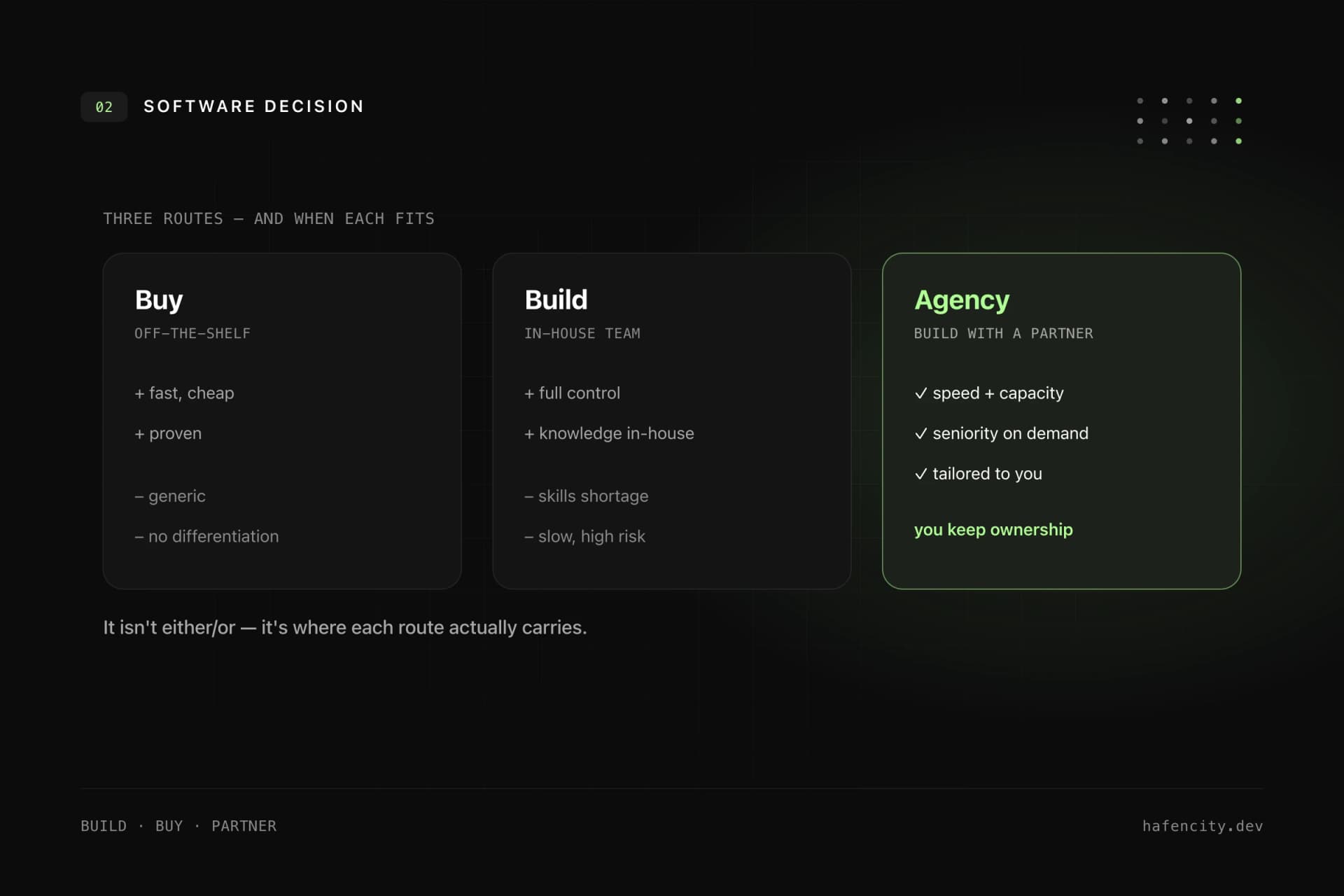
The biggest cost lever is not the hourly rate but the engagement model. In 2025 freelancers average around €104 per hour per the Freelancer-Kompass, while specialised agencies typically charge between €120 and €150 — for which they deliver a cross-functional team of design, development, and project management instead of one individual.
| Model | Hourly rate | Strength | Fits |
|---|---|---|---|
| Freelancer | ~€104 (avg) | cheap, flexible | clearly scoped tasks |
| Agency | €120–150 | team, continuity, maintenance | products with a roadmap |
| In-house team | salary + overhead | full control | long-term core systems |
The lesson: an hourly rate of €100 is not automatically cheaper than €140 if the cheaper model generates more coordination, rework, and maintenance. Model total cost over the product lifetime, not just the entry point. How to recognise a good agency and what matters in the contract, we cover in detail in Software agency Hamburg: spotting a good agency.
Web and app: the stack decision in 2026
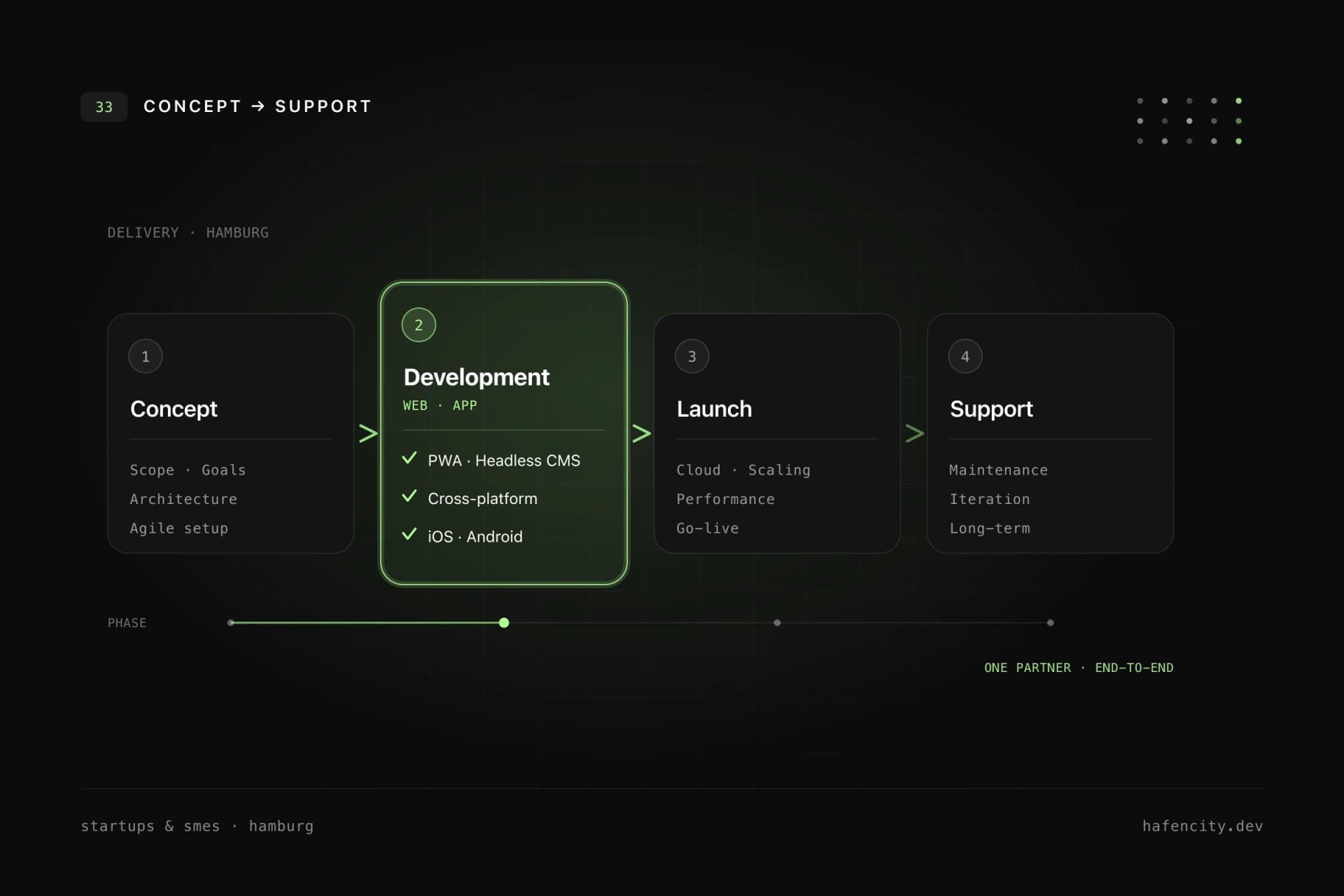
Successful web and app development starts with a stack decision that fits the roadmap — not the hype. For web apps, Next.js 16 is a robust standard: Turbopack is now on by default, the React Compiler is stable, and Server Components enable fast, well-indexable interfaces. Headless CMS and Progressive Web Apps remain sensible building blocks for fast loading and easy maintainability.
On mobile, the native-versus-cross-platform question decides a large part of the budget. With Flutter or React Native (currently 0.86) you get a single codebase for iOS and Android instead of two separate teams — noticeably lowering development and maintenance cost. Native development pays off where maximum performance or deep platform integration matters. Which path fits, we settle per project in our app development.
Accessibility has been mandatory since June 2025
Since 28 June 2025, digital accessibility is no longer optional for many companies but law. The German Accessibility Strengthening Act (BFSG) implements EU Directive 2019/882 and obliges many websites, apps, and online shops to be WCAG-conformant accessible. Violations can incur fines of up to €100,000 depending on the case.
Exempt are micro-enterprises with fewer than 10 employees and at most €2 million in annual revenue when offering services. For everyone else: accessibility belongs in the requirements from the start, not as a later patch. What concretely needs doing is shown in our BFSG checklist for website and app.
Startup or SME: different levers
Startups and SMEs build software with the same craft but different priorities. Startups optimise for speed: an MVP should learn in the market quickly, with architecture and feature depth growing alongside traction. Short decision paths and agile methods are the decisive advantage here — and they fit Hamburg's capital-efficient founding culture well.
SMEs, by contrast, optimise for integration. New software must slot into established structures — ERP, CRM, inventory systems — and complement existing processes rather than replace them. The pragmatic path is usually step-by-step modernisation: core systems stay stable, individual modules get renewed, and interfaces connect old and new. That builds durable competitiveness without risking operations.
Next steps
Three questions bring clarity before the first ticket is written:
- Goal: let an MVP learn in the market fast, or modernise an existing system cleanly?
- Model: is a freelancer enough for a clearly scoped task, or does the product need a team with roadmap and maintenance?
- Obligations: does the product fall under the BFSG — and is accessibility planned in from the start?
If you want to talk these points through with someone who delivers web and app projects here in Hamburg regularly: take a look at our web development or book an intro call directly.