A service portal for assets, tickets, spare parts and documents
Project description
For a mid-sized mechanical-engineering company we developed a customer portal for mechanical-engineering service. The company supports industrial equipment across multiple plants. Before the project, many service processes ran through email, phone calls, PDF attachments, ERP extracts and personal follow-ups. Customers often struggled to see which ticket was open, when a spare part would arrive, which documentation was current or whether an asset required attention.
The platform connects assets, tickets, spare parts, live data, documents, contracts and invoices in one shared work context. It is not only a self-service area, but a digital model of the relationship between manufacturer and operator.
Target state
The business goal was to make service processes more controllable and transparent. Instead of explaining every case manually, customers should be able to see what is happening, which next steps are planned and which commercial information belongs to the process.
The user goal was clarity for maintenance, plant management and procurement. Users should be able to start from a plant or asset and find tickets, documents, spare parts, live data and invoices without switching between disconnected systems.
Challenges
The largest complexity was connecting service and machine data. A ticket has SLA, status, priority, asset, location, possible spare parts, history, internal ownership and customer communication. Without these relationships, a portal becomes only a nicer inbox.
The spare-parts process was another critical area. Customers should not search a generic shop, but see parts that fit their assets. Compatibility, bills of material, delivery time, contract discounts, cost centers and order history all influence the decision.
Implementation
We structured the platform around the customer's natural workflow: plant, asset, case. The dashboard shows the current plant situation with open tickets, active machines, deliveries, SLA and upcoming tasks.
The asset detail brings together master data, serial number, model, maintenance contract, owners, live production count, OEE, open cases and predictive hints. From there, tickets, spare parts, documents and maintenance can be connected logically.
Outcome
The portal simplifies industrial service by organizing complexity instead of hiding it. Customers can move from plant to asset and see open tickets, matching spare parts, current documents, relevant live data and related invoices or contracts.
For the platform, this creates a foundation for scalable digital service, spare-parts revenue, ERP integrations, document workflows and later predictive-maintenance functionality.
Product views
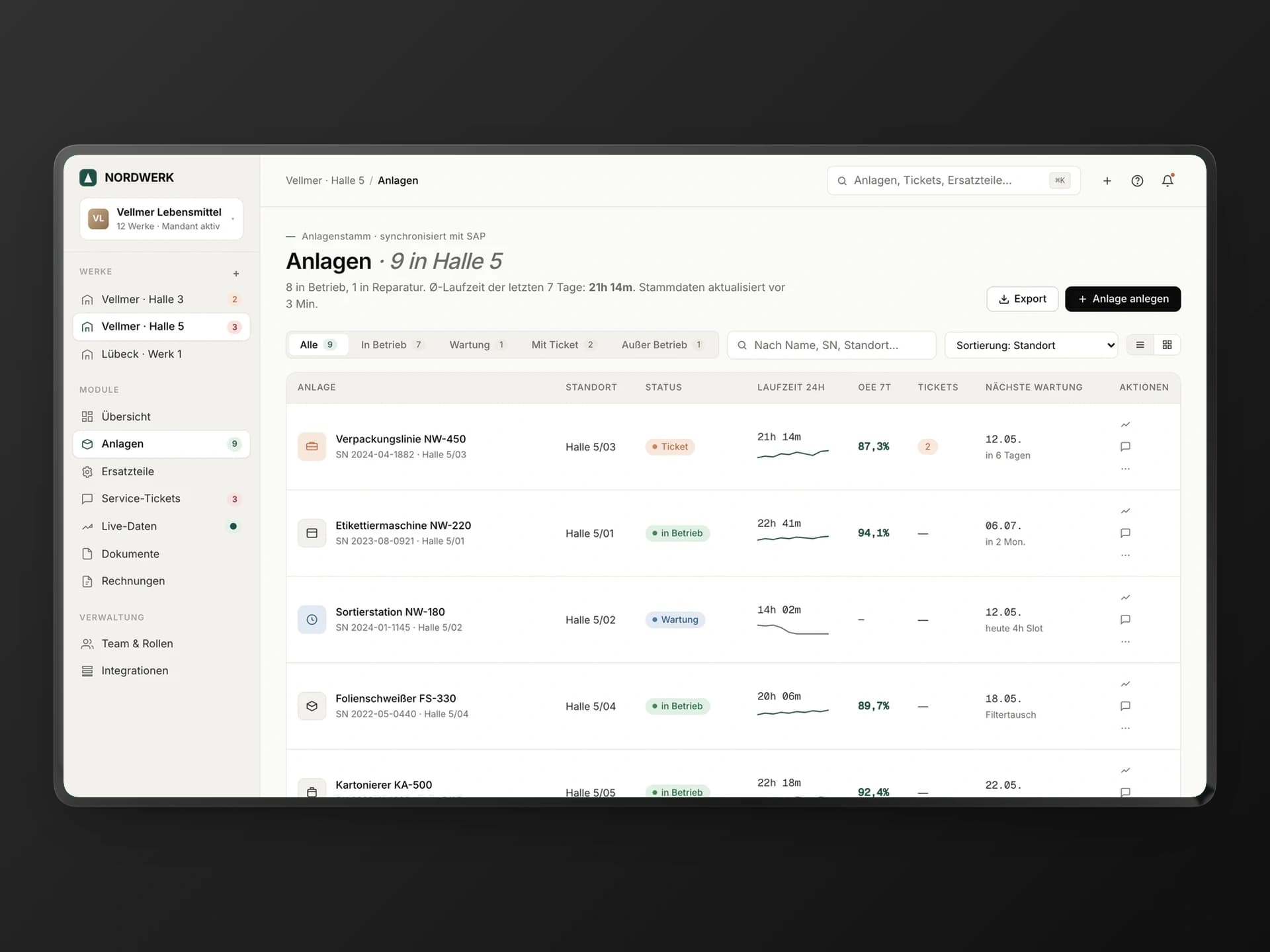
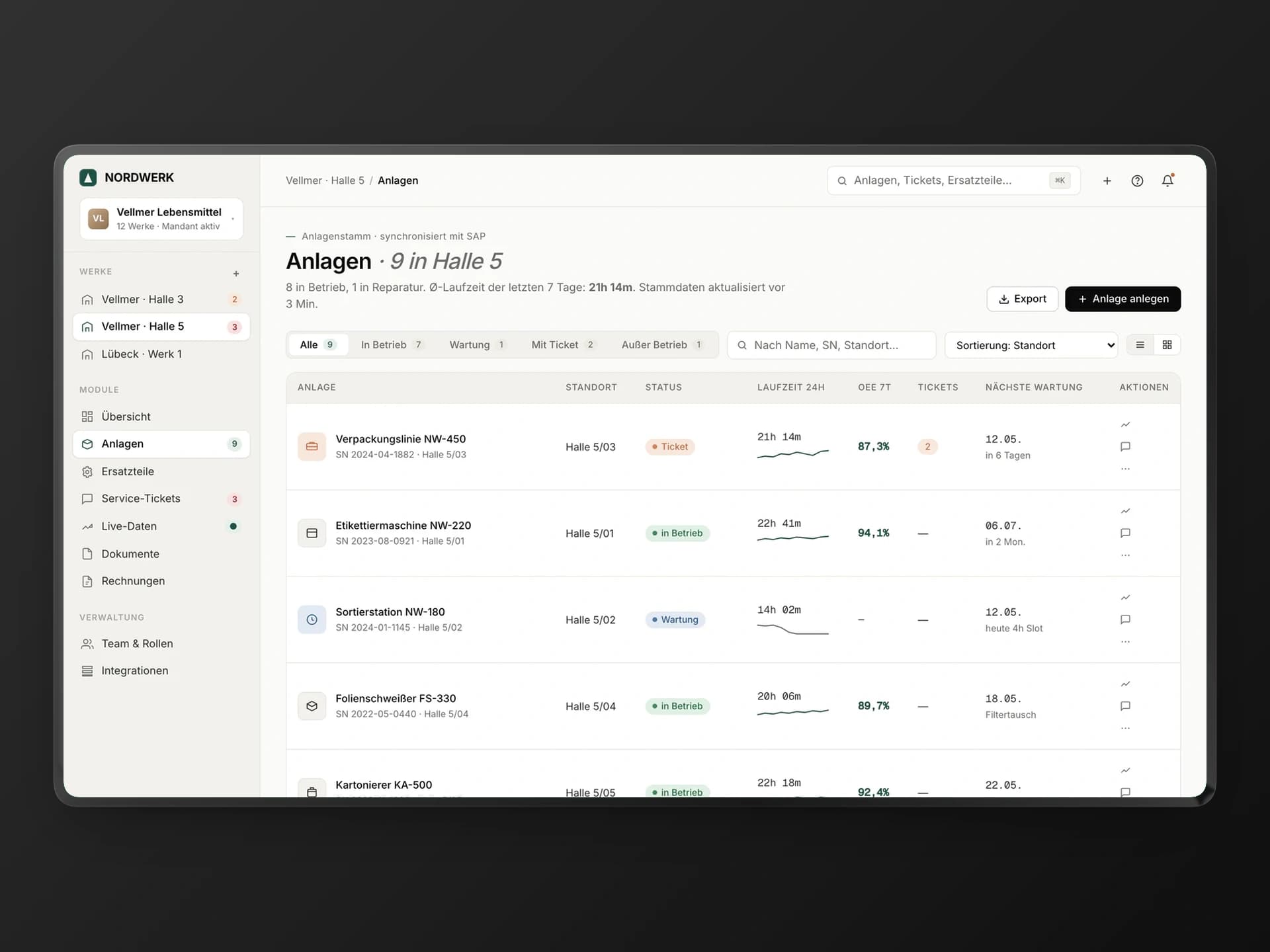
Asset list
Overview of all machines with OEE, status, location, maintenance and ongoing processes.
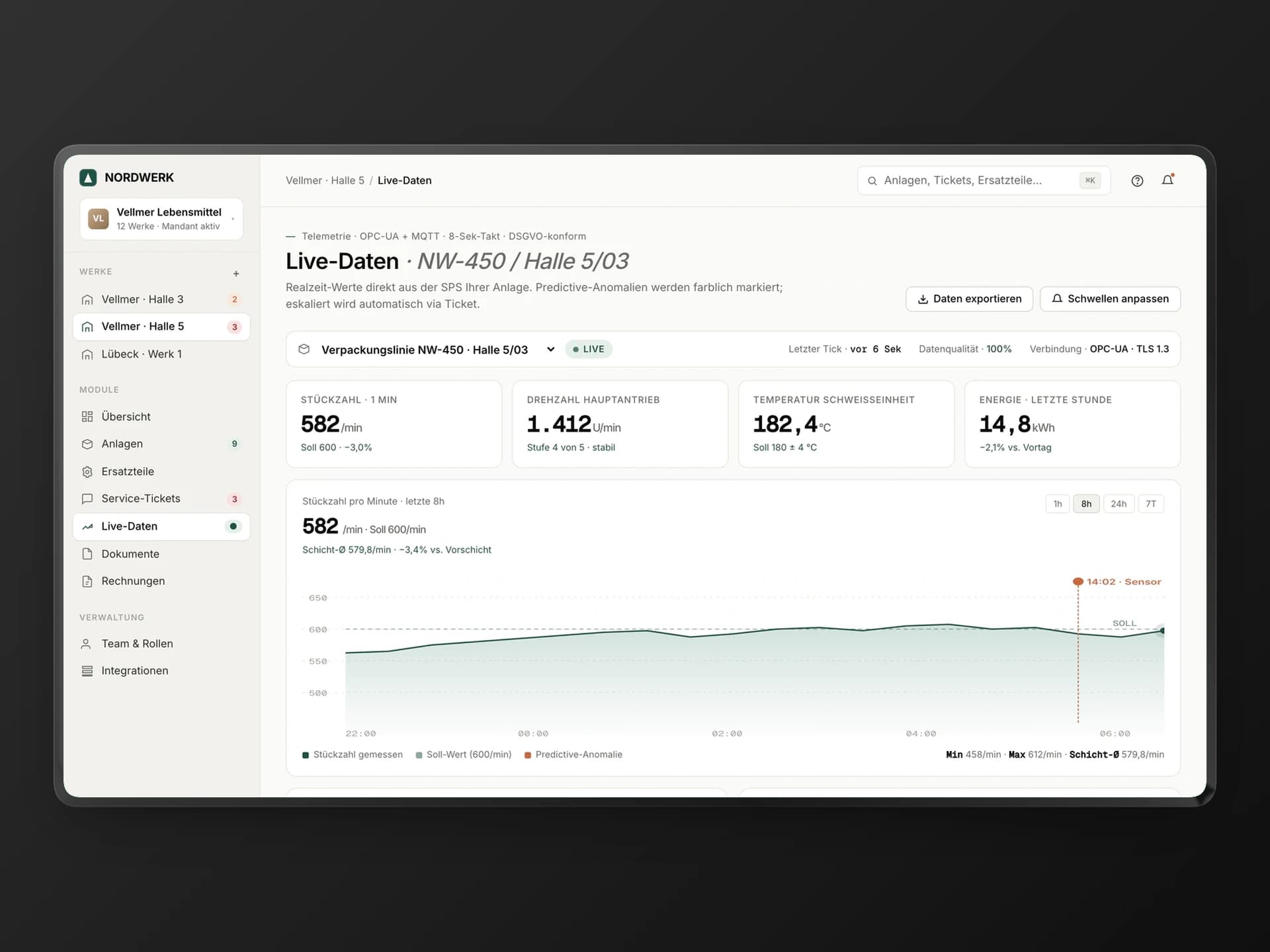
Live data
Production data, sensor drift, anomalies and health metrics for asset operations.
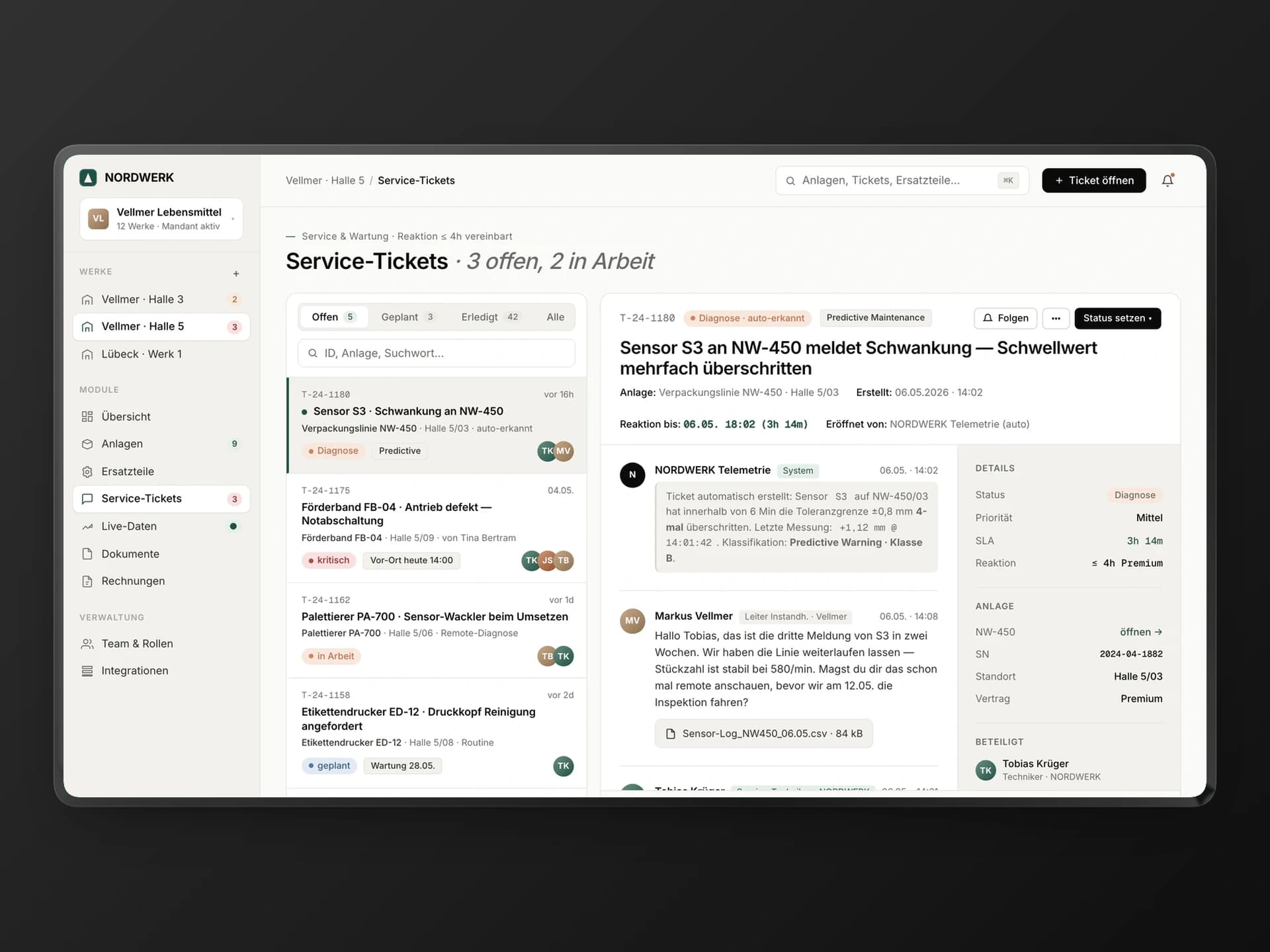
Service tickets
Master-detail view with SLA, system events, communication and status logic.